What is coal ore?
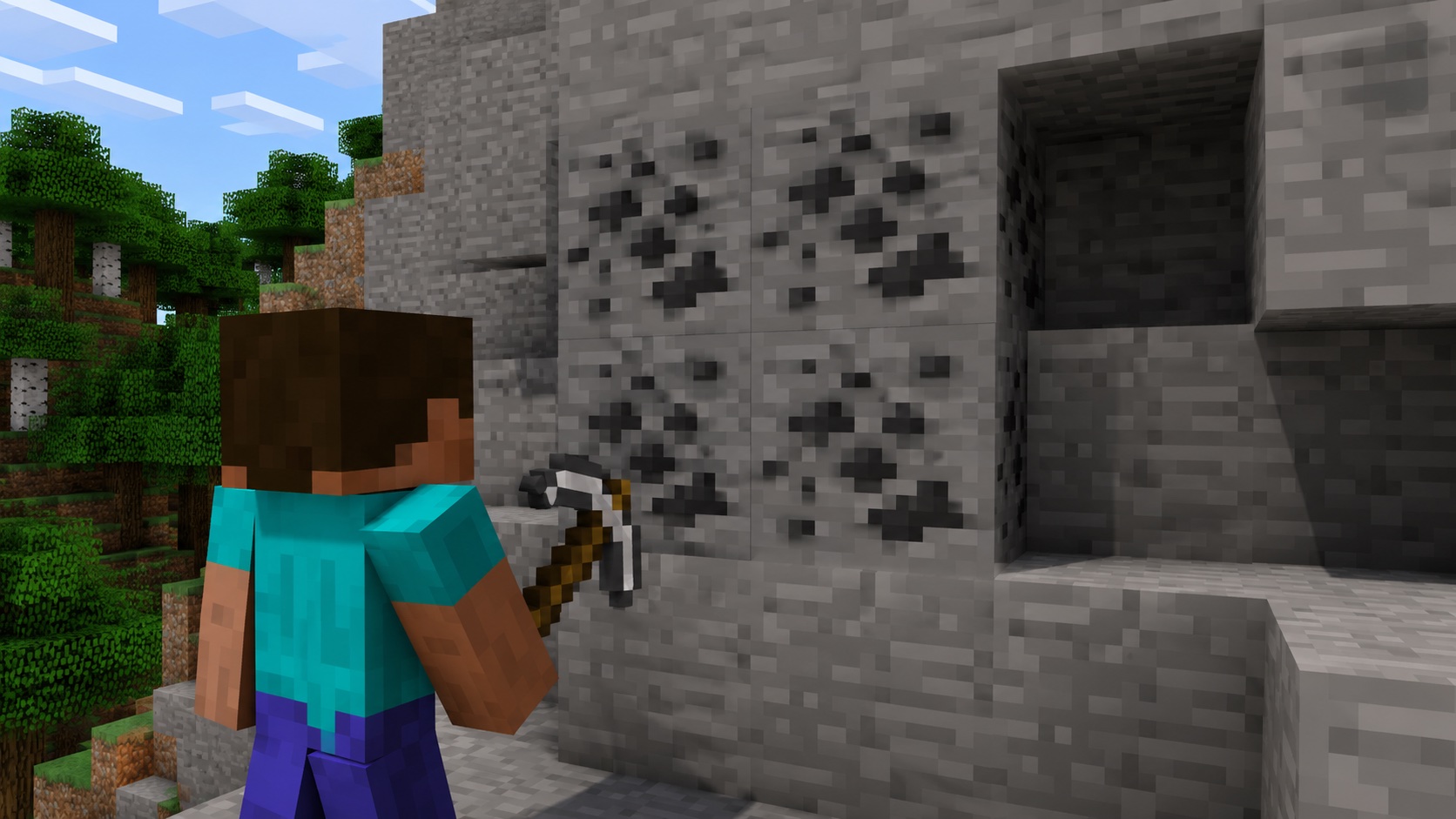
Coal ore is the most common ore block in Minecraft. It generates throughout the Overworld, drops coal when mined with a pickaxe, and gives you almost everything you need for early-game survival: torches, smelting fuel, campfires, and a steady villager trade. If you’ve made it past your first night, you’ve probably already mined some.
There are two variants. Regular coal ore generates in stone above Y=0, while deepslate coal ore generates in deepslate below Y=0. Both drop the same coal item, but the deepslate version is harder to break and rewards slightly more experience.
Where to find coal ore
Coal ore appears in every Overworld biome that has stone exposed: mountains, plains caves, ravines, forest hills, even desert cliffs. It is by far the most abundant ore in the game, and entire veins often poke out of cliffs and hilltops where you can mine them without digging.
The fastest way to stock up is to walk along a mountain biome, jagged peaks, or windswept hills. These biomes have rocky surfaces with coal veins visible right at the top. Caves and ravines also expose huge veins on their walls, which is why most players collect dozens of coal during their first cave trip.
Y levels and generation
Regular coal ore generates between Y=0 and Y=320, with the highest density between Y=80 and Y=136. That overlaps with mountain peaks and the upper third of cave systems, which is why mining at altitude works so well for coal.
Deepslate coal ore generates between Y=-16 and Y=0. It is less common than the regular variant, but the same vein patterns hold once you cross the deepslate boundary. If you’re branch mining for diamonds and you hit deepslate coal, take it with you.
Mountain biomes get a generation bonus in Java Edition. Above Y=136, coal ore veins generate more often, which makes peaks and slopes the densest place to find coal in the entire game.
How to mine coal ore
You need at least a wooden pickaxe to mine coal ore. Hitting it with your fist, a sword, an axe, or a shovel will break the block but drop nothing. That is one of the most common mistakes new players make: punching ore until it shatters and walking away empty-handed.
Pickaxe tier changes mining speed but not drops. Wooden takes about 1.5 seconds per block, stone about 0.75, iron about 0.4, diamond and netherite faster still. Deepslate coal ore takes roughly twice as long to break as the regular version, which is why a stronger pickaxe pays off below Y=0.
Drops and experience
By default, coal ore drops one piece of coal and a small XP burst (0 to 2 per block). Deepslate coal ore drops the same coal with a slightly higher XP range. Across a vein, that adds up fast.
Two enchantments change the drop:
- Fortune raises the coal count. Fortune I averages about 1.33 coal per ore, Fortune II about 1.75, and Fortune III about 2.2, with a maximum of 4 coal from a single block.
- Silk Touch drops the coal ore block itself instead of coal. That lets you collect ore for decoration, transport coal in compressed form, or smelt the block later for experience.
Smelting coal ore
If you collect the block with Silk Touch, you can smelt it in a furnace or blast furnace. Each smelt produces one coal plus 0.1 XP. The reason to do it is XP farming: a stack of silk-touched ore in a blast furnace becomes a steady drip of experience when you pull the coal out.
What coal is used for
Coal is the most flexible fuel in Minecraft and the only practical torch source early on. Once you have a few stacks, your survival workflow opens up.
Torches and lighting
One coal plus one stick crafts four torches. Torches light caves, mark trails, prevent hostile mob spawns inside your base, and stop tree-growth issues around farms. Most players burn through coal mostly to keep their world lit.
Furnace fuel
One piece of coal smelts eight items in any furnace, blast furnace, or smoker. That makes coal the default fuel for cooking food, smelting iron, and turning stone into smooth stone. Nine coal craft into one block of coal, which acts as long-burn fuel for 80 items and saves inventory space.
Other recipes
Coal also slots into a handful of other crafts:
- Campfires use coal or charcoal in the middle of the recipe.
- Fire charges, the dispenser-launchable projectile, take one coal as part of the craft.
- Blocks of coal compress nine coal into one slot for storage and long-burn smelting.
Trading with villagers
Apprentice-level Fisherman villagers buy coal for emeralds in Java Edition. If you have a coal vein and a Fisherman villager nearby, that trade is one of the cheapest ways to grind early emeralds. The Bedrock trade list shifts slightly between updates, so check your version before you commit a vein to villager trading.
Coal vs charcoal: do you need both?
Charcoal is the wood version of coal. You smelt any log in a furnace and get one charcoal per log. Charcoal stacks separately from coal in your inventory, but it works the same way: same fuel value, same torch recipe, same campfire ingredient.
Most players use whichever they have more of. If you’re surrounded by trees, charcoal is your fuel. If you’ve found a coal vein, coal is your fuel. There is no real reason to keep both stocked unless you’re sorting them for a specific build.
Tips and common mistakes
A short list worth keeping in mind:
- Always have a pickaxe before you start mining. Hitting coal ore with a fist drops nothing.
- Save Fortune III for ores that drop a single item by default (diamond, redstone, lapis, emerald). The Fortune gain on coal is real but smaller per block.
- Don’t smelt coal ore for coal in normal play. Mining it directly already drops coal. Only smelt silk-touched ore if you’re farming experience.
- Light up coal veins as you mine them. Veins can extend for many blocks, and torches stop hostile mobs from spawning while you work.
- For decorative builds, silk-touched coal ore is one of the best dark-textured accent blocks in the game.
Java vs Bedrock differences
Coal ore behavior is almost identical across the two editions. The differences worth knowing:
- Mountain biome bonus. Java generates extra coal ore above Y=136 in mountain biomes. Bedrock generation is similar but the exact rates are not always the same.
- XP drops match between editions, but Bedrock smelting times can vary slightly with chunk loading and world settings.
- Villager trade prices for coal can update on different schedules. If your edition shows a different price, the local trade list is what your game uses.
For day-to-day mining, treat coal ore the same way on both editions. The strategies above work everywhere.
Frequently asked questions
What is the best Y level for coal ore?
For raw quantity, anywhere from Y=80 to Y=140 in mountain biomes gives the densest veins. The mountain bonus stacks with that range, so peaks are where most experienced players go for coal. If you’re already deep, deepslate coal ore between Y=-16 and Y=0 is your fallback.
Does Fortune work on coal ore?
Yes. Fortune I, II, and III each raise the average coal drop. Fortune III can produce up to 4 coal from a single ore block. Silk Touch overrides Fortune, so don’t combine the two on one pickaxe if your goal is more coal.
Can you mine coal ore with a stone pickaxe?
Yes. A wooden pickaxe also works. Iron and netherite mine faster but drop the same loot. Stone is usually the right tool because it’s cheap to make and quick to swing.
What’s the difference between coal and charcoal?
Coal comes from coal ore. Charcoal comes from smelting logs. Both work as fuel and both craft torches. They stack separately, but they are functionally identical.
Can creepers destroy coal ore?
Creeper explosions can break exposed coal ore, but the ore drop chance from explosions is low. Light up areas around big veins to keep mobs from spawning near them.
Why isn’t my coal ore dropping anything?
The most common reason is the wrong tool. Fists, swords, axes, and shovels break the block but drop nothing. Use a pickaxe (wooden or better) and the coal will drop normally.
Can you make coal ore in a crafting table?
No. Coal ore is a naturally generated block and cannot be crafted. You can collect the block itself with Silk Touch and place it down again, but you can’t combine items at a crafting table to create new coal ore.
Final notes
Coal ore is the workhorse of the Overworld. It funds your torches, your furnaces, your trades, and most of your early-game economy. If you spawn near a mountain biome and see a vein on a slope, stop and clear it before you do anything else. That pile of coal will pay for itself many times over before you ever see iron.