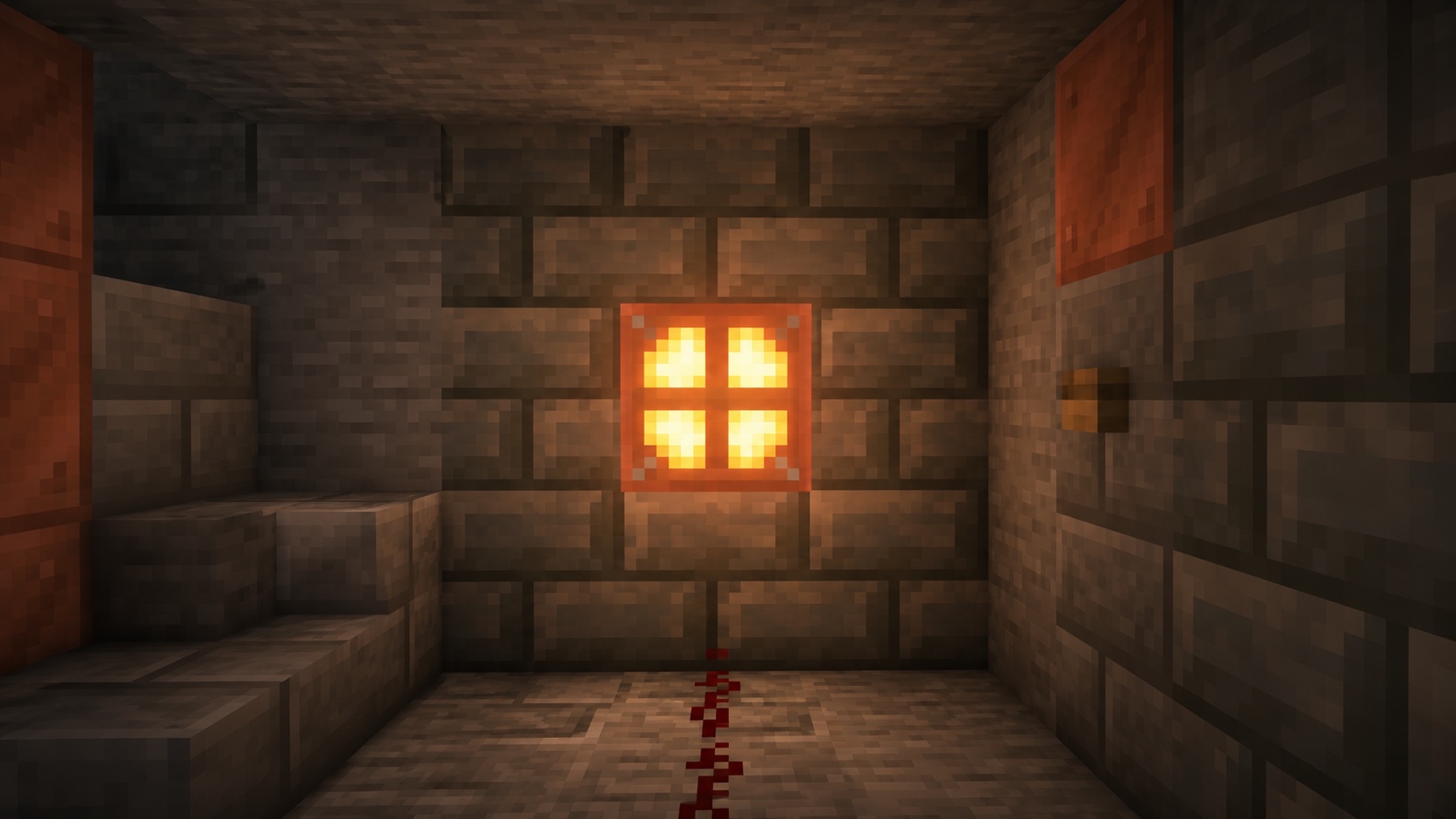
The copper bulb is a redstone-powered light source added in Minecraft 1.21 (Tricky Trials). It looks like a small copper sphere on a square base, lights up when you give it a redstone signal, and flips between on and off with each pulse. That toggle behavior is the reason it’s the most interesting new block in 1.21 for redstone players, and it doubles as a perfectly good light source for normal builds.
This guide covers what the copper bulb is, how to craft it, how the toggle mechanic works, what oxidation does to its brightness, and the redstone tricks that make it worth keeping around.
What is the copper bulb?
The copper bulb is the first vanilla light source that holds its state on its own. A redstone lamp lights up while it’s powered and goes dark the moment the signal stops. A copper bulb does the opposite: a single pulse turns it on and the bulb stays on until the next pulse turns it off. So you can light a room with a single button press, then walk away and never think about it again.
It’s also a copper block, which means it oxidizes. A fresh bulb glows at light level 15. A fully oxidized one drops to light level 4. Wax it with a honeycomb to freeze the oxidation, or scrape it with an axe to roll it back. The basic copper-block lifecycle applies here in full.
Copper bulbs come in four oxidation tiers, each visually distinct: the bright copper of an unoxidized bulb, the slightly tarnished exposed bulb, the green-streaked weathered bulb, and the fully patina-covered oxidized bulb. They all toggle the same way. Only their light output changes.
How to craft a copper bulb
The recipe takes 3 copper blocks, 1 blaze rod, and 1 redstone dust, arranged in a plus shape on the crafting grid:
- Top center: copper block
- Left and right middle: copper block
- Center: blaze rod
- Bottom center: redstone dust
The recipe yields 4 copper bulbs.
The trickiest part for most players is the blaze rod. Blazes spawn in nether fortresses, so you need to make a trip to the Nether and find a fortress before you can craft any copper bulbs. One blaze rod gives you four bulbs, which is enough for most lighting projects.
Use regular copper blocks for the recipe, not cut copper and not waxed copper. The recipe also doesn’t accept oxidized copper blocks at every stage cleanly, so the safest move is to craft your copper blocks fresh from raw copper ingots and use them right away.
How the toggle works
This is the part that makes the copper bulb interesting. A redstone lamp turns on while it’s powered and off when the signal stops. A copper bulb behaves differently: every rising edge of a redstone signal flips its state. One pulse turns it on, the next pulse turns it off, and so on.
That means a single button press at the door of your base can light up an entire room and leave it lit when you walk inside, with no extra circuit required. Tap the button again on the way out and the lights go off.
The bulb also outputs a comparator signal of 15 when it’s on, and 0 when it’s off. So you can use a copper bulb plus a comparator as a one-block memory cell. That’s a big deal for compact redstone designs because the alternative used to be a several-block latch.
Quick redstone facts
- Toggles state on the rising edge of a signal (the moment the signal comes on)
- Stays in its current state when the signal stays the same
- Outputs a comparator signal of 15 when on, 0 when off
- Can be powered by buttons, levers, pressure plates, observers, redstone torches, or any other signal source
Light levels and oxidation
A copper bulb’s light output drops as it oxidizes, just like its color shifts from copper to teal-green over time. The four stages and their light levels:
| Stage | Light level when on |
|---|---|
| Copper bulb (unoxidized) | 15 |
| Exposed copper bulb | 12 |
| Weathered copper bulb | 8 |
| Oxidized copper bulb | 4 |
For reference, a torch is light level 14 and a glowstone block is 15. So an unoxidized bulb is the brightest light source you can craft early game. A fully oxidized one is dimmer than a torch, which means a long-running base will quietly get darker if you don’t intervene.
Oxidation speed depends on how many copper blocks are nearby. A lone bulb on a stone wall ages slowly. A bulb in the middle of a copper-heavy build ages faster. The rate is randomized in chunks the player has loaded, so a bulb in an unloaded chunk doesn’t age at all until you walk back into range.
How to keep a bulb bright
You have two options. First, you can wax the bulb with a honeycomb (right-click in Java, tap in Bedrock) to lock it at whatever oxidation stage it’s currently at. You can wax all four stages, so wax it the moment you place it if you want the brightest version forever. Second, if a bulb has already aged, hit it with an axe to scrape it. Each scrape moves it back one oxidation stage, restoring brightness step by step.
Waxing the moment you place is the practical move for any base lighting you don’t want to maintain. Save the unwaxed look for builds where the patina is part of the aesthetic.
Best uses for the copper bulb
Three setups where the bulb shines.
Push-once room lighting
Wire a single button to one or more bulbs at the entrance of a room. Press the button on the way in to turn the lights on, press it again on the way out to turn them off. Cleaner than a lever (you don’t have to remember the lever’s state) and more compact than a redstone lamp on a T flip-flop.
Compact memory cells in redstone
A copper bulb plus a comparator gives you a 1-bit memory cell in two blocks. That’s huge for tileable storage circuits, drop counters, hidden door logic, and anything else where space matters. Some farm and contraption designs that used to need RS NOR latches are now smaller and faster with bulbs.
Decorative lighting that blends with copper builds
If your base uses a lot of copper, a waxed copper bulb fits the palette better than glowstone or sea lanterns. You can mix oxidation stages on the same wall for a weathered look, then wax each one to lock the variation in.
Tips and common mistakes
- Mine a copper bulb with a stone pickaxe or better. Anything weaker drops nothing.
- Crafting with cut copper or waxed copper blocks doesn’t work. The recipe wants regular copper blocks.
- If a bulb won’t toggle, check whether the source signal actually pulsed. Holding a button down doesn’t keep the bulb in any specific state. Only the moment the signal switches from off to on counts.
- A comparator reads the bulb’s state, not its light level. Even an oxidized bulb still reads 15 from a comparator when it’s on.
- Don’t waste a bulb on a small space lit by a single torch. Use bulbs where the lighting is doing real work, like underground bases, AFK rooms, or dark corridors.
Frequently asked questions
What version added the copper bulb?
The copper bulb was added in 1.21, the Tricky Trials update. It’s available in both Java and Bedrock.
How do you turn a copper bulb on?
Hit it with a redstone signal. Any source works: a button, lever, pressure plate, observer, daylight detector, or redstone torch will do. The bulb toggles state every time the signal turns on.
Why does my copper bulb get dimmer over time?
The bulb is oxidizing. Each stage cuts the light level: 15, then 12, then 8, then 4. Wax the bulb with a honeycomb to stop the oxidation, or scrape it with an axe to step it back to a brighter stage.
Can a copper bulb be waxed?
Yes. Use a honeycomb on the bulb to wax it. Waxed bulbs stop oxidizing and stay at whatever stage you locked them at. You can wax any of the four oxidation stages.
Does the copper bulb output a redstone signal?
It outputs a signal of 15 to a comparator when it’s on, and 0 when it’s off. That makes it useful as a memory bit in redstone circuits.
Can I push a copper bulb with a piston?
Yes. Copper bulbs can be pushed and pulled by pistons and sticky pistons, which lets you build movable redstone setups around them.
Where do I find the copper bulb recipe in survival?
The recipe unlocks once you have the ingredients. Pick up a blaze rod and a copper block and the recipe shows up in your recipe book.
Worth picking up
The copper bulb is the rare new block that’s actually useful for two completely different things. It’s the brightest legal light source on Java, and it’s a one-block memory cell. If you’ve been holding off because you’re not sure how it works, craft four with one trip to the Nether, wax them on the spot, and find a wall in your base that needs lighting. The redstone use cases are worth experimenting with separately.