What the copper door is
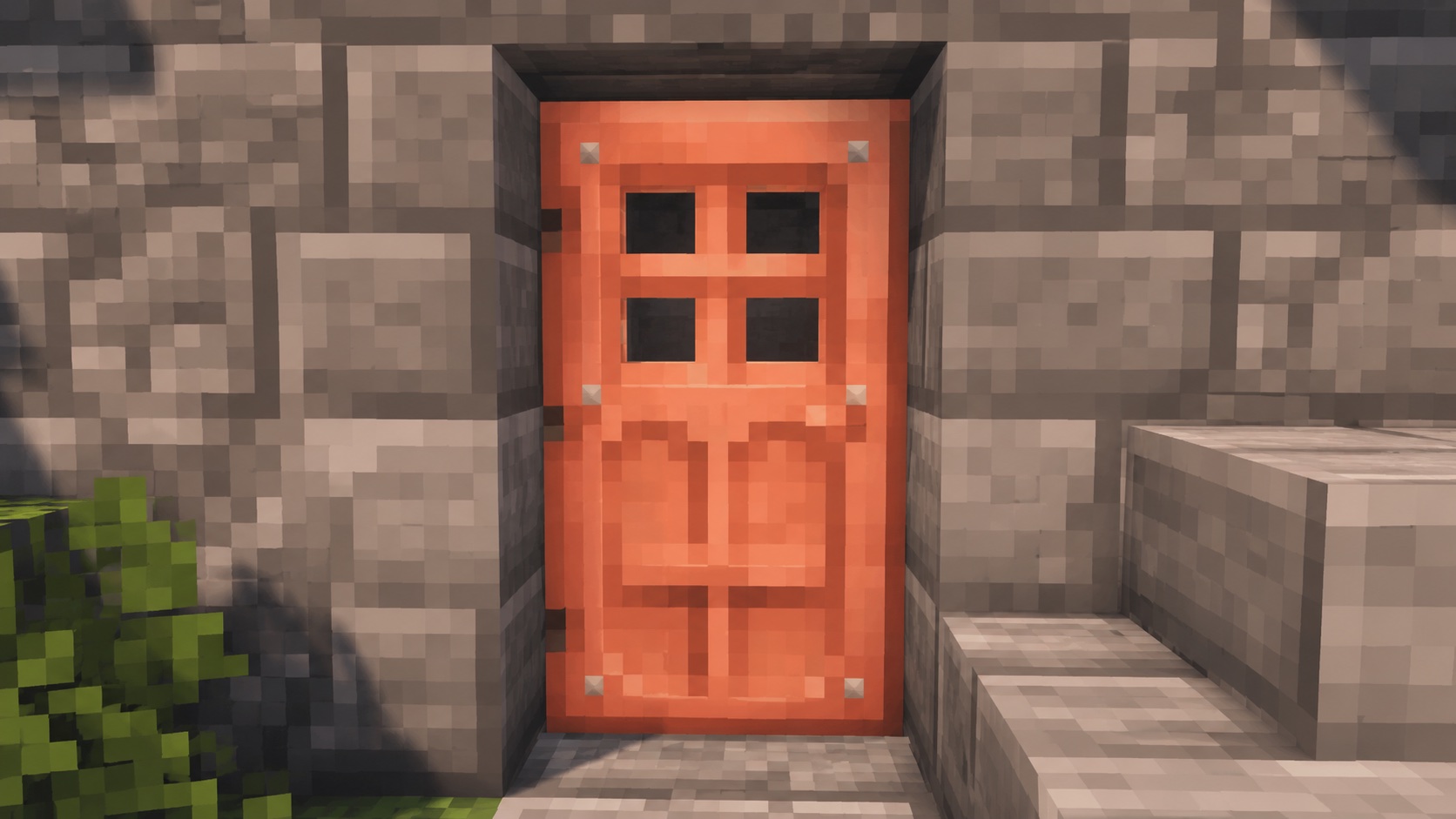
The copper door is a craftable two-block-tall door added to Minecraft in version 1.21, alongside copper bulbs, copper grates, and a fresh batch of copper-block variants in the Tricky Trials update. It looks like a metal door with a riveted panel and a small lever-style handle, and it can change appearance over time as it oxidizes through four distinct color stages.
Like other doors, it occupies the bottom and top half of a single block column when placed, and it takes inputs from both your hand and redstone. That makes it the only metal door in the game you can open without a button, lever, or pressure plate, which is the main reason builders reach for it.
It stacks to 64 in the inventory, breaks fastest with any pickaxe (and slower with any other tool), and drops itself when broken. So it behaves like a normal block in your inventory but acts as a door once placed.
How to craft a copper door
A copper door is crafted from six copper ingots in a 2-by-3 vertical pattern, the same layout used for wooden and iron doors. One craft yields three copper doors.
The copper ingots themselves come from smelting raw copper or from breaking down a block of copper. Raw copper drops from copper ore and deepslate copper ore, which spawn most often between Y=0 and Y=80, with the highest density around Y=48. A small amount of copper is more than enough for one or two doors, but if you plan to wall an entire fortress in them, expect to mine a lot of ore or set up an automated copper farm using drowned spawners.
Each oxidation level has its own crafted variant. You can craft a copper door directly from exposed, weathered, or oxidized copper ingots, but in practice most players craft the unoxidized door and let it age in place. The exception is when you want a uniform aged look across a build, in which case it can be faster to mine or trade for already-oxidized copper and craft directly to the stage you want.
The four oxidation stages
Copper doors share the same aging system as every other copper block. They cycle through four stages over in-game time:
- Unoxidized: a warm pinkish-orange, the color of a fresh copper ingot
- Exposed: copper starts to dull, with small streaks of green creeping in
- Weathered: roughly half copper, half green patina, similar to a fading penny
- Oxidized: full teal-green patina, the classic Statue-of-Liberty look
Each stage progresses randomly, with the chance based on the surrounding copper. A door with other copper blocks next to it oxidizes faster than one placed in isolation, because the game checks neighbor count when rolling the oxidation chance. The change is purely visual, so the door functions the same at every stage. It opens the same, takes the same redstone signals, has the same hitbox, and breaks at the same speed.
Oxidation in Minecraft is slow on purpose. Expect many in-game days, not minutes, for a door to move through a stage on its own. If you want to speed things up, you can use an AFK farm parked near the door (which keeps the chunk loaded and rolling random ticks) or build with already-aged copper from the start.
Waxing a copper door
If you like the current look of a copper door and want to lock it in, use a honeycomb. Right-click any copper door with a honeycomb in your hand and the door becomes waxed at its current oxidation stage. A small particle effect plays to confirm the wax.
A waxed copper door no longer oxidizes. It still functions normally for opening and closing, still accepts redstone signals, and still drops as the same waxed item when broken. The only thing the wax changes is the cosmetic aging.
Waxing is permanent until you scrape the wax off with an axe. Right-click a waxed copper door with any axe to remove the wax. Once unwaxed, the door resumes oxidizing from whatever stage it was in. So if you wax a weathered door, then unwax it later, it picks up where it left off rather than restarting from unoxidized.
Reversing oxidation
If a door has aged further than you wanted, you can roll the oxidation back without breaking and replacing the block. Two methods work:
- Right-click the door with an axe to scrape one stage of oxidation off. You can repeat this to walk a door back from oxidized all the way to unoxidized, one stage per click.
- A natural lightning strike on the door or directly adjacent blocks resets it to fully unoxidized in a single hit. This is rare in normal play but can be triggered with a channeling trident in a thunderstorm if you want a controlled de-aging method.
Each axe scrape uses one durability point on the axe, so a netherite axe with Unbreaking handles a full village’s worth of doors before needing repair. Stone or iron axes work fine for small jobs.
How copper doors handle redstone
The copper door behaves like a wooden door for inputs and like an iron door for looks. You can open it by:
- Right-clicking the door directly
- Powering it with redstone, including a button, lever, pressure plate, redstone torch, target block, or signal line
That combination is the door’s biggest selling point. An iron door requires a redstone trigger, and a wooden door can be torn down by zombies on hard difficulty. The copper door splits the difference: zombies cannot break it, but you do not need a button on the wall to walk through your own front door.
Mobs cannot use copper doors. Villagers, in particular, treat them the same way they treat iron doors and refuse to path through them. If you want NPC traffic, stick to wooden doors. The same is true for piglins, pillagers, and any other path-finding mob: they ignore the door’s existence as a passage option.
Copper doors do receive redstone but do not output a signal. If you need to detect whether a copper door is open, place an observer next to it and read the state change, or use a tripwire or pressure plate inside.
Tips and common mistakes
A few things to know before you commit a build to copper doors:
- Place a copper door before placing the block above it. Doors need vertical space, and trying to fill in the top block first will block placement.
- Copper doors do not connect to each other the way fence gates do. Two copper doors next to each other open and close independently, which is useful for double-wide entrances if you wire them to the same lever or pressure plate.
- If you want a uniform look across a building, wax every door at the same time, ideally on the same day in the same chunk. Otherwise some doors may oxidize a stage further than their neighbors before you finish.
- Mossy or jungle biomes have a flavor that pairs well with weathered copper. Snowy or icy biomes look sharper with unoxidized doors.
- Copper ingots are easy to over-spend on doors. One stack of 64 ingots makes 32 doors, which is plenty for most large builds. Plan your copper budget before you start crafting.
- If you are designing a redstone trap, copper doors give you a hand-opened front and a redstone-locked back without needing a button on the visible side.
Where to find copper doors in survival
Copper doors do not generate naturally in any structure as of the 1.21 update. The only way to add them to a survival world is to craft them from copper ingots. They do not appear in chest loot, villager trades, or trial chamber rewards.
That can change in a future update, so check the patch notes when a new release lands. The 1.21 family expanded copper a lot compared to earlier versions, and a future update could add copper doors to ancient cities, villages, or new structures. For now, treat the door as a player-only crafted item.
Frequently asked questions
Can zombies break copper doors?
No. Zombies can break wooden doors on hard difficulty, but they cannot break copper doors at any difficulty. Copper doors are a safe alternative to iron doors when you want the security without the redstone requirement.
Do villagers use copper doors?
No. Villagers do not path through copper doors, the same as iron doors. If you want a building villagers will enter and treat as a home, use a wooden door.
Can copper doors be waxed at any oxidation level?
Yes. Honeycomb works on the unoxidized, exposed, weathered, and oxidized stages. Whatever stage the door is at when you wax it is the stage it stays at until you scrape the wax off with an axe.
How long does a copper door take to fully oxidize?
It varies. Oxidation rolls a chance every random tick, and that chance depends on how many copper blocks are nearby. In a dense copper build you might see a door fully oxidize in several in-game days. In an isolated placement, it can take many days or longer. There is no fixed timer.
Does a copper door light up redstone?
No. A copper door receives redstone but does not output a signal. To detect whether a copper door is open, use a separate sensor like a tripwire, observer, or pressure plate on the floor inside.
Are copper doors blast-resistant?
Copper doors have the same low blast resistance as other doors. A single creeper explosion at close range will destroy them. If you need an explosion-proof entrance, use obsidian framing or a piston door.
Can I dye a copper door?
No. Copper doors do not accept dye. The only way to change their color is through oxidation, which moves them along the four-stage palette from pinkish copper to teal patina.
Do copper doors and copper trapdoors share the same oxidation timer?
No. Each copper block has its own independent oxidation roll. A door and a nearby trapdoor crafted at the same time will probably age at similar speeds because they share neighbor counts, but they are not linked. You can wax one and let the other age freely.
Where the copper door fits
A copper door earns its slot in the inventory because it covers a gap nothing else fills: a hand-operated metal door that ages into a different color over time. For survival bases, that means front doors that resist zombie raids without forcing you to build a redstone hookup. For decorative builds, it means a door that grows greener every season without any further input. Use it where you want both.