What copper ore is
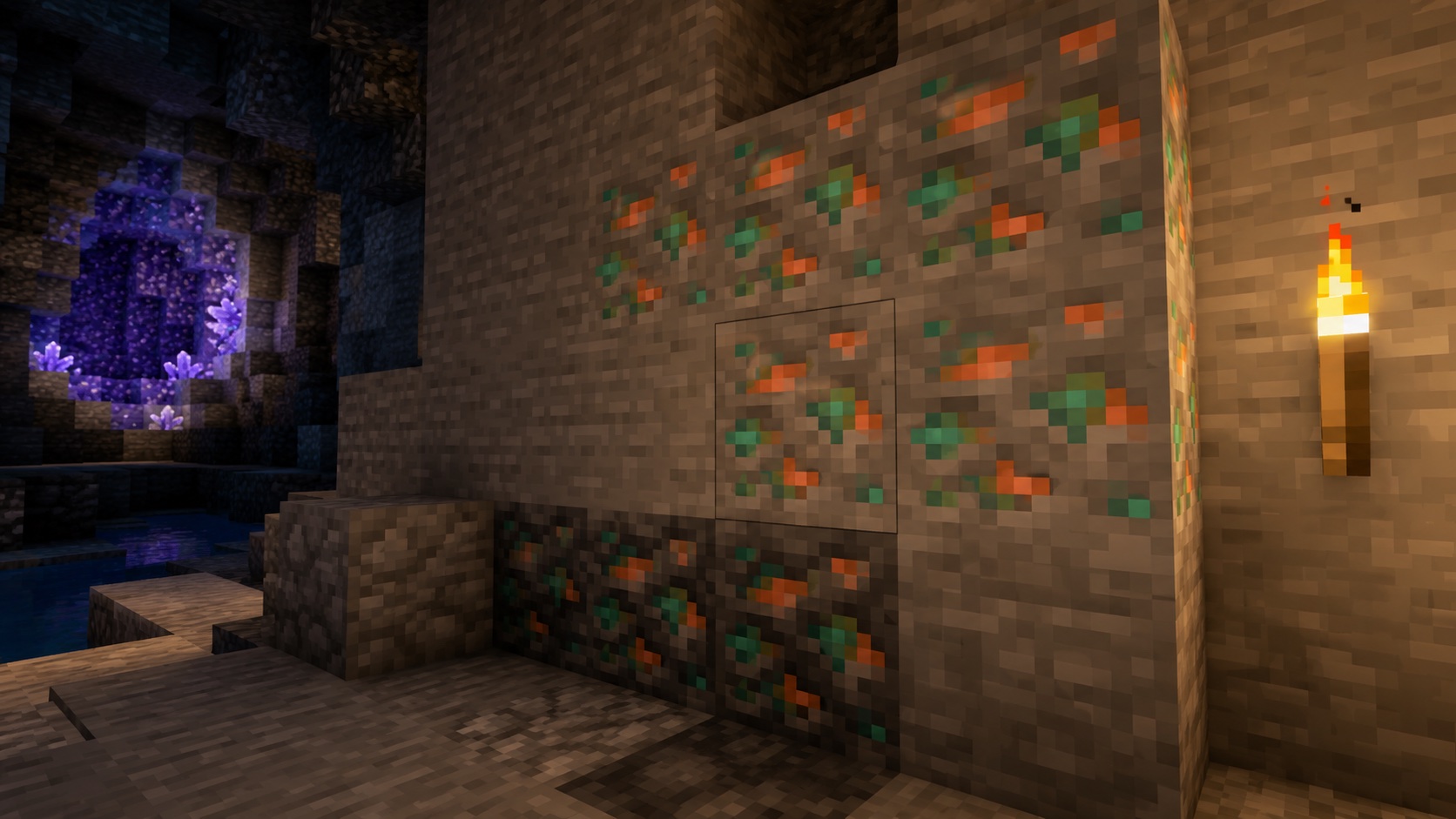
Copper ore is the block you mine to get raw copper, which smelts into copper ingots. It was added in the 1.17 Caves & Cliffs update and now spawns across most of the overworld. If you’ve seen a stone block with green-and-orange flecks running through it, that’s copper.
Copper is the only ore in Minecraft that oxidizes once you’ve placed its block form, which is what makes it interesting beyond raw resource gathering. The ingot also feeds into a small list of items every late-game world ends up wanting: lightning rods, spyglasses, brushes, and the various copper blocks people build with.
Where to find copper ore
Copper ore generates in the overworld between Y -16 and Y 112. The peak spawn rate sits around Y 47 to 48, so digging a shaft to that level and branching out is usually the fastest way to stockpile some. It overlaps the iron and coal range, so if you’re already doing iron runs, you’ll come back with copper too.
Copper ore can show up in any overworld biome where the underground has stone or deepslate, but not every biome is equal. Dripstone caves are the standout. Lush caves and regular ravines also work well. Mountain biomes that expose lots of cliff face often have visible copper in the stone walls without any mining at all.
Stone copper ore vs. deepslate copper ore
Two visual variants exist:
- Copper ore: spawns in regular stone above Y 0. Lighter background, faster to mine.
- Deepslate copper ore: spawns in deepslate below Y 0. Darker background, slower to mine because deepslate is harder than stone.
Both drop the same loot. The only practical difference is mining speed and where you have to be standing to find them. You’ll see the stone variant during normal cave exploration and the deepslate variant once you’ve gone past Y 0.
The biome that matters
Dripstone caves spawn copper ore at much higher rates than any other biome. If you find one on your seed, that’s the spot to mine. The ore generates in larger veins inside dripstone caves, and you’ll often see big chunks of copper in the walls and ceilings.
Outside dripstone caves, regular caves and ravines anywhere in the overworld give you a steady supply with a few hours of branch mining. Underwater ravines and exposed cliffs also work, especially if you have Respiration on your helmet for the underwater ones.
How to mine copper ore
Tool requirements
You need a stone pickaxe or better. A wooden pickaxe still breaks the block, but you get nothing out of it. Iron, diamond, and netherite all mine copper ore at faster speeds, but a stone pickaxe is fine for early-game runs.
Fortune and Silk Touch
Without enchantments, each block of copper ore drops 2 to 5 raw copper. Fortune significantly increases that. With Fortune III on the pickaxe, a single block can roll into double-digit drops on a good hit, which is why it’s worth saving a Fortune-enchanted pickaxe for ore runs.
Silk Touch makes the block drop as copper ore instead of raw copper. That’s mainly useful if you want to move the ore back to your base and smelt it later, or if you want a wall of ore blocks for decoration. The block still smelts into a single copper ingot if you do put it through a furnace, so Silk Touch costs you nothing if you keep one ore-form pickaxe and one Fortune pickaxe in your hotbar.
How to use copper
Smelting raw copper into ingots
Drop raw copper into a furnace or blast furnace with any fuel. Each unit gives one copper ingot. Blast furnaces work twice as fast and don’t drop XP when you collect the ingot, but a regular furnace is fine if you don’t have a blast furnace yet.
Raw copper blocks and storage
Once you’ve smelted enough raw copper to fill a few stacks, storage becomes the question. Crafting raw copper into raw copper blocks (9 raw copper in a 3×3 grid) compresses storage 9x. The block looks similar to other raw ore blocks, fine for organized storage chests.
Just remember the smelting trap: a raw copper block in a furnace gives one copper ingot, not nine. Always break the block back into raw copper items before smelting.
Crafting recipes that use copper
Copper ingots feed a small but practical recipe list:
- Block of copper: 9 ingots in a 3×3 grid. The base block for builds and the only one that visibly oxidizes.
- Lightning rod: 3 ingots stacked vertically. Place it on a roof to redirect lightning strikes within a small radius.
- Spyglass: 2 copper ingots and 1 amethyst shard. Right-click to zoom in on far-off blocks and mobs.
- Brush: 1 copper ingot, 1 stick, 1 feather. The archaeology tool used on suspicious sand and gravel.
- Copper bulb (1.21): 3 copper blocks, 1 blaze rod, 1 amethyst shard. A redstone-toggleable light source.
- Copper door, copper trapdoor, copper grate, chiseled copper: each crafted from copper blocks.
How copper oxidation works
Once you place most copper blocks, they slowly cycle through four stages: copper, exposed, weathered, and oxidized. Each stage adds more green to the texture. The full cycle takes a long real-world time, and the rate varies based on how many copper blocks sit nearby.
If you don’t want any of that, wax the block. Right-click a honeycomb on any copper block to wax it; the current stage is locked from then on. To strip wax or roll the block back one stage, hit it with an axe.
Tips and common mistakes
- Don’t mine copper ore with a wooden pickaxe. The block breaks and you get nothing.
- Run Fortune III on your copper pickaxe if you can. The drop boost is large enough that the trip-time math changes.
- If you want clean unoxidized copper in your build, place fresh blocks first and decide later whether to wax. You can always wax, but you can’t speed up oxidation.
- Don’t store copper as raw copper blocks unless you’re sure you won’t need to smelt it soon. Breaking the blocks back into items before smelting is an annoying extra step, and stacking raw copper items in regular chests works fine for normal-size hoards.
- Dripstone caves are worth the trip. A single dripstone cave usually outproduces an hour of branch mining at Y 47.
Java vs. Bedrock differences
Generation, drops, and crafting recipes for copper ore behave the same on Java and Bedrock. Oxidation timing has small implementation differences under the hood but ends at the same four visible stages. Waxing and unwaxing work the same on both editions.
Frequently asked questions
What Y level is best for copper ore?
Y 47 to 48 has the highest spawn rate for copper ore in regular stone, according to the generation rules added in the Caves & Cliffs update. If you’re inside a dripstone cave, the entire cave is fair game and the spawn rate is much higher than anywhere else in the overworld.
Do I need an iron pickaxe for deepslate copper ore?
No. A stone pickaxe still works. Deepslate copper ore is slower to mine than the stone variant, but the tool requirement is the same.
How much raw copper do I get per block?
Without enchantments, 2 to 5 raw copper. Fortune III pushes that into double digits on lucky rolls and noticeably raises the average yield per block. The exact maximum depends on the random rolls, but Fortune III always outpaces mining without it.
Can I get copper without mining?
Drowned have a small chance to drop a copper ingot when killed, especially with a Looting sword. It’s not a reliable source unless you’ve built a drowned farm, and farms are usually a midgame project.
Does copper oxidize in your inventory?
No. Only placed copper blocks oxidize. Items in your inventory or in chests stay exactly as they were when you mined them.
How do I stop a copper block from turning green?
Wax it. Right-click any copper block with a honeycomb. The block locks at its current oxidation stage and won’t change unless you remove the wax with an axe.
Is copper still worth mining once I have iron and diamond?
Yes, if you want any of the items that need it: lightning rods, spyglasses, brushes, copper bulbs, or the new copper-based blocks like the door, trapdoor, and grate. If you don’t need any of those and you don’t build with copper, skipping it is fine.
If you’re starting fresh and want the most out of copper, set up a small outpost near a dripstone cave. The yield-per-hour is hard to match anywhere else, and you’ll have enough copper to handle every recipe and decorative project for a long time.