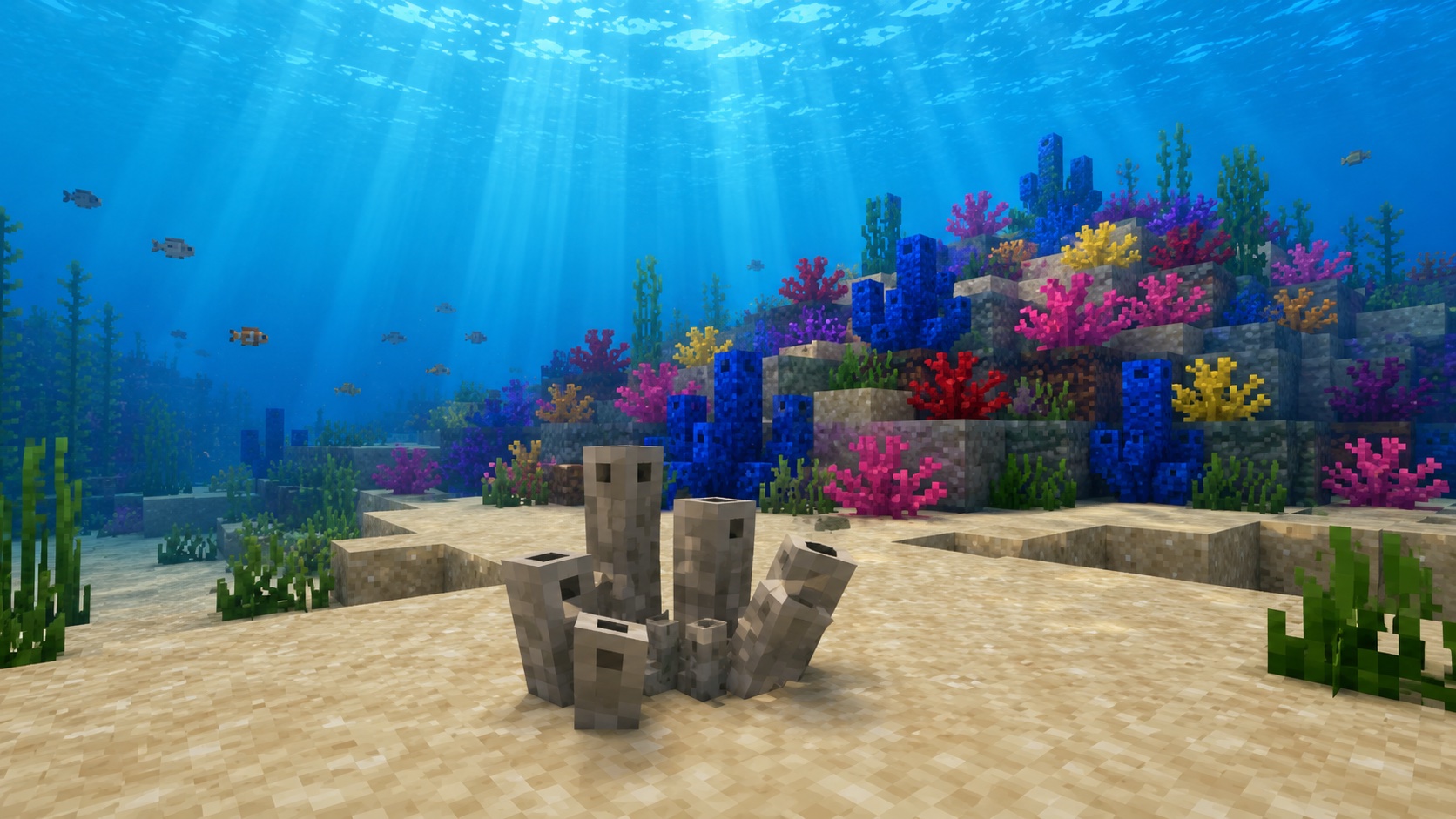
What is dead tube coral?
Dead tube coral is the gray, lifeless version of tube coral. Live tube coral is the deep blue plant that pokes up like a finger from the ocean floor in warm oceans. When that plant loses contact with water, it turns gray within about a minute and stops being alive. What is left behind is dead tube coral.
It is a small plant block, not a full cube. The block underneath it has to be solid for it to stay placed. Dead tube coral cannot come back to life. Once it turns gray, it is gray forever.
Where to find dead tube coral
Dead tube coral generates naturally inside coral reefs in warm ocean biomes. Reefs spawn with a mix of live and dead coral, so you can find both side by side without doing anything special.
You can also make your own. Take a piece of live tube coral, place it somewhere with no water touching it, and wait. After a short time it dies and becomes dead tube coral. This is the most reliable way to get a stockpile if you do not want to roam the ocean.
Coral reef biome notes
Reefs only spawn in warm ocean biomes (the lighter blue water with a sandy floor). Cold and frozen oceans do not have coral, alive or dead. If your seed has no warm ocean nearby, the only path is to grow live coral from coral fan or coral block sources, then let it die.
How to mine dead tube coral
Use any pickaxe. Wood, stone, iron, gold, diamond, or netherite all work, and Silk Touch is not needed because the block is already dead. Mining without a pickaxe gives you nothing, so an empty hand is wasted.
One swing breaks it. The block drops itself and you can pick it up like any other item.
Tools and drops at a glance
| Tool | Drop |
|---|---|
| Any pickaxe | Dead tube coral |
| Hand, axe, shovel, sword, hoe, shears | Nothing |
If you accidentally use the wrong tool, the block still breaks but you walk away empty-handed. Switch to a pickaxe before you start.
How to place and use it
Place dead tube coral on the top face of any solid block. It works on stone, sand, dirt, gravel, and most other full blocks. It will not stay on glass, leaves, or other non-solid surfaces.
The block can be placed underwater or in air. Live tube coral dies if it is not next to water, but dead coral does not have that rule. That makes it useful for above-ground builds where you want a coral look without keeping the area flooded.
Building ideas
- Dry reef displays in deserts or beaches, where live coral would die instantly.
- Aquariums with a mix of live and dead coral for a more natural look.
- Fossil gardens, where weathered gray plants fit a ruins theme better than colorful live ones.
- Underwater monument builds, where dead coral works as filler between live patches.
Dead tube coral is also waterloggable. If you place it in a square that already has water, the block keeps the water flowing around it. Break it later and the water stays in place.
How tube coral dies
Live tube coral dies in about one minute when it is not adjacent to a water source on at least one side. The check is simple: is there water touching this coral, including the block underneath? If not, a timer starts, and the coral turns gray.
This catches a lot of new players. You mine a piece of live coral with Silk Touch, sprint home, and by the time you place it, every adjacent square is air. The coral dies on the spot. To keep it alive, place it back into water before the timer runs out, or build a small flooded display before you go gather the coral.
Why this matters for builds
If you want a colorful reef in your base, plan the water layout first. Frame the area with glass or signs so a flooded space is ready, then bring in your live coral. If your build is dry, dead coral is the only option. Trying to do it with live coral in a dry room is a common mistake.
Dead tube coral vs. its block and fan cousins
The tube coral family has three shapes, and each has a dead version. The naming gets confusing fast, so here is the short version.
- Dead tube coral is the small plant. It pokes up out of a block and looks like a thin finger. This is what this article covers.
- Dead tube coral block is a full cube. You place it like any other block and it has six gray faces.
- Dead tube coral fan is the flat fan-shaped piece that hangs off the side of a block or sits on top.
All three start as live blocks (deep blue) and turn gray when removed from water. The block version is the only one that drops a different item depending on Silk Touch. With Silk Touch, you get the live block. Without it, you get the dead block. Plants and fans are not drop-substituted that way; live ones need Silk Touch to drop at all, and dead ones drop themselves with a pickaxe.
If you only want gray pieces for a build, mining the live block without Silk Touch is the fastest way to stack dead coral blocks. For the plant and fan versions, just let live coral die and then mine the gray result.
Transporting live coral without it dying
Most dead tube coral in your base will be there because live coral died on the trip home. A bit of planning prevents that.
The simplest path is to bring a water bucket and a piece of glass. When you find live coral, mine it with Silk Touch, then place a single block of glass somewhere flat, place water on top, and stick the live coral into the water square. The block now keeps the coral alive while you keep mining. When you are ready to leave, break the coral back into your inventory; it survives the move home as long as it goes back into water within a minute of being placed.
If you want to move a lot of coral at once, dig a small flooded hole near the reef. Place all your coral there as you collect it, then come back when you are ready to bring it home in batches. Coral does not despawn, so a flooded storage hole works as a long-term holding pen.
Java vs. Bedrock differences
The behavior is the same on both editions for everyday use. Dead tube coral generates in warm ocean reefs, drops with any pickaxe, and can be placed on solid blocks underwater or on land. The death timer for live tube coral is also similar.
One small difference shows up in how bone meal interacts with coral. On a coral block in warm ocean water, bone meal can spread new coral, including tube coral, which can then die into the gray version. The mechanic works on both editions but tends to feel a bit faster on Java in practice. Either way, it is a live-coral feature, so it does not change anything once you have the dead block in hand.
Tips and common mistakes
Bring a pickaxe before you head to a reef. Many players grab a sword or shears, swim down, hit a piece of dead coral, and watch it disappear with no drop. A wood pickaxe is enough.
If you are worried about live coral dying in your inventory after pickup, that does not happen. Coral in your inventory is safe. The death timer only runs while the coral is placed in the world.
To make dead coral on demand, place live coral in a single dry block and wait about a minute. You do not need to break and replace it. Just leave it dry and it will turn gray on its own.
Coral blocks (the full cube versions) and coral fans follow slightly different mining rules from coral plants. The plant version covered in this article drops with any pickaxe when dead. The fan version also drops with any pickaxe when dead. The block version always drops itself with a pickaxe regardless of state, and Silk Touch only matters when you are trying to mine a live coral block and keep it alive.
Frequently asked questions
Does dead tube coral grow back?
No. Once tube coral dies, it stays dead. There is no way to revive it inside the game.
Can I get dead tube coral without Silk Touch?
Yes. Dead tube coral is the easy version. Any pickaxe drops it. Silk Touch is only relevant for the live blue version.
Can dead tube coral be placed on land?
Yes. Unlike live tube coral, the dead version does not need water to survive. You can place it on a desert block in direct sun and it will stay gray forever.
Why did my live tube coral turn gray when I got home?
It died in transit. Live coral has a one-minute death timer when it is not next to water. If you placed it in a dry build area, that timer ran out. Keep it in water until you are ready, or pre-build a wet display before placing.
Does dead tube coral give experience when mined?
No experience drops from dead coral, live coral, or any coral fan. The block is purely decorative.
Does dead tube coral count as a plant for redstone?
No. Dead coral does not power any redstone, does not send signals to comparators or observers, and does not react to bone meal. Treat it as a flat decorative block.
Can I dye dead tube coral?
No. Dead coral is a single gray color and there is no recipe to dye it. If you want different colors, use the live versions or paint the look you want with stained glass and gray plants together.
Closing
Dead tube coral is one of the easiest coral parts to work with. It mines fast, it drops with any pickaxe, and it does not need water once placed. If you want a reef build that looks lived-in rather than freshly grown, mix dead tube coral with live patches and let the gray break up the color.