What is deepslate lapis lazuli ore?
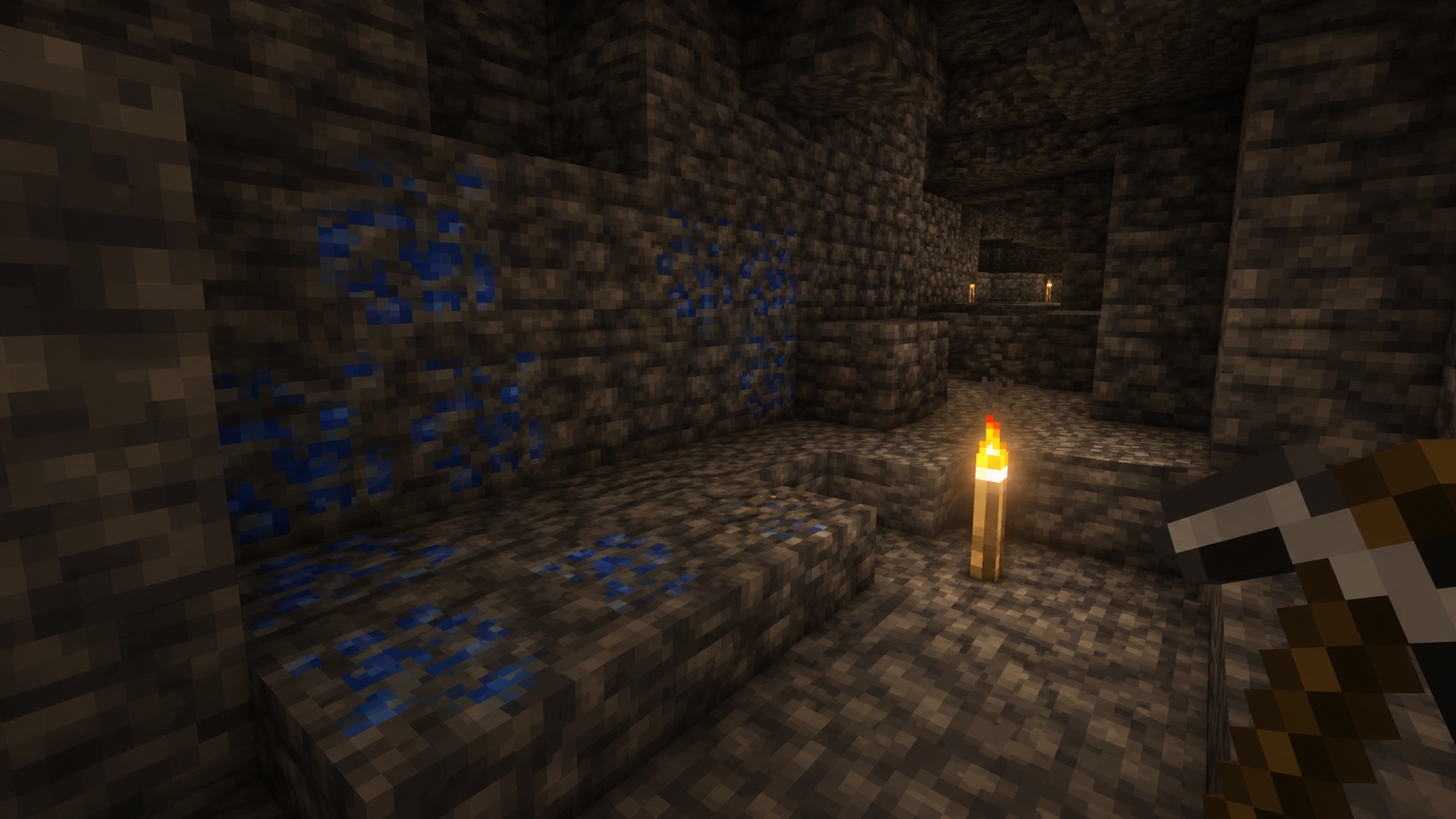
Deepslate lapis lazuli ore is the deepslate version of regular lapis lazuli ore. It spawns in the deepslate layer of the world (below Y=0) and drops the same item, lapis lazuli, when mined with the right tool. Visually it’s a dark gray block with the same blue speckles as its stone counterpart, just on the deepslate texture.
If you’re hunting lapis for enchanting or dye crafting, this is the variant you’ll see most often. Lapis spawns peak between Y=0 and Y=-32, which is squarely inside deepslate territory. The block was added in the Caves and Cliffs update (1.17) when Mojang split every overworld ore into a regular and deepslate version.
The short version: same drops, slightly tougher to mine, found deeper underground. Bring at least a stone pickaxe and a Fortune III enchant if you want to walk out with stacks.
Where to find deepslate lapis lazuli ore
Lapis lazuli ore generates in two overlapping batches in Java and Bedrock, with the higher concentration sitting deep inside the deepslate layer. The single most productive Y level is around Y=-1, which is the peak of the lower batch. Spawns thin out as you climb back up toward sea level and as you drop down toward bedrock.
Practical range to mine for lapis:
- Best yield: around
Y=-1 - Reliable zone:
Y=-32toY=32 - Rare appearances: as high as
Y=64and as low asY=-64
Because deepslate replaces stone below Y=0, almost all lapis at the peak Y level will be the deepslate variant. Above Y=0, you’ll see the regular stone variant instead. The drop is identical, so it doesn’t matter for stockpiling, but it’s a useful tell for how deep you are when you’ve lost your bearings in a cave.
It can spawn in any overworld biome where deepslate is exposed: deepslate caves, normal caves, dripstone caves, lush caves, and ravines that punch down past Y=0. Strip mining at Y=-1 in any overworld biome works.
Ore veins for lapis lazuli are small. A typical cluster contains 1 to 10 blocks, with most veins falling in the 4 to 7 range. Compare that to coal or copper veins, which can fill an entire wall, and you’ll see why people who only mine for diamonds rarely come home with much lapis. The block placement also follows a triangular distribution around the peak Y level: spawn density rises smoothly from Y=-32 up to Y=-1, then falls off as you climb above it. Build your branch mine close to the peak and you’ll cross many more veins per chunk than at the edges of the range.
How to mine it
You need at least a stone pickaxe to get any drops. Wooden pickaxes will break the block, but the lapis won’t drop and you’ll waste the spawn.
The mining hierarchy:
- Stone, iron, diamond, or netherite pickaxe: drops lapis lazuli
- Wooden or gold pickaxe: no drop, block is destroyed
- Any other tool or bare hand: no drop, slower break
Deepslate lapis lazuli ore has a hardness of 4.5, compared to 3.0 for the regular stone variant. In practice that means it takes roughly 50 percent longer to mine each block by hand. With Efficiency V on an iron or diamond pickaxe, the difference is barely noticeable. Bring Efficiency on your pickaxe if you plan to clear a long branch tunnel.
Mechanics and drops
Mining the block without Silk Touch drops 4 to 9 lapis lazuli per ore. The drop count is rolled randomly inside that range for each block.
Fortune multiplies that range:
| Enchantment | Drops per ore |
|---|---|
| None | 4 to 9 |
| Fortune I | 4 to 13 |
| Fortune II | 4 to 18 |
| Fortune III | 4 to 27 |
Fortune III is the single biggest yield boost in the game for any ore that drops a count instead of a single item. If you’re farming lapis for an enchanting setup or for blue dye, mine with Fortune III.
Silk Touch swaps the drop entirely: instead of raw lapis lazuli, the block drops as deepslate lapis lazuli ore. You’d only use Silk Touch if you wanted to relocate the block (for decoration, a display case, or to smelt it later for one item of lapis per ore). It’s almost always the wrong call for farming.
Smelting deepslate lapis lazuli ore in a furnace or blast furnace gives one piece of lapis lazuli per ore. That’s a downgrade from raw mining, so smelting is only useful when you have spare Silk Touch blocks lying around.
Each block also drops between 2 and 5 experience orbs when broken without Silk Touch. With Silk Touch, no XP drops, because the ore block itself is the drop.
One quirk worth knowing: lapis ore drops scale with the maximum, not the average. Going from no enchantment to Fortune III roughly triples the average yield per block. On a full inventory clear of one branch tunnel, the difference between a stone pickaxe and a Fortune III iron or diamond pickaxe is the difference between a stack of lapis and four stacks of lapis. The time investment to enchant the pickaxe pays back inside one mining run.
What lapis lazuli is good for
The whole point of mining this ore is what lapis lazuli does once you have it.
- Enchanting: every enchant at an enchanting table costs 1 to 3 lapis per use. A serious enchanting habit eats through stacks fast.
- Blue dye: lapis lazuli is the blue dye source. One lapis equals one blue dye for wool, beds, banners, candles, and concrete powder.
- Block of lapis lazuli: nine lapis pieces craft into one block, useful as a decorative storage cube or a visual marker.
- Trading: cleric villagers trade emeralds for lapis lazuli at the apprentice tier. Stocking up makes early-game emerald farming much easier.
The enchanting math is what most players underestimate. Each enchant at the table costs 1 lapis for a level 1 slot, 2 lapis for a level 2 slot, and 3 lapis for a level 3 slot. A full level 3 enchant also drains 3 levels of XP. If you’re enchanting an Efficiency V pickaxe and a Fortune III pickaxe at level 30 each, that’s 6 lapis lazuli total. A single deepslate lapis lazuli ore vein covers it. Stockpile a single chest of lapis and you’ll be set for most of the year.
For cleric trading, the apprentice tier offer is typically 1 emerald for 4 to 6 lapis lazuli. That’s not a great rate compared to using lapis for enchants directly, but it’s a steady emerald source once you have a self-sustaining mining loop.
Java vs Bedrock differences
Drop counts, Y level distribution, and tool requirements are identical across editions in current versions. Both editions cap at Fortune III for the multiplier, and both use the same range table.
Texture and rendering are the same. Spawn rates have been equalized since the Caves and Cliffs rewrite, so a strip mine at Y=-1 performs the same on either edition.
Tips and common mistakes
Mine at Y=-1, not at diamond level. People hunting both diamond and lapis often default to Y=-58 for diamonds and miss lapis on the way down. Strip mining at Y=-1 nets far more lapis per hour, and you can take a separate trip for diamonds at the deeper level.
Don’t break with a wood or gold pickaxe. The block has tool tier requirements like any other ore. A pickaxe that’s too weak destroys the spawn for nothing.
Carry Fortune, not Silk Touch. Unless you’re collecting blocks for a display or rebuilding a base, Silk Touch on lapis is a waste of an enchantment slot.
Watch for lava. Y=-1 is well below sea level and close to lava lake territory. Bring a water bucket, place a torch every few steps, and don’t dig straight down.
If you’re hunting lapis with the goal of enchanting, pair the mining run with a stack of bookshelves and a quiet base location. Lapis costs less per enchant than the experience itself, so a small stockpile lasts a long time.
Set up a Beacon with Haste II near a strip mine and your effective break time on deepslate ores drops by another big chunk. Pair that with Efficiency V on a netherite pickaxe and most of the perceived “deepslate is annoying to mine” complaint disappears. It’s still slower than regular stone, just no longer something you notice round to round.
Pattern matters. A 2×1 branch mine with branches three blocks apart catches more lapis veins per block dug than a single long tunnel, because lapis veins are small and clustered. If you only dig in a straight line, you’ll walk past many veins sitting one or two blocks to either side of your path.
Frequently asked questions
What Y level is best for deepslate lapis lazuli ore?
Around Y=-1. That’s the peak of the lower lapis ore batch, and below Y=0 every spawn appears as the deepslate variant.
What pickaxe do I need?
Stone pickaxe or better. Wood and gold pickaxes break the block but drop nothing.
How much lapis does each ore drop?
4 to 9 lapis lazuli without enchantments. With Fortune III, the range expands to 4 to 27.
Does Silk Touch work on it?
Yes. With Silk Touch, you get the deepslate lapis lazuli ore block itself instead of raw lapis. Useful for relocation or display, not for farming.
Can you smelt lapis lazuli ore?
Yes, in a furnace or blast furnace, but you only get one lapis per ore. Mining with Fortune gives far more.
Why is mining it slower than regular lapis ore?
Deepslate has higher hardness (4.5 vs 3.0). Efficiency V on a diamond or netherite pickaxe closes most of the gap.
Does it generate in the Nether or End?
No. Lapis lazuli ore in any form is overworld-only.
Worth knowing
If your goal is enchanting, the floor for “enough lapis” is much lower than people think. A single Fortune III run at Y=-1 for an hour produces enough lapis to power hundreds of enchants. Mine once, store it in a block of lapis cube, and stop worrying about it.