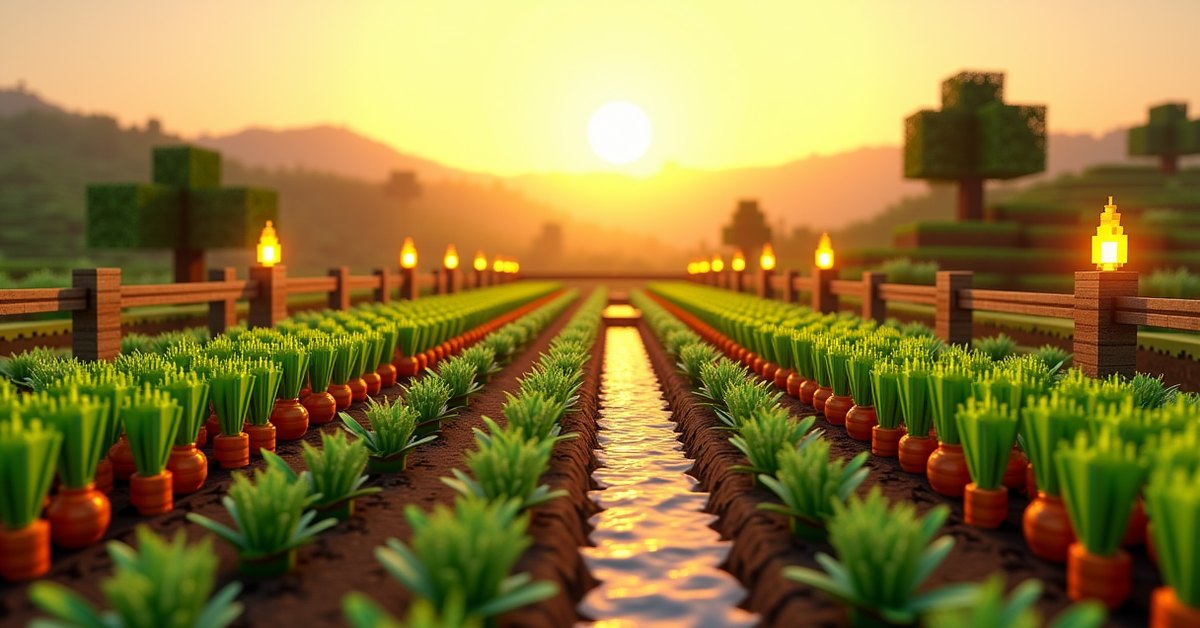
What farming means in Minecraft
Farming crops is how you turn a patch of dirt into a steady supply of food, trade goods, and brewing ingredients. Instead of hunting animals or raiding chests, you plant seeds on tilled soil, wait for them to grow, and harvest the results over and over. A small wheat plot can keep you fed for an entire world.
The four crops that grow directly on farmland are wheat, carrots, potatoes, and beetroot. Melons and pumpkins are a little different: you plant their seeds on farmland, but the stem grows fruit on a block next to it. Once you understand how farmland, light, and water work together, every one of these crops follows the same basic rules.
This guide covers how to set up a plot, what makes crops grow faster, how much each one drops when you harvest, and the mistakes that quietly ruin a farm.
How to start a crop farm
You need three things: tilled soil, seeds, and light. Tilling comes first. Hold any hoe and use it on a dirt, grass, or dirt path block to turn it into farmland. Wood, stone, iron, gold, diamond, and netherite hoes all till at the same speed, so a wooden hoe is fine for a starter farm.
Next, get seeds. Wheat seeds drop when you break tall grass, so you usually have a few before you even build a farm. Carrots and potatoes are the planted items themselves: place a carrot or a potato on farmland and it grows into more. Beetroot seeds come from breaking beetroot plants or from village farms and chest loot.
Plant a seed by using it on a farmland block. The crop appears as a small sprout and slowly works its way through several growth stages until it looks full and ready. Break it at that final stage to collect the harvest.
Light and water requirements
Crops need a light level of at least 9 on the block above them to grow. Daylight covers this outdoors. Underground or at night, place torches, lanterns, or glowstone nearby so the farm never drops below that threshold. Crops in the dark simply freeze at whatever stage they reached.
Water keeps farmland hydrated, and hydrated farmland grows crops much faster. A single water source hydrates farmland up to four blocks away in every horizontal direction, so one water block in the center of a nine-by-nine plot keeps the whole thing wet. Hydrated farmland looks dark and damp; dry farmland looks pale. Crops still grow on dry soil, just slower, and empty dry farmland eventually turns back into dirt.
How crop growth actually works
Growth happens on random ticks, which means there is always some luck involved in when a plant advances. You cannot watch a crop grow in real time, but you can stack the odds in its favor.
Each crop moves through a set number of stages. Wheat, carrots, and potatoes have eight stages; beetroot has four. The plant is only harvestable for its full yield at the final stage, so breaking it early gives you less.
The game scores the soil around each plant to decide how fast it grows. Hydrated farmland is worth more than dry farmland, and the block the crop sits on counts the most. The surrounding eight blocks add smaller bonuses when they are farmland too. More wet farmland around a plant means faster growth.
Why rows beat solid blocks
There is one mechanic that trips up most new farmers. If a crop has the same crop type planted next to it on both axes, north-south and east-west at the same time, the game roughly halves its growth speed. A solid square of nothing but wheat triggers this penalty on almost every plant inside it.
The fix is to plant in rows. Put one type of crop in a straight line, then leave the next row for a different crop, a strip of water, or a gap. Alternating wheat and carrots row by row, for example, lets every plant grow at full speed. It feels counterintuitive to space crops out, but a striped farm out-produces a packed one.
Speeding things up with bone meal
Bone meal forces a crop to jump forward several growth stages at once. It works on wheat, carrots, potatoes, and beetroot, and a few uses will usually take a young plant to full size. On melon and pumpkin plants, bone meal grows the stem to maturity but will not instantly spawn the fruit, so you still wait for that part.
You make bone meal from bones dropped by skeletons, or in bulk from a composter. Drop extra seeds, crops, or plant matter into a composter and it eventually produces bone meal, which closes the loop on a self-sustaining farm.
What each crop drops
Yields vary a little each time because of built-in randomness, but the patterns are steady once you harvest in bulk.
| Crop | Harvest yield | Notes |
|---|---|---|
| Wheat | 1 wheat plus 0 to 3 seeds | Seeds replant the next round |
| Carrots | 2 to 5 carrots | Replant one, eat or trade the rest |
| Potatoes | 1 to 5 potatoes | Small chance of a poisonous potato |
| Beetroot | 1 beetroot plus 1 to 4 seeds | Beets make red dye and soup |
Because each harvest usually returns more than you planted, a farm pays for itself within a couple of cycles. Keep one carrot or potato back to replant, and the surplus becomes food, golden carrots, or villager trades.
Useful things to do with crops
Wheat feeds and breeds cows, sheep, and goats, and it crafts into bread, hay bales, and cake. Carrots breed pigs and rabbits and become golden carrots, one of the best foods in the game. Potatoes can be baked for a solid hunger refill. Beetroot feeds into beetroot soup and red dye.
Crops are also trade fuel. Farmer villagers buy wheat, carrots, potatoes, and beetroot for emeralds, so a large plot turns into a reliable income stream once you have a villager hall set up.
Common farming mistakes
The fastest way to wreck a farm is to jump on it. Jumping or falling onto farmland turns the block back into dirt and pops off whatever was planted. Walk across your rows, never hop, and fence the plot so mobs cannot trample it either.
The second common problem is light. A farm that looks fine during the day can sit frozen all night if it has no torches. If your crops seem stuck, check the light level before anything else, then check that the farmland is still hydrated.
The third is overcrowding. Packing one crop into a solid field feels efficient but triggers the growth penalty described above. Spacing crops into rows looks emptier and grows faster.
Automating the harvest
Once a manual farm works, you can let the game run it for you. A common trick is to place a water source at the top of a sloped plot; flicking it on with a dispenser or a lever washes every loose crop down into a hopper and a chest. Pair that with a row of observers and pistons and you get a contraption that harvests and collects without you touching a hoe.
The hands-off option is a farmer villager. Give a villager access to a fenced plot stocked with seeds and they will plant, tend, and harvest crops on their own, then toss surplus food to other villagers to trigger breeding. It is slower than a redstone build but takes no upkeep.
Java and Bedrock differences
Crop farming works almost identically across both editions. Farmland hydration, the light-level-9 rule, the row-spacing growth bonus, and bone meal all behave the same way whether you play Java or Bedrock. The main thing players notice is trampling: in both editions, landing on farmland from a jump or a fall reverts it to dirt, so the safe-farm habits are the same on either platform.
Frequently asked questions
What light level do crops need to grow?
At least 9 on the block directly above the crop. Sunlight handles this outdoors. Indoors or underground, torches, lanterns, or glowstone keep the level high enough.
Do crops need water to grow?
No, but they grow much faster on hydrated farmland. One water source keeps farmland wet up to four blocks away in each direction, so a single water block can hydrate a nine-by-nine plot.
Why won’t my crops grow?
Usually light or hydration. Confirm the light level is 9 or higher, make sure the plant is on farmland, and check that the soil is dark and hydrated. Crowding one crop into a solid block also slows growth, so try spacing it into rows.
Does bone meal work on every crop?
It instantly grows wheat, carrots, potatoes, and beetroot. On melon and pumpkin plants it matures the stem but does not spawn the fruit, so you still wait for that step.
How do I stop my farmland from turning back into dirt?
Do not jump on it, and keep mobs off it with a fence. Empty, unhydrated farmland also reverts over time, so keep crops planted and a water source nearby.
Do crops really grow faster in rows?
Yes. A crop surrounded by the same crop on both axes grows at about half speed. Planting in single rows separated by water, a gap, or a different crop avoids the penalty.
Can I farm without sunlight?
Yes. As long as the light level stays at 9 or above from torches or other light sources, crops grow underground or at night just as they do in daylight.
If you only build one farm, make it a striped plot with a water channel down the middle and torches on the corners. That single layout handles light, hydration, and the row bonus at once, and it scales up cleanly when you want more food or more emeralds.