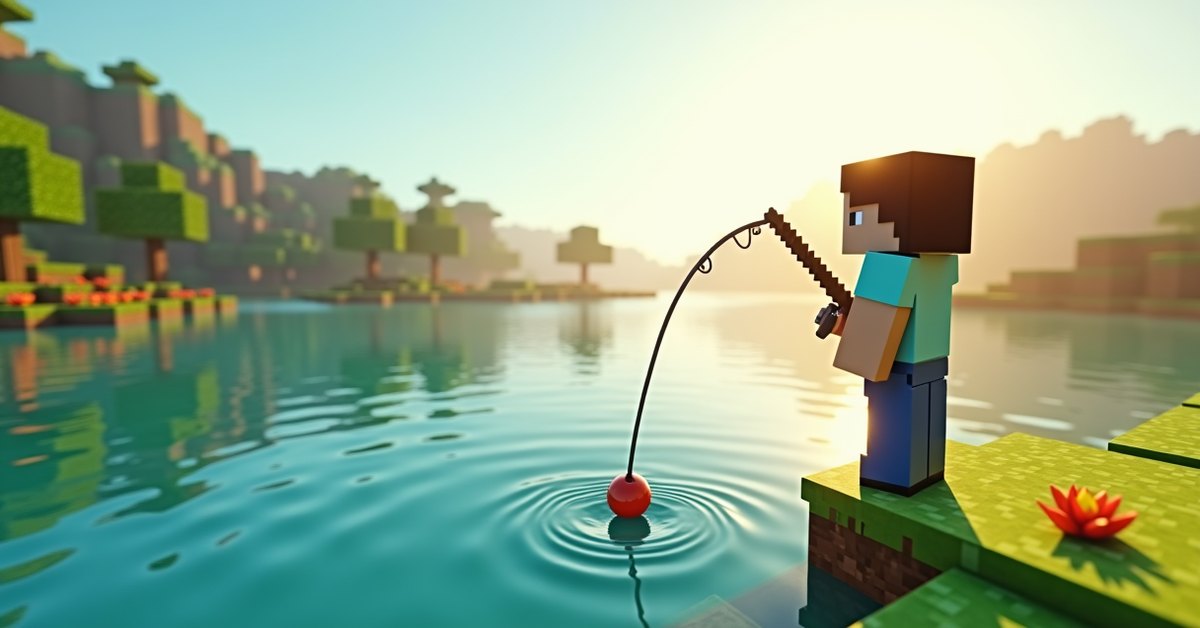
What fishing is and why it’s worth doing
Fishing in Minecraft is the act of casting a fishing rod into water and reeling in whatever bites. Most of the time you pull up food, but the same rod can land enchanted books, name tags, saddles, and nautilus shells. That mix of cheap food and rare loot is what keeps fishing useful from your first night to a late-game base.
You only need one tool and a bit of water, so fishing works almost anywhere: a pond, the ocean, a one-block hole you dug yourself. Once you understand the timing and a few rules about where you cast, it turns into one of the most reliable ways to farm both experience and treasure without leaving home.
What you need to start fishing
You need a fishing rod and a body of water. The rod takes three sticks and two string, placed in a diagonal line so the string trails off the bottom corner:
- Top-right slot: one stick
- Center and middle-left: the other two sticks, forming the diagonal
- The two string go in the bottom-right and middle-right slots
String comes from killing spiders, breaking cobwebs, or finding it in chests. Spiders drop it reliably at night, so most players have enough for a rod within a day or two. You can also get a rod as a rare fishing catch or trade for one with a fisherman villager.
How to fish, step by step
Stand near water and use the rod to cast the bobber out. Now you wait. After a random delay the water near your bobber starts to move: a trail of small bubbles appears and travels toward the bobber like something swimming up to it. When that trail reaches the bobber, the bobber dips under the surface with a small splash sound.
The moment it dips, use the rod again to reel in. Your catch flies toward you as a dropped item, so stand close enough to pick it up. Timing is the whole skill here. Reel too early and nothing happens; reel a beat late and the fish gets away and you start the wait over.
The default wait is between 5 and 30 seconds, chosen at random each cast. You can shorten that with rain and with the Lure enchantment, both covered below.
What you can catch
Every catch falls into one of three pools: fish, junk, or treasure. The game rolls which pool you get from, then picks an item inside it. In open water with no enchantments, you land fish about 85 percent of the time, junk around 10 percent, and treasure roughly 5 percent.
Fish
The fish pool is the common one and the reason fishing feeds you. You can reel in raw cod, raw salmon, pufferfish, and tropical fish. Cod and salmon cook into solid meals. Pufferfish are mainly brewing ingredients for water breathing potions, and tropical fish are used to breed and heal axolotls.
Junk
Junk is the disappointing pool, but not all of it is useless. It includes damaged leather boots and fishing rods, leather, sticks, string, bowls, water bottles, bamboo, ink sacs, tripwire hooks, lily pads, and rotten flesh. The damaged rods sometimes come with random enchantments, so even a junk rod can be worth keeping.
Treasure
Treasure is what most people are really fishing for. The pool includes enchanted books, enchanted bows, enchanted fishing rods, name tags, saddles, and nautilus shells. Name tags and saddles have no crafting recipe, so fishing is one of the few renewable ways to stock up on them. There is one catch: treasure only bites under specific conditions, which is where open water comes in.
Open water and why treasure won’t bite
To catch treasure, your bobber has to land in what the game calls open water. The rule checks the area around the bobber: roughly a 5-by-5 footprint of water with open air above it, free of solid blocks, lily pads, and overhangs. If anything other than water or air sits in that zone, the bobber is in “not open water” and the treasure pool is switched off.
This is the single most common reason a fishing spot underperforms. If you fish from a one-block hole, under a roof, or next to a wall, you will still pull up fish and junk forever and never see an enchanted book. The fix is simple: cast into the middle of a pond or ocean, well clear of the edges and anything overhead.
Enchantments that make fishing better
Two enchantments are made for fishing, and two general ones keep your rod alive.
Lure
Lure cuts the wait time between bites. Each level shaves about 5 seconds off the delay, so Lure III can drop the average wait dramatically. It does not improve what you catch, only how fast bites come.
Luck of the Sea
Luck of the Sea shifts the odds toward treasure and away from junk. At level III, treasure chances go up and junk chances drop noticeably. If you are fishing for enchanted books or name tags, this is the enchantment you want.
Unbreaking and Mending
A rod has limited durability, and fishing eats into it every cast and every catch. Unbreaking makes the rod last longer, and Mending repairs it using the experience orbs you earn from each catch. A Mending rod used for fishing effectively repairs itself as you go, so it almost never breaks.
One quirk worth knowing: Lure and Luck of the Sea pull from the same enchantment pool, so getting both at high levels on one rod usually means combining two enchanted rods or books on an anvil rather than hoping the enchanting table hands you everything at once.
Rain, timing, and experience
Rain helps fishing in two ways. It lowers the wait time between bites, and rain falling directly on your bobber gives a small extra speed bonus. If it starts raining while you fish in the open, expect catches to come faster.
Every successful catch also drops 1 to 6 experience points. Over a long session that adds up, which is part of why a fishing spot doubles as a quiet XP farm. Pair that XP with a Mending rod and the rod repairs itself from the same orbs it helped you earn.
Building an AFK fishing farm
Because fishing is mostly waiting, players often automate the casting. The basic idea is to hold the rod still over water and let the game register bites for you. A simple manual version is just sitting at a good open-water spot and re-casting after each catch. More elaborate redstone setups can detect the catch sound and re-cast automatically.
How well these farms work depends on your version of the game, so test your setup before leaving it running for an hour. Make sure the spot counts as open water if treasure is the goal, otherwise the farm only produces fish and junk.
Java and Bedrock differences
The open-water requirement for treasure is a Java Edition rule, and it is strict. Bedrock Edition handles the surrounding-block check differently, which is why some AFK fishing designs that print treasure on one edition come up empty on the other. If you follow a farm tutorial, match it to your edition.
The core loop is the same on both: craft a rod, cast, watch for the dip, reel in. The differences are in the fine print of catch rates and farm behavior, not in how you actually fish.
Tips and common mistakes
- Fish from open water if you want treasure. A roofed dock or a tiny hole kills your treasure odds.
- Reel in on the dip, not on the bubble trail. The trail is your warning; the splash is your cue.
- Put Mending on your fishing rod so it repairs from the XP you catch.
- Don’t fish in the rain expecting more treasure. Rain speeds up bites, it does not change the loot pools.
- Keep an eye on rod durability if you skip Unbreaking and Mending, since a long session can wear a plain rod down to nothing.
Frequently asked questions
How do you make a fishing rod?
Combine three sticks and two string in a crafting grid, with the sticks forming a diagonal and the string trailing off the bottom corner. That gives you one fishing rod.
Why am I not catching treasure?
Almost always because your bobber isn’t in open water. Treasure only bites when the area around the bobber is clear water and air with no solid blocks, lily pads, or roof nearby. Move to the middle of a pond or ocean.
Does Lure increase treasure?
No. Lure only reduces the time between bites. For better treasure odds you want Luck of the Sea, which shifts catches away from junk and toward treasure.
Can you catch name tags and saddles by fishing?
Yes. Both are in the treasure pool, and since neither has a crafting recipe, fishing in open water is one of the few renewable ways to get them.
Does fishing give XP?
Every successful catch drops 1 to 6 experience points. A Mending rod can turn that XP back into rod durability, so your gear repairs itself while you fish.
Does rain make fishing faster?
Yes. Rain lowers the wait time between bites, and rain landing on the bobber adds a small extra speed bonus. It does not change what you catch.
The short version
Fishing rewards patience and the right spot. Craft a rod, find open water with nothing overhead, add Luck of the Sea and Mending when you can, and the same quiet activity that feeds you early on becomes a steady source of enchanted books, rare items, and experience.