What enchanting does
Enchanting adds special powers to tools, weapons, armor, and a few other items. An enchanted pickaxe can mine faster or drop extra ore. Enchanted boots can soften fall damage or let you walk on water. A sword can set mobs on fire or hit harder. You spend experience levels and lapis lazuli to add these effects, so enchanting is one of the main reasons to bank XP instead of dying with it in your pocket.
Most enchantments come from an enchanting table, but that is not the only source. You can also get them from enchanted books, villager trades, fishing, and chest loot. This guide covers the table first, since that is where most players start, then walks through the other routes and how to manage what you end up with.
Enchanting works the same way in survival across recent versions. The examples here assume a normal survival world on a current release.
How to build an enchanting table
The enchanting table needs three ingredients: one book, two diamonds, and four blocks of obsidian. In the crafting grid, put the book in the top center slot, a diamond on each side of the middle row, and obsidian filling the bottom row plus the slot under the book.
Obsidian forms when water touches a lava source, and you mine it with a diamond or netherite pickaxe. Two diamonds is a real cost early on, so most players build their first table once they have a small stash of diamonds and a few obsidian blocks to spare. The table alone lets you enchant, but on its own it only reaches low levels. To push past that, you add bookshelves.
How enchanting works at the table
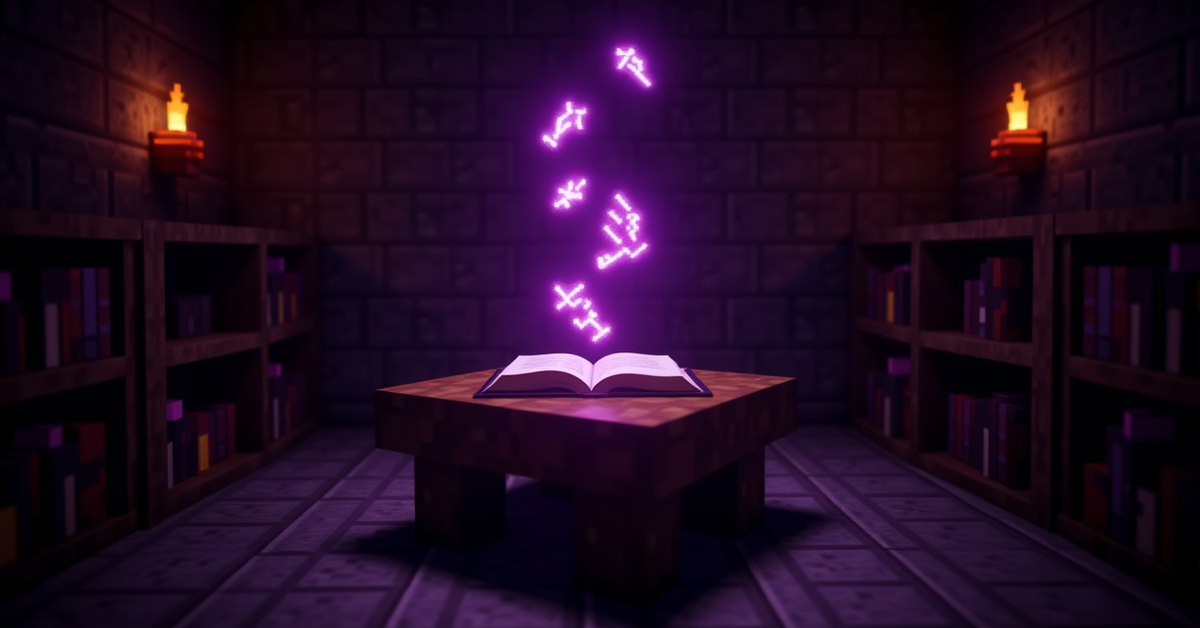
Open the table and place an item in the left slot. You also need lapis lazuli in the second slot. Three options appear on the right, each with a number that shows the experience level you need to use it. The exact enchantments are partly hidden: you see one enchantment name (often in an unreadable runic font) and a hint, but you will not know the full result until you commit.
That hidden part is the point. Enchanting is random within limits. A higher option pulls from a stronger pool and usually gives better or multiple enchantments, but you do not get to pick the exact outcome at the table. If you want precise control, enchanted books and an anvil are the answer, which the next sections cover.
Lapis lazuli and level costs
Each of the three options costs lapis lazuli equal to its position: one lapis for the top option, two for the middle, three for the bottom. The table consumes that lapis when you enchant.
The experience cost works the same way by position. The top option spends one level, the middle spends two, and the bottom spends three. So a single enchant never drains more than three levels, even when the option demands that you reach level 30 first.
Why the level you see isn’t the level you spend
This trips up a lot of new players. The big green number on each option is the level you must have, not the level you lose. To unlock the strongest bottom-row option you need level 30, but enchanting it only takes three levels off your total. You keep the rest.
Because of this, there is no reason to enchant at level 4 when a short wait gets you to 30. The higher your level when you open the table, the better the options, and the actual spend stays tiny. Save up to 30, then enchant.
Bookshelves and stronger enchantments
Bookshelves raise the level cap of the options the table offers. With no shelves, the best option tops out low. Surround the table correctly and the options climb to 30, where the best enchantments live.
Fifteen bookshelves is the maximum the table reads. Place them one block away from the table, leaving a one-block air gap between the shelf and the table on every side. They sit in a square ring around the table, at the same height as the table or one block higher. If you put a shelf right up against the table, or block the gap with a torch or a slab, it stops counting. A common setup is a 5 by 5 floor with the table in the center and shelves lining the edge.
Crafting a bookshelf takes six wooden planks and three books, and each book takes three paper and one piece of leather. Paper comes from sugar cane, so a sugar cane farm and a few cows make the shelves affordable in bulk.
Material enchantability
Different materials take to enchanting differently. Each one has an enchantability value that affects how good the rolls tend to be. Gold has the highest enchantability of the common tool and armor materials, so a golden pickaxe or golden armor often pulls strong enchantments at the table.
The catch is durability. Gold gear breaks fast, so enchanting it directly is usually a waste of a good result. The smarter move is to enchant a book on cheap material logic, or to enchant the gear you actually plan to use and accept slightly lower odds. Diamond and netherite have lower enchantability than gold but last long enough to be worth it. Books also enchant well, which is part of why the book route is so popular.
Enchanted books and the anvil
You can enchant a book at the table just like a tool. The result is an enchanted book holding one or more enchantments. On its own a book does nothing, but combined with an item on an anvil, it transfers its enchantment to that item.
The anvil is where control happens. Put your tool in the left slot and an enchanted book in the right slot, and the anvil shows the combined result and its level cost. This lets you choose exactly which enchantments go on which gear, instead of gambling at the table. You can also combine two of the same item, or two enchanted books, to merge their enchantments.
Anvils cost experience and take damage with use, so they wear out and eventually break. Every time an item is worked on an anvil it gains a “prior work penalty” that makes the next combine more expensive. In Java Edition, once a combine would cost 40 levels or more, the anvil shows “Too Expensive” and refuses the job in survival. Plan your order of operations so the expensive merges happen while the penalty is still low.
Other ways to get enchantments
The table is not the only path. Librarian villagers sell enchanted books for emeralds, and a librarian with the right trade can supply specific enchantments like Mending without any luck at the table. Resetting a librarian’s job site block before its first trade locks lets you fish for the enchantment you want.
Fishing can hook enchanted books and enchanted gear, though the odds improve with Luck of the Sea. Chest loot in structures, raid drops, and piglin bartering also turn up enchanted items and books. If the table keeps refusing to give you a particular enchantment, one of these sources usually has it.
To remove an enchantment, use a grindstone. It strips enchantments off an item and returns a little experience, which is handy for cleaning up a piece you got from loot or for recovering XP from gear you no longer want. Curses are the exception: a grindstone will not remove them.
Treasure enchantments and curses
Some enchantments never appear at the table at all. These are called treasure enchantments, and you can only get them from trading, fishing, or loot. The list includes Mending, Frost Walker, Soul Speed, Swift Sneak, and the two curses. Mending is the one most players hunt for, since it repairs gear using experience and keeps a favorite tool alive almost forever.
Curses are negative enchantments. Curse of Binding stops you from taking a piece of armor off once you put it on, until the armor breaks or you die. Curse of Vanishing destroys the item when you die instead of dropping it. Both can show up on loot, so check enchanted gear before you equip it.
Tips and common mistakes
Reach level 30 before enchanting, since the spend is the same handful of levels either way and the results are far better. Keep a stack of lapis lazuli on hand so you are never stuck mid-session. Build your bookshelf ring with the air gap correct on the first try, because a blocked gap silently caps your options and is easy to miss.
For gear you care about, enchant a book and apply it with an anvil rather than enchanting the item directly. That way a bad roll only costs a book, not your diamond armor. And do the math on anvil order: merge your books and cheaper combines first so the prior work penalty does not push your final piece over the cost limit.
Java vs Bedrock differences
The core loop is the same in both editions: table, lapis, levels, bookshelves, anvil. The main difference is the anvil cost limit. Java Edition blocks any survival combine that would cost 40 levels or more with “Too Expensive,” while Bedrock Edition does not enforce that cap the same way, so very expensive combines are still possible there. The randomness behind the three table options also uses a seed that behaves a little differently between editions, but for everyday play the experience is close enough that the same strategy works on both.
Frequently asked questions
How many bookshelves do I need for level 30?
Fifteen, placed one block away from the table with an air gap on each side. More than fifteen makes no difference, since the table only reads up to fifteen.
Why are my enchant options so low?
Either you have no bookshelves, or something is blocking the air gap between a shelf and the table. A torch, slab, or extra block in the gap stops a shelf from counting. Clear the gaps and the options should climb.
Does enchanting cost the full displayed level?
No. The number shown is the level you need to have, not the amount you lose. The top, middle, and bottom options spend one, two, and three levels respectively, plus the matching lapis.
Can I get Mending from the enchanting table?
No. Mending is a treasure enchantment, so it only comes from villager trades, fishing, or chest loot. Librarian trading is the most reliable way to get it.
How do I remove an enchantment?
Use a grindstone. It strips most enchantments and gives back a little experience. It will not remove curses, though.
Why does my anvil say “Too Expensive”?
In Java Edition survival, any combine that would cost 40 levels or more is blocked. This usually happens after an item has been worked several times and built up a prior work penalty. Use a fresh item or merge in a different order.
Where to go next
Once your table and bookshelf ring are set, the real progress comes from picking which enchantments matter for your playstyle and chasing those through books and trades. A librarian villager who sells Mending is worth more than a dozen lucky table rolls, so it is often the next thing to set up after the table itself.