What hunger and saturation are
Hunger is the row of drumsticks above your hotbar. It drops as you do things, and when it runs low you stop healing, then stop sprinting, and eventually take starvation damage. Eating food fills it back up.
Saturation is a second value you never see. It sits hidden behind the hunger bar and works like a fuel reserve: it drains first, before any drumsticks come off, and it controls how fast you heal. Two foods can restore the same number of drumsticks but leave you full for very different lengths of time, and saturation is the reason why.
Once you understand how the two work together, you can pick foods that keep you fed and healing for far longer, which matters on long mining trips and during fights.
How the hunger bar works
The hunger bar holds 10 drumsticks, and each drumstick is worth 2 food points, so a full bar is 20 points. Most foods are measured in those half-drumstick steps. Bread restores 5 points (two and a half drumsticks), and a cooked steak restores 8 points (four drumsticks).
Your hunger level controls three things. At 18 points or higher (9 drumsticks), your health slowly regenerates on its own. At 6 points or lower (3 drumsticks), you can no longer sprint. At 0 points, you start taking starvation damage.
You normally can’t eat when the bar is already full. A few items ignore that rule and can be eaten at any time: golden apples, enchanted golden apples, milk buckets, honey bottles, suspicious stew, dried kelp, and chorus fruit. Everything else waits until you’ve lost at least half a drumstick.
Saturation: the hidden buffer
Every food gives you saturation on top of the drumsticks it restores. Saturation can never rise above your current hunger level, so it tops out at 20 when your bar is full. As long as saturation is above zero, your hunger bar will not drop at all. Only after saturation hits zero do the drumsticks start coming off.
The amount of saturation a food gives depends on a hidden quality rating, not just its drumstick value. The game multiplies the food’s points by that rating, then doubles it, and caps the result at your current hunger. That’s why a golden carrot and a piece of bread feel so different even though their drumstick counts are close.
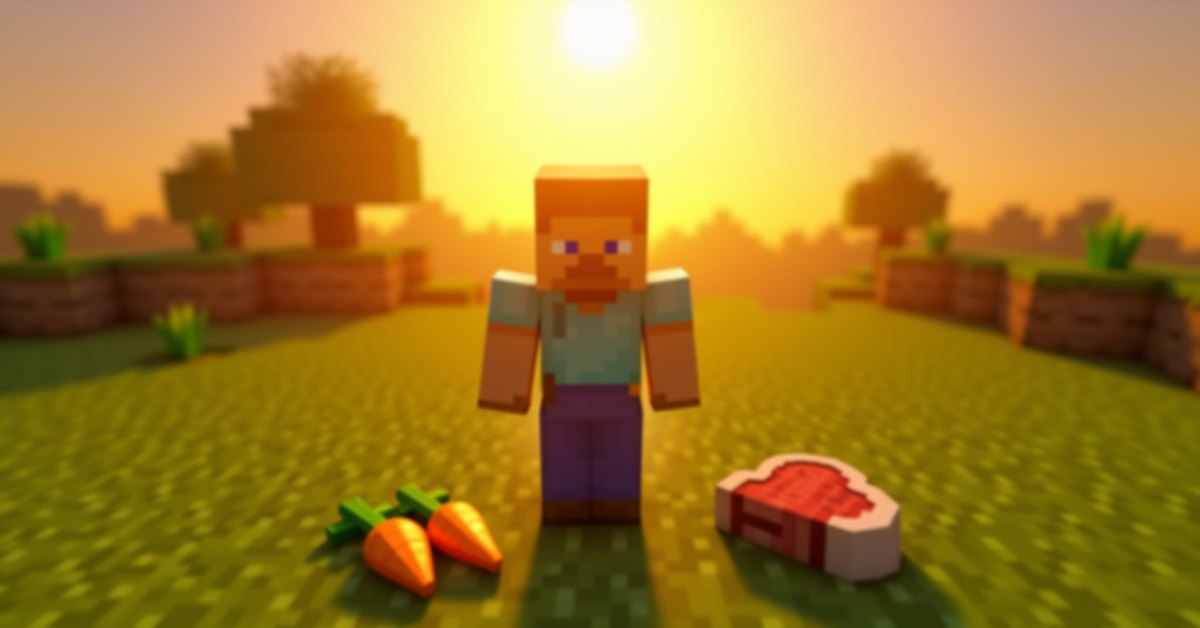
A golden carrot restores 6 points of hunger but a full 14.4 saturation. Bread restores 5 points of hunger but only 6 saturation. Same general size on the bar, more than double the staying power from the carrot.
Exhaustion: what actually drains you
You don’t lose hunger or saturation directly from a timer. You lose it through exhaustion, a third hidden value that climbs as you move and act. When exhaustion reaches 4.0, the game resets it and removes 1 point of saturation. If saturation is already at zero, it removes 1 point of hunger instead.
Different actions add different amounts of exhaustion. The numbers below are for Java Edition.
| Action | Exhaustion added |
|---|---|
| Sprinting | 0.1 per block traveled |
| Swimming | 0.01 per block |
| Jumping | 0.05 per jump |
| Sprint-jumping | 0.2 per jump |
| Attacking or taking damage | 0.1 each |
| Breaking a block | 0.005 each |
| Regenerating 1 health | 6.0 |
Plain walking and sneaking add nothing. The big cost is healing itself. Every half-heart you regenerate burns 6.0 exhaustion, which is more than a full reset cycle, so recovering health is by far the fastest way to empty your food bar. This is the core trade in Minecraft survival: food isn’t really fuel for walking around, it’s fuel for staying alive.
Health regeneration and starvation
When your hunger is 18 points or higher, you heal at a steady, slow pace, roughly half a heart every few seconds. When your hunger bar is completely full and you still have saturation left over, you heal much faster, about half a heart every half second. That fast healing is what high-saturation foods like steak and golden carrots buy you, and it’s the difference between surviving a creeper blast and not.
At the other end, an empty hunger bar means starvation. On Easy difficulty, starvation stops at 5 hearts. On Normal, it drops you to half a heart. On Hard, it can kill you outright. On Peaceful, the hunger bar refills on its own and you never starve, so food only matters there for items that need it.
Best foods for hunger and saturation
If you only carry one food for long trips, make it golden carrots or cooked steak. Both give high saturation, which means fewer stops to eat and faster healing. The table below lists common foods by how much hunger and saturation each one restores.
| Food | Hunger restored | Saturation |
|---|---|---|
| Golden carrot | 6 | 14.4 |
| Cooked steak or porkchop | 8 | 12.8 |
| Cooked mutton | 6 | 9.6 |
| Cooked salmon | 6 | 9.6 |
| Cooked chicken | 6 | 7.2 |
| Bread | 5 | 6.0 |
| Baked potato | 5 | 6.0 |
| Apple | 4 | 2.4 |
| Melon slice | 2 | 1.2 |
| Cookie | 2 | 0.4 |
| Rotten flesh | 4 | 0.8 |
Golden carrots win on saturation, but they cost gold and carrots, so most players use them for combat and long expeditions and fall back on steak or bread for everyday eating. Cookies and melon slices barely register on saturation, which makes them poor travel food even though they stack well.
Tips and common mistakes
Eat before your bar drops below 18, not after. If you let hunger fall under 9 drumsticks, natural healing shuts off, and that’s usually the worst time to discover you’re out of food. Topping up early keeps the slow regen running.
Don’t sprint everywhere out of habit. Sprinting is ten times more draining than swimming per block and adds up fast on long overland trips. Sprint-jumping looks efficient but is the single most expensive way to travel.
Carry a stack of cheap food and a few high-saturation foods. Bread or baked potatoes handle routine topping up, while a handful of golden carrots or steaks gives you the fast healing you want in a fight. Eating a low-saturation food on a near-full bar wastes most of its saturation, since saturation can’t climb above your hunger level.
Watch out for rotten flesh. It fills 4 points of hunger but has an 80% chance to give you the Hunger effect, which speeds up exhaustion and drains the bar faster than the flesh restored. It works in a pinch, but it’s a last resort.
Status effects that change hunger
A few status effects touch this system directly. The Hunger effect, which you get from rotten flesh, raw pufferfish, and some other sources, raises your exhaustion rate so the bar drains faster while it lasts. It doesn’t take food off the bar by itself; it just makes everything you do cost more. A glass of milk clears it.
The Saturation effect works the opposite way and refills both hunger and saturation every tick while it’s active. You normally only run into it from a lucky suspicious stew made with a specific flower, so it’s rare, but it’s the one effect that fills the hidden buffer straight to the cap.
Regeneration from a potion or a beacon heals you without touching the food rules, but the healing still charges exhaustion the same way natural regen does. Drinking a Regeneration potion in a fight will chew through your food bar quickly, so keep something to eat on hand when you do.
Java and Bedrock differences
The core system is the same on both: hidden saturation drains before visible hunger, exhaustion drives the loss, and the 18-point and 6-point thresholds for healing and sprinting hold across editions. The food values in the tables above match both versions.
The main practical difference is in fine timing. Some exhaustion and regeneration rates differ slightly between Java and Bedrock, so the exact seconds-per-heart can feel a touch different, but the strategy doesn’t change. High-saturation food still heals faster and lasts longer on either platform.
Frequently asked questions
Does saturation show up anywhere on screen?
No. Saturation is fully hidden. The only clue is behavior: if your hunger bar isn’t dropping even while you move, you still have saturation left.
Why does my hunger bar drop so fast sometimes?
Almost always because you’re healing. Regenerating health costs 6.0 exhaustion per half-heart, far more than moving around, so taking damage and healing back up burns through food quickly.
What’s the best food in Minecraft?
Golden carrots give the most saturation of any normal food, which makes them the best choice for long trips and fights. Cooked steak is a close second and much cheaper to stock.
Can I eat when my hunger bar is full?
Usually no. A short list of items can be eaten anytime, including golden apples, milk buckets, honey bottles, suspicious stew, dried kelp, and chorus fruit. Regular food waits until you’ve lost at least half a drumstick.
At what hunger level can’t I sprint?
Sprinting shuts off when your hunger drops to 6 points (3 drumsticks) or lower. Eat back above that line to sprint again.
Do I lose hunger on Peaceful?
The bar can still tick down, but it refills on its own and you never take starvation damage. Health also regenerates regardless of food level on Peaceful.
The short version
Treat saturation, not the visible bar, as your real fuel gauge. High-saturation foods like golden carrots and steak keep that hidden reserve full, which means fewer meals and much faster healing when it counts. Carry cheap food for routine topping up and save the good stuff for the moments you’re actually taking hits.