What a jukebox does in Minecraft
A jukebox is the block that plays music discs. Drop a disc into it, the song plays once, and you get the disc back when you eject it. That is the whole job. It is the only vanilla way to hear a music disc on demand without using commands.
It also shows up indirectly in a lot of other systems. Parrots dance to it. Comparators read it. The game pauses your normal background music while a disc is playing. So while the block looks like a side decoration, it is wired into more parts of Minecraft than most utility blocks.
How to craft a jukebox
The recipe is one of the simpler diamond recipes in the game: eight wood planks around one diamond on a crafting table.
- 8 wood planks (any type)
- 1 diamond in the center slot
The output is one jukebox. The wood type sets the color of the block, but the function is identical no matter which planks you use. The diamond is consumed when you craft the block, and you do not get it back when you break the jukebox later.
Jukeboxes can also generate in some woodland mansion rooms, so it is occasionally possible to pick one up in the wild without paying the diamond cost. Most players still craft their own because the wild copies are rare and the recipe is cheap once you have a single diamond.
How to use a jukebox
Place the jukebox like any other block. Then, with a music disc in your hand, right-click on the top face of the block (or use the “use” button on Bedrock).
Three things happen when a disc goes in:
- The disc enters the jukebox and the block visually updates to show the disc on top.
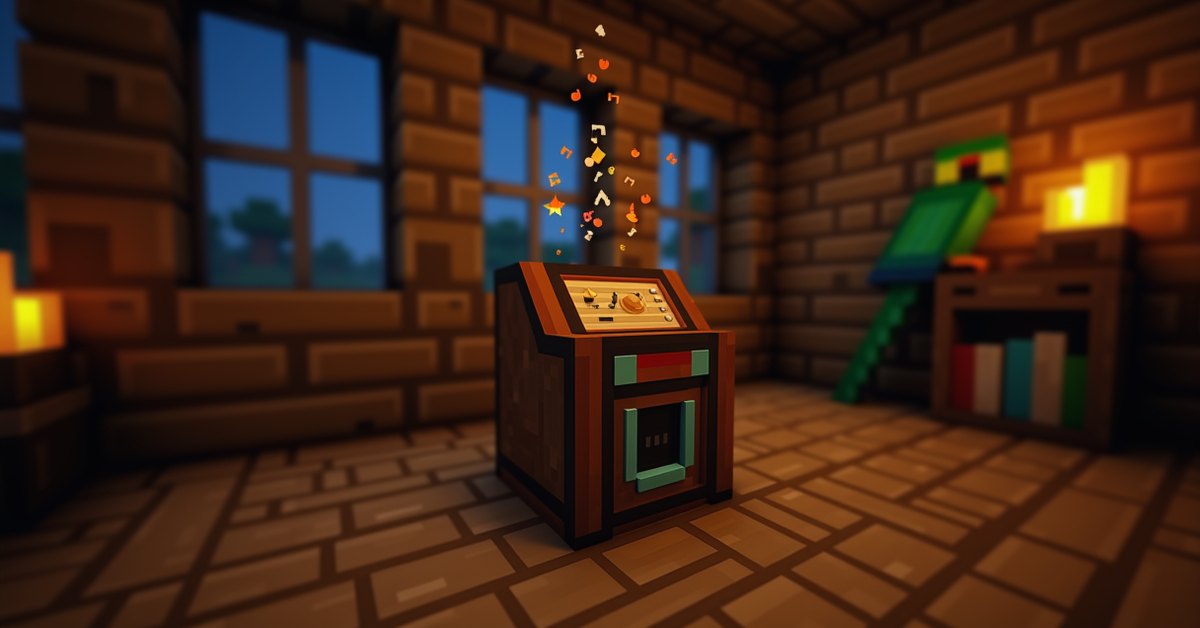
- The song plays from the start, with note particles drifting up out of the block while the song runs.
- Your normal background music stops so the disc has the audio space to itself.
The song plays exactly once. After it ends, the disc stays inside the block and the jukebox sits silent. To hear the song again, you have to eject the disc and put it back in.
Getting the disc back out
There are two ways to retrieve a disc. You can right-click the jukebox with an empty hand, which pops the disc out as an item, or you can break the block, which drops both the jukebox and the disc.
Breaking the jukebox does not destroy the disc. Music discs are hard to lose in vanilla survival; the game treats them as recoverable items, and a quiet pickup is usually all it takes to get the disc back.
Mechanics and behavior
Range and audio
You can hear the music from a wide area around the block, but the sound still gets quieter the further you walk. The audible range is large enough that one jukebox covers a normal-sized base. If you want music throughout a larger build, you will need more than one block.
Parrots dance
In Java Edition, tamed parrots within a few blocks of an active jukebox bob and dance to the music. The effect stops when the disc ends or when the parrot moves out of range. Bedrock Edition has the same general behavior, though the exact dance distance can vary slightly between versions.
Note particles
A playing jukebox emits small colored music-note particles from its top face. The particles are only visible, not functional. They are a quick way to confirm at a glance that a disc is running, which is handy when you are checking a redstone setup.
Comparator output
Place a redstone comparator one block out from the jukebox, with the comparator’s input arrow pointing away from the jukebox. While a disc is playing, the comparator outputs a redstone signal whose strength depends on which disc is loaded. Every disc gives a different number, and the values run from 1 up to 15.
This is how nearly every disc-detector contraption works. You feed the comparator output into a circuit that does something different depending on which song is playing, or just into a lamp to confirm the jukebox is active. The signal stops the moment the song ends, which makes the comparator a clean “currently playing” sensor.
Music discs you can play
Jukeboxes accept any music disc in the game. The list has grown across several updates, so the exact set of discs depends on your version. The main categories are:
- The original tracks (including 13, cat, blocks, chirp, far, mall, mellohi, stal, strad, ward, 11, and wait), most of which drop when a skeleton or stray kills a creeper.
- Structure-tied discs, such as pigstep from bastion remnants, otherside from stronghold corridor chests, and 5 from ancient cities.
- Trial Chambers discs introduced in the 1.21 update, which drop from chests inside the chambers.
The “creeper shot by a skeleton” method is the only renewable source for most of the older discs, and it is how players actually farm them. The usual setup is a controlled spot where a skeleton can shoot a creeper without the player intervening. When the creeper dies to the skeleton’s arrow, it has a chance to drop one of the music discs.
Tips and common mistakes
A jukebox holds exactly one disc at a time, so there is no way to queue songs by clicking faster. If a disc is already loaded, right-clicking the block with another disc in hand does nothing; you have to eject the current disc first.
The song does not loop on its own. If you want continuous music, the usual trick is a small redstone clock that ejects and re-inserts the disc, or several jukeboxes running with offset start times.
The block is wooden-tier, so any tool will break it, but an axe is fastest. Discs survive explosions and fire and drop as items when the block breaks. They still follow the normal five-minute item despawn timer, so pick them up quickly if nobody is around.
Java vs. Bedrock differences
The core function is the same on both editions: place the block, insert a disc, the song plays. Parrot dancing tends to look a little more consistent on Java Edition, while Bedrock parrots dance reliably but with slight version-to-version differences. Both editions output a redstone signal through a comparator, and the disc-to-signal-strength mapping has lined up across recent versions, though older Bedrock builds may differ for the very newest discs. New disc additions usually arrive on both editions within the same update cycle, with Bedrock occasionally getting them in a hotfix shortly after.
Frequently asked questions
Do you need a diamond to craft a jukebox?
Yes. One diamond goes in the center of the crafting grid surrounded by eight wood planks. The diamond is consumed when you craft the block, and you do not get it back when you break the jukebox later.
How long does a music disc play?
Each disc has its own length. The shorter tracks like 13 run under two minutes, while longer tracks such as pigstep, otherside, and the newer Trial Chambers discs can run for several minutes. The song plays through once and stops; the jukebox does not loop.
Can a jukebox power redstone directly?
No. A jukebox does not emit a redstone signal on its own. To detect when one is playing, place a comparator next to it. The comparator reads the jukebox and outputs a signal whose strength depends on the current disc.
Can I stack music discs on the same jukebox?
No. A jukebox holds one disc at a time. You have to eject the current disc before another one can be inserted. Right-clicking with a disc in hand while one is already loaded does nothing.
What is the easiest disc to get?
Disc 13 and cat are the most common drops from the skeleton-kills-creeper method, so most early-game players hear one of those first. They tend to drop within a few attempts at a small mob farm where a skeleton can target creepers.
Do jukeboxes work in the Nether and the End?
Yes. A jukebox functions the same in any dimension. The block does not require sky access, light, or any specific biome to play a disc.
Can a jukebox silence ambient game music?
Sort of. Starting a disc on a jukebox pauses your normal background music for that disc’s duration. Once the disc ends, the regular game music can resume. It is not a permanent mute, but some builders use a constantly cycling jukebox to keep certain in-game tracks suppressed.
Worth keeping one in every base
A jukebox is cheap once you have a single diamond, and the comparator hookup makes it useful for more than music. A small disc collection plus a jukebox by your front door is a fast way to make a base feel like yours, and a couple of redstone builds (lit floor panels that change with the song, hidden disc-detector doors) make the block worth the trip back to your storage room.