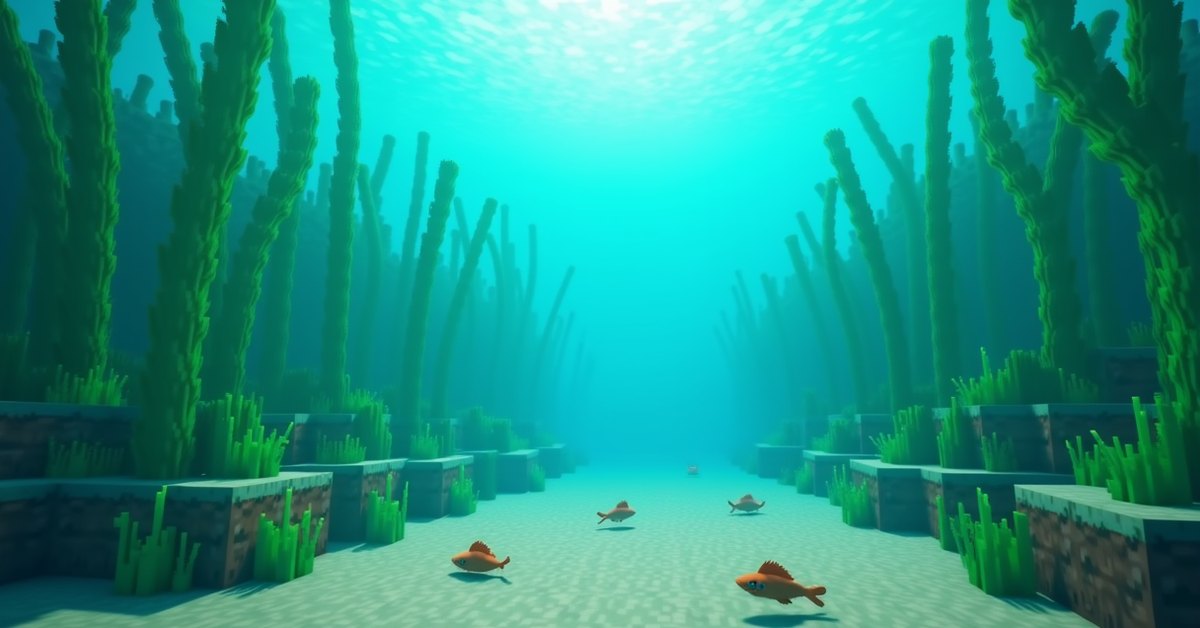
What kelp is and where it grows
Kelp is the tall green plant that grows in straight columns in most of Minecraft’s oceans. You’ll see it swaying in cold, lukewarm, and regular ocean biomes, sometimes in dense forests that stretch from the seabed close to the surface.
It looks decorative, but kelp does real work. It cooks into dried kelp for a fast snack, packs into a furnace fuel that beats most wood options, and grows on its own fast enough to power a hands-off food and fuel setup. If you’ve ever drowned grabbing a few stalks, this guide covers where to find kelp, how to harvest it, how to grow it, and what to do with the result.
Kelp generates naturally in normal, cold, lukewarm, and deep ocean variants. It does not generate in warm oceans, which feature coral and sea pickles instead, or in frozen oceans, which are too cold for plant life. Look for tall green stalks rising from sand, dirt, gravel, clay, or stone on the ocean floor. A single stalk can grow up to 26 blocks tall, and they often appear in clusters that form underwater forests.
River biomes do not generate kelp naturally, but kelp will survive and grow if you transplant it there yourself. To spot kelp quickly from the surface, swim out over an ocean and look down for dark green patches against the lighter sand. The taller a stalk grows, the closer the top sits to the surface, so it’s easier to spot from above.
How to harvest kelp
Breaking kelp is fast. You don’t need a tool. Any block of kelp you break drops itself as an item, with no special enchantment required. A sword speeds the break slightly and takes no durability against plants.
A few practical notes for harvesting:
Drink a water-breathing potion before a long harvest run so you can focus on collecting instead of surfacing for air. A turtle shell helmet adds ten seconds of underwater breathing on top of that, and Respiration on any helmet stretches your air supply further.
Breaking the bottom block of a kelp stalk causes the whole column above it to break and drop as items. That’s the fastest way to clear a kelp forest: aim low and work along the floor.
Kelp also breaks when flowing water washes over a planted stalk, which means you can build a redstone-controlled flush system that harvests automatically. More on that below.
How kelp grows
A kelp plant grows from the bottom up. The plant has two states: a growing tip at the top of the stalk, and aged segments below the tip that stop growing once a new tip forms above them.
Growth requires a water source block directly above the top of the stalk. As long as that condition holds, the tip has roughly a 14% chance to grow one block taller per random tick. In practice, a kelp stalk gains about one block every one to two minutes of real time, depending on the chunk’s random tick speed.
Kelp grows to a maximum of 25 blocks above the bottom planted block, for a 26-block stalk total. Once it hits the limit, the top ages and stops growing.
Bone meal works on kelp. One bone meal applied to a kelp tip adds one segment immediately. It’s slower per bone meal than wheat or carrots, but it’s a reliable way to top up a stalk when you want a fast harvest.
What kelp will grow on
Plant kelp on any of these blocks underwater: dirt, coarse dirt, rooted dirt, podzol, mycelium, mud, sand, red sand, gravel, clay, stone, andesite, diorite, granite, deepslate, or any of their polished or cobbled variants. It will not plant on netherrack, end stone, or wood blocks.
If you’re building a farm away from an ocean, dirt and stone both work fine and are easy to source.
Dried kelp and dried kelp blocks
Smelting a kelp item in a furnace gives one dried kelp. Dried kelp is a snack food: it restores 1 hunger point (half a drumstick) and 0.6 saturation. The standout feature is eating speed. Dried kelp eats in about 0.865 seconds, faster than any other food in the game. That makes it useful in combat as an emergency top-up when you don’t want to stand still chewing a steak.
Nine dried kelp craft into one dried kelp block. The block has two jobs.
First, it’s compact storage. One stack of 64 blocks equals 576 dried kelp.
Second, it’s furnace fuel, and an efficient one. A single dried kelp block burns for 200 seconds and smelts 20 items, averaging 2.5 items per dried kelp inside the block. Since kelp regrows on its own, dried kelp blocks become a renewable fuel source once a farm is running.
Building an automatic kelp farm
The standard kelp farm uses growth detection and water flow to harvest stalks without player input. The simplest version looks like this:
Plant a row of kelp on the ocean floor or in a controlled water column. Above each stalk, set an observer pointing at the kelp tip. Wire the observers to a dispenser that places a water source over the kelp, breaking the column and washing the drops into a hopper line.
When a stalk grows one block, the observer fires and triggers the harvest. The plant resets to its short state and starts growing again. The farm produces a steady trickle of kelp with no input, and the output stacks into chests via the hoppers.
Most players pair the farm with a row of about six furnaces, fed by harvested kelp on the input side and producing dried kelp on the output side. The first batch bootstraps the system, and from there the farm runs on its own output: kelp comes in, dried kelp goes out, and some of it gets crafted into blocks for fuel and storage.
Other uses for kelp
Kelp slots into a handful of other roles.
Composting: kelp adds a layer to a composter with a 30% chance per piece. It’s not the most efficient input, but a kelp farm produces enough surplus to keep a bone meal pipeline alive.
Decoration: a kelp stalk planted in a fish tank or a player-made pond reads as a real, living plant. Pair it with sea pickles and a tropical fish or two for a quick aquarium build.
Trading: kelp is not part of any villager trade in either edition, so don’t expect to sell it for emeralds.
Java and Bedrock differences
Kelp behaves almost identically across editions, but a few things are worth flagging.
Growth probability is the same in both versions, so a farm sized for Java performs about the same in Bedrock. Bone meal acceleration works in both.
Observer timing is slightly different between editions, so a redstone contraption tuned tight in one version may need a one-tick adjustment in the other. For a standard observer-and-flush kelp farm, that rarely matters.
In Bedrock, dried kelp’s eating animation runs a hair slower than in Java, but it’s still the fastest food to eat in the game.
Tips and common mistakes
A few things that trip players up.
Don’t try to plant kelp on wood, netherrack, or end stone. Use dirt or stone.
Kelp in a flowing water current detaches and drops as an item. If you’re building corridors of flowing water near a kelp stalk, you’ll lose the plant. Use only source water blocks inside the kelp column itself.
Kelp will grow upward only if the block above the tip is a water source. Place a non-water block on top and the stalk just sits there: no error, no item drop, no growth.
Dried kelp stacks like normal food in your hotbar. Carry a stack as an emergency snack on long mining trips. It’s cheap, it eats fast, and it fills the gap when you’re at half hunger.
When farming kelp in tight spaces, remember that pistons can push and break kelp the same way as flowing water. A pushing piston is a clean alternative to a dispenser flush if you’ve got the redstone for it.
Frequently asked questions
Can you eat kelp without drying it?
No. Raw kelp has no eat action. Smelt it into dried kelp first, then it counts as food.
How long does kelp take to grow naturally?
Roughly one block every one to two minutes of real time, depending on the chunk’s random tick speed. Use bone meal for instant growth.
Does kelp work as fuel without crafting it into blocks?
A single dried kelp item burns for 4 seconds and smelts about half an item, which isn’t useful on its own. Dried kelp blocks are the form you want for fuel.
Will kelp grow in a vertical column of water I built myself?
Yes. As long as every block in the column is a water source and the base is a valid block like dirt, sand, or stone, kelp grows the same way it does in the ocean.
Does kelp need light to grow?
No. Kelp grows in any light level, including total darkness. It only needs water and a valid base block.
Can I farm kelp in the Nether?
No. Water evaporates when placed in the Nether, so kelp has nowhere to live. Build kelp farms in the Overworld.
Do mobs damage kelp?
No mob breaks kelp blocks. Kelp only breaks from player action, flowing water, or piston pushes.
A starter kelp farm is one of the cheapest auto-fuel sources in the game. If you’ve got an ocean nearby and an afternoon free, a ten-stalk version with a small furnace array will keep your furnaces running for the rest of the playthrough.