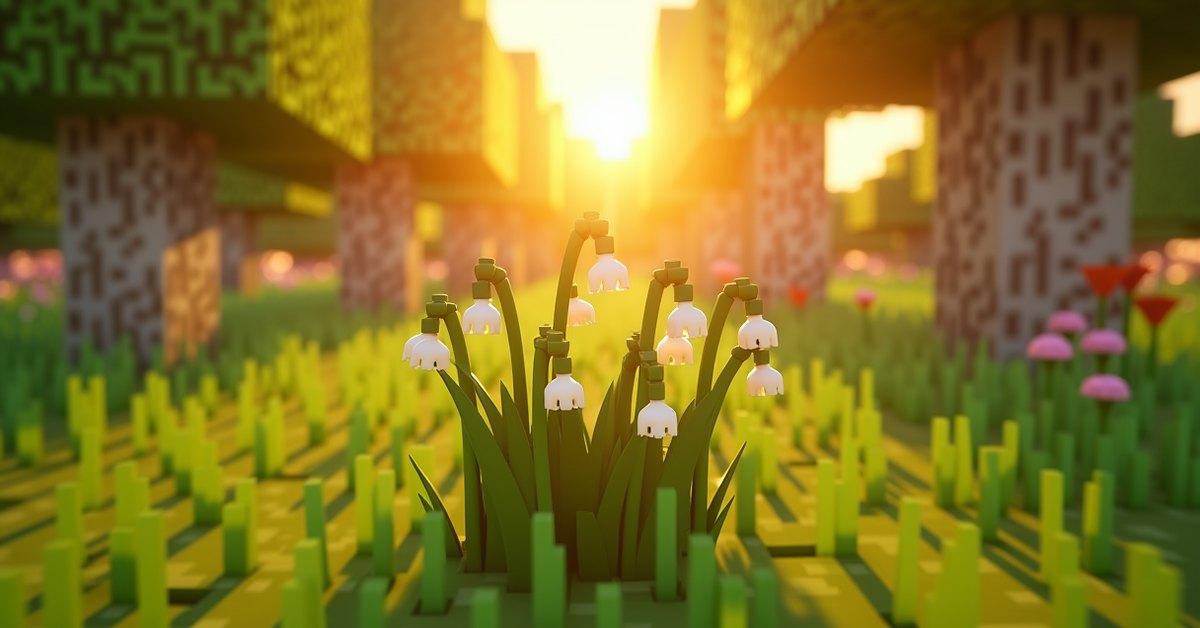
Lily of the valley is one of the rarer small flowers in Minecraft. It’s a single block-tall plant with a thin green stem and bell-shaped white blooms, and it only spawns naturally in one biome. If you’ve come across it in the wild, you’ve likely also noticed how few crafting recipes it shows up in compared to other flowers.
The short answer: lily of the valley makes white dye, can be placed in a flower pot, and pulls double duty as the “watch out” ingredient in suspicious stew. Eat a stew made with it and you’ll take poison damage. That’s the whole kit. The rarity is what makes it interesting, not a long list of uses.
What is lily of the valley?
Lily of the valley is a small flower added to Minecraft in version 1.14, the Village and Pillage update. Like other small flowers, it occupies a single block, breaks instantly by hand, and drops itself when broken. Its in-game appearance is based on the real-world flower of the same name, which has the same bell-shaped white blooms. The real plant is poisonous to humans and pets, and the game leans on that fact for one of its crafting uses.
The block ID is minecraft:lily_of_the_valley. It counts as a small flower along with poppies, dandelions, and the other one-block plants, not as a tall flower (the two-block kinds like sunflowers and lilacs).
Where to find lily of the valley
Lily of the valley spawns naturally in the Flower Forest biome. That’s the main place to look. Flower Forest is a relatively rare biome variant of the standard birch forest, packed with mixed flower types instead of plain grass. If you’re searching for one specific flower in survival, Flower Forest is almost always the answer, and lily of the valley is no exception.
You won’t find lily of the valley spawning in plains, regular forests, sunflower plains, or other flower-heavy biomes. The flower forest is the only natural source for getting it the slow way.
If you can’t locate a Flower Forest near your base, the /locate biome minecraft:flower_forest command works in worlds with cheats enabled and points you to the nearest one. The coordinates it returns can sometimes be a long ride or boat trip away, so plan for that.
How to get lily of the valley
You have two practical ways to collect lilies of the valley in survival.
Break what’s already there
The most direct method: walk through a Flower Forest and break every lily of the valley you see. Each one drops itself. No tool is required, your bare hand works fine, and shears don’t speed it up.
Bone meal grass in a Flower Forest
This is the fastest way to farm lily of the valley in volume. Stand inside a Flower Forest biome with bone meal in hand and use it on grass blocks. The grass spawns tall grass and flowers in the area around it, and any flowers it spawns will be drawn from the biome’s flower pool, which includes lily of the valley alongside alliums, oxeye daisies, cornflowers, and a few other natives.
You can’t bone meal a lily of the valley directly to duplicate it like a sapling. Bone meal does nothing to placed flowers. If you find a single flower in the wild and need more, walk it back to a Flower Forest first.
Trading and chests
Lily of the valley doesn’t appear in standard villager trades or generated chest loot, so the in-world sources above are the only ones. If you play with mods or data packs, all bets are off.
What lily of the valley does
Three things, plus passive decoration.
White dye
Place one lily of the valley anywhere in a crafting grid and you get one white dye. The recipe is shapeless, so the slot doesn’t matter.
That’s the same yield as bone meal, which is white dye’s other source. If you’ve already got a stack of bones from a skeleton farm, you don’t really need lilies for white dye. But if you’re starting out and short on bones, knowing the flower works is useful, and in worlds where you’ve built up a flower farm anyway, the dye is essentially a side product.
Suspicious stew with poison
Lily of the valley is one of the flowers that can be added to suspicious stew. The recipe is one red mushroom, one brown mushroom, one bowl, and one flower of your choice in the crafting grid; the flower determines what status effect the stew applies.
With lily of the valley, the effect is Poison. Eat the stew and you’ll take poison damage for several seconds. Poison can’t kill you on its own (it stops at half a heart), but it does soften you up for whatever else is about to hit you.
This is a niche use, but it has a few real applications. You can leave a stack of poison stews in a chest for an unwary friend to find. You can carry one to quickly apply the poison status to yourself for testing. You can also feed it to a brown mooshroom to milk a Poison-effect suspicious stew straight from the cow: feed the brown mooshroom a lily of the valley first, then milk it with a bowl.
Flower pots and decoration
Lily of the valley can be placed in a flower pot. Use it on a flower pot like any other potted plant. This is the second-most common use beyond dyeing, especially since the white-on-clay look fits the cottage and Nordic build styles a lot of players gravitate toward.
Bees
Bees treat lily of the valley as a normal flower. They’ll fly over to it, hover, and pollinate, then carry pollen back to their nest to top up their honey level. If you’re building a bee farm, it counts as a valid food source for the bees.
Tips and common mistakes
A few things players run into the first time they go looking for lily of the valley.
Don’t confuse it with cornflower or azure bluet. Cornflower is the blue one. Azure bluet is white-and-yellow with a flat top. Lily of the valley is the one with bell-shaped white blooms hanging on a single thin stem.
Don’t bone meal the flower itself. As covered above, bone meal does nothing to a placed flower. Use bone meal on grass blocks inside the Flower Forest if you want to spawn more.
Don’t waste it on dye if bones are easy. Once you have a skeleton farm running, bones give you white dye at scale. Save lilies for stew and decoration, where they can’t be substituted.
Don’t expect to find a single one in a standard birch forest or plains. The naming and the lookalike biomes throw a lot of players off. If your search isn’t landing in a Flower Forest, you’re in the wrong place.
Java vs. Bedrock differences
For lily of the valley specifically, behavior matches across Java and Bedrock: same biome spawning, same dye recipe, same suspicious stew effect, same flower pot compatibility. There aren’t meaningful version-specific quirks worth flagging here. If you’ve played in either edition, what you’ve learned carries over.
Frequently asked questions
Is lily of the valley really poisonous in Minecraft?
Sort of. The flower itself doesn’t poison you when you hold it, break it, or pot it. But suspicious stew brewed with it does. Eating one applies the Poison status effect. The flower’s real-world counterpart is poisonous to humans and animals, and Mojang carried that across into the game’s stew mechanic.
Can you grow lily of the valley with bone meal?
Not directly. Bone meal on the flower does nothing. Bone meal on grass blocks inside the Flower Forest biome will spawn new flowers in the surrounding area, and lily of the valley is one of the possible spawns. Bone meal on grass anywhere else won’t produce it.
What biomes does lily of the valley spawn in?
Just the Flower Forest. It doesn’t generate in plains, sunflower plains, regular forests, swamps, or anywhere else by default.
What does lily of the valley craft into?
One white dye per flower. It’s also a valid ingredient for suspicious stew, where it gives the Poison effect.
Can you put lily of the valley in a flower pot?
Yes. Use the flower on an empty flower pot and it’ll place inside. Use an empty hand on the pot to take it back out.
Do bees pollinate lily of the valley?
Yes. It counts as a normal small flower for bee behavior. Bees will pollinate it and use it to fill their honey level back at the nest.
Is lily of the valley rarer than other flowers?
In terms of biome restrictions, yes. It only spawns in one biome, which itself is uncommon. Once you’re inside a Flower Forest, though, it’s not noticeably rarer than the other flowers that spawn there. Finding the biome is the bottleneck, not finding the flower.
If you’re playing survival and need a lot of them, locking down a Flower Forest base and bone-mealing grass on repeat is far faster than wandering the overworld hoping for a wild patch.