Logs are the raw wood blocks you get from chopping down trees in Minecraft. Almost everything wooden in the game starts here: planks, sticks, tools, doors, fences, beds, signs, boats, banners, ladders, charcoal, and a long list of redstone components all trace back to a log. If you have spent any time in survival, you already know the routine. Spawn in, find a tree, punch wood, and you are off to the next thing.
This guide covers every wood type currently in the game, how logs behave as blocks, how to strip them, how much fuel they give, and the small differences between Java and Bedrock that occasionally trip people up.
What logs are
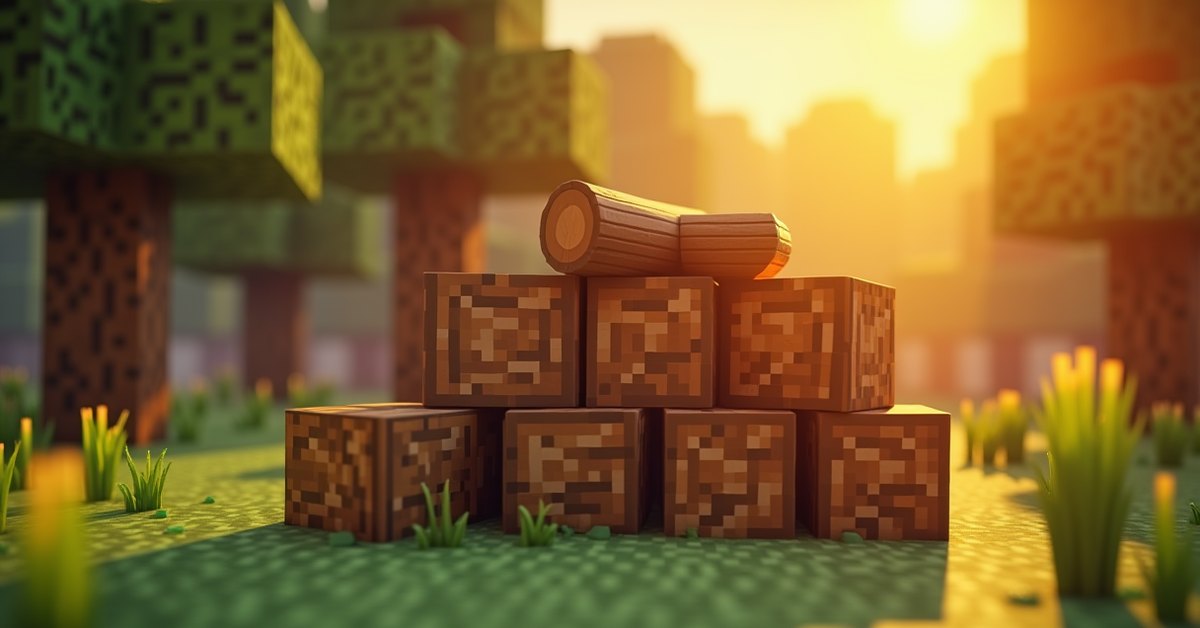
A log is a six-sided block with bark on four sides and a cut end on the other two. The bark and the end-grain are different textures, which is why logs have a clear “up” direction. Logs are an axis-aligned pillar block, so the side you place against decides whether the grain runs vertically (the usual tree look) or horizontally.
Each wood type has its own log block. Mining one always drops itself, whether you use an axe or your bare fist. Axes are faster, though, and there is no Fortune bonus on logs because the drop is already the block itself.
How to get logs
Trees grow on grass and dirt in most overworld biomes. Find one, walk up to it, and either:
- Punch with your hand. Slow, but it works.
- Use an axe. Much faster, and Efficiency speeds it up further.
You get the same log block either way. You do not need a specific tool tier; even a wooden axe chops oak. There is no Fortune effect on logs. Unbreaking helps an axe last longer, and Mending is worth it on a long-term tree axe you plan to keep around.
Once a tree is fully chopped, the leaves decay over a few seconds and may drop saplings (replant), sticks, and for oak or dark oak, the occasional apple.
Wood types in the overworld
As of Minecraft 1.21 the overworld has nine log types, each tied to a tree that grows in specific biomes:
- Oak log: the default tree, found across most temperate biomes. Yellow-brown bark, light-tan planks.
- Birch log: pale, near-white bark with dark stripes. Light blond planks.
- Spruce log: dark brown bark, deep brown planks. Common in taiga biomes.
- Jungle log: medium brown bark, pinkish planks. Jungles only.
- Acacia log: gray bark, orange planks. Savanna only.
- Dark oak log: very dark bark, espresso-brown planks. Found in dark forests.
- Mangrove log: red-brown bark, reddish planks. Mangrove swamps only. Mangrove trees grow from propagules, not from saplings.
- Cherry log: gray bark with pink streaks, pale pink planks. Cherry grove biome.
- Pale oak log: washed-out, near-bone-colored wood from the pale garden biome added in the 1.21 cycle.
As blocks, these are all the same thing in different colors. Same fuel value, same crafting recipes, same orientation behavior. The only real difference is which planks they make, which changes the color of every wooden item you craft from them.
Crimson and warped stems
The Nether has two wood-like blocks: crimson stem and warped stem. They look and act like logs in most ways, but they are called stems, not logs, and they have one important difference: stems do not burn. Lava, fire charges, and flint and steel will not ignite a crimson or warped stem block. That makes them the safest wood to build with in the Nether, and the only sensible choice for a portal-side base.
Stems still craft into planks (crimson planks and warped planks), strip with an axe, and give the same fuel yield as overworld logs. They count as a wood type for most recipes, including fences, doors, signs, stairs, and slabs.
Stripping logs
Right-click a log with any axe to strip the bark off. The block becomes a stripped log: six sides of clean cut-grain texture, no bark. The same works on stems and on bamboo blocks.
Stripping is one-way. You cannot put the bark back. If you want the all-bark look on every face instead of stripped grain, craft a wood block from four logs in a 2×2 square. A wood block has bark on all six sides, which works well for corners and exposed beams where end-grain would look wrong.
Builders use stripped logs constantly because the grain texture reads as pillars, framing, or smooth siding depending on orientation. It is one of the most-used building blocks in any wooden style.
Crafting with logs
A single log placed in any crafting grid produces four planks of the matching wood type. Planks are the foundation of almost every wooden recipe in the game, and from planks you get sticks, which unlocks tool crafting.
Other direct uses for a raw log:
- Smelt a log in a furnace to get charcoal. Charcoal works the same as coal for torches, fuel, and campfires.
- Combine four logs in a 2×2 square to craft a wood block (the all-bark version).
- Most wooden tools, doors, fences, beds, boats, and signs use planks rather than logs directly, so a log usually goes to planks first.
Logs as fuel
Logs burn in a furnace, smoker, or blast furnace for 15 seconds each, which smelts 1.5 items per log. Stripped logs and wood blocks give the same fuel value. So do planks: 1.5 items per plank means 6 items per log if you convert first.
That is why most players turn logs into planks before fueling. You get four times the burn duration out of the same wood. The math is the same on Java and Bedrock.
For early-game smelting, logs and charcoal are the cheapest fuel you can get. Once you have a steady coal supply, save your logs for building.
Placement and orientation
Logs are an axis-aligned block. The orientation depends on which face you click when placing:
- Click the top or bottom of another block: the log stands vertical, end-grain up and down (the natural tree look).
- Click the north or south face: the log lies horizontal along the north-south axis.
- Click the east or west face: horizontal east-west.
Right-clicking a log with an axe does not change its orientation; it strips it. To rotate a placed log, break it and replace it from the side you want.
Logs and fire
Every overworld log type is flammable. Lava, fire charges, flint and steel, and lightning strikes will all ignite a log, and the fire spreads to neighboring flammable blocks. This is why wooden bases near lava lakes go up fast, and why crimson and warped stems are the standard for Nether builds.
Bamboo blocks behave like logs in this respect too. They burn.
Tips and common mistakes
- If you only need a quick handful of planks, punching trees is fine. For anything past the first day, make a wooden axe right away. The speed difference is huge.
- Do not sleep on Efficiency. A Diamond or Netherite axe with Efficiency V chops in a fraction of a second. Add Unbreaking and Mending and you have a tree-clearing tool that lasts forever.
- Fortune does nothing on logs. Save Fortune for diamonds, ancient debris, ores, and crops.
- If you are stripping a stack of 64 logs for a build, do it on the ground first, then place. Stripping in place is fine, but it is slower.
- Mangrove, cherry, and pale oak only grow in their specific biomes. Bring saplings or propagules home if you want a sustainable supply at base.
- Saplings need clear space above them. Oak and birch need a 1-wide column with about 5 blocks of headroom. Spruce, jungle, dark oak, mangrove, and cherry need a 2×2 sapling cluster and more vertical clearance.
Java vs. Bedrock differences
For logs themselves the two editions are essentially the same. Axes strip logs in both. The planks recipe is identical. Fuel values match. Every wood type listed above exists on both editions in 1.21. The small day-to-day differences (tree growth speed, sapling drop rates) are minor enough that most players never run into them.
Frequently asked questions
What is the fastest way to get a lot of logs?
Find a dark forest with huge dark oak trees, or a regular forest with thick oak cover, and chop the trunks from the bottom up. A Diamond or Netherite axe with Efficiency makes short work of the canopy. For a steady supply, build a tree farm with saplings, bone meal, and a piston-based chopping rig.
Do all wood types make the same number of planks?
Yes. One log of any type gives four planks of the matching type. The recipe is identical across all nine overworld woods and both Nether stems.
Can you mine logs without an axe?
You can. Your hand works, it just takes longer. The log drops itself either way. There is no penalty for fist-mining wood the way there is for fist-mining stone or ore.
Can a stripped log be turned back into a regular log?
No. Stripping is permanent. If you want bark on the block again, break the stripped log and craft a wood block from four fresh logs.
Are crimson and warped stems considered logs?
They are wood-type blocks, and they craft into planks the same way, but in the game files they are stems, not logs. They also do not burn, which is the most useful practical difference.
What is the best wood type for building?
That is a taste call. Spruce reads as cabin or modern dark. Birch is light and clean. Cherry gives you a soft pink palette nothing else can match. Oak is the all-rounder. Mangrove is great when you want red tones. The mechanics are the same on every wood, so pick by color.
Why will my sapling not grow?
Most stuck saplings need more space than people give them. Oak and birch want a 1-wide column with about 5 blocks of clear sky. Spruce, jungle, dark oak, mangrove, and cherry want a 2×2 sapling cluster and more headroom. Bone meal helps once the spacing is right.
The wood-type list keeps growing, but the basic flow with logs has not changed since alpha. Chop a tree, strip the log, craft the planks. Plant a sapling for every tree you take down and you will never run out.