Quick overview
Nether bricks are the dark, fire-resistant masonry blocks that make up nether fortresses. They show up the moment you step into the Nether and find one of those imposing red-brown structures stretching across the lava, and they’ve grown into a popular building material once players figure out how to bring them back to the Overworld.
Mechanically, nether bricks are just a block, but they come with a few quirks that catch new players off guard. The fence won’t connect to oak. The block won’t burn. Wither skeletons treat it like home. This guide covers how to make nether bricks, the variants you can craft from them, and what to know before you build with them.
What are nether bricks?
Nether bricks are a stone-tier block introduced alongside nether fortresses in late 2011. They have a hardness of 2 and a blast resistance of 6, so a single creeper explosion at close range won’t level a wall built from them.
You find nether bricks naturally in two places: the walls, floors, and stairs of nether fortresses, and as the surface material of a few small ruined structures scattered through the Nether. Bastions and ancient cities use different blocks (blackstone and deepslate respectively), so if a structure looks dark gray instead of dark purple-brown, you’re looking at something else.
Mining nether bricks requires a pickaxe. A wooden pickaxe works, but stone or better is faster and won’t break as quickly. Mining with anything other than a pickaxe drops nothing.
How to get nether bricks
The fastest way to get nether bricks is to mine them straight out of a fortress. They’re stacked everywhere in those structures, and one fortress can supply enough material for a sizeable build. Just remember a pickaxe.
If you don’t want to live in the Nether, you can make nether bricks from scratch in the Overworld. You only need two ingredients: netherrack and fuel.
Smelting netherrack
Mine a stack of netherrack, bring it home, and smelt it in a furnace. Each piece of netherrack produces one nether brick (the item, not the block). One unit of fuel smelts the usual eight items, so coal or any common fuel works fine.
Netherrack is so common in the Nether that running back for more is rarely an issue. A single mining trip can yield two or three stacks without much effort.
Crafting the block
Place 4 nether brick items in a 2×2 pattern on a crafting grid to produce 1 nether bricks block. The ratio is one-to-one with the building blocks you see in fortresses, so to fill out a full stack of 64 blocks you need 256 nether brick items, which means 256 netherrack to smelt.
This is the slow, expensive part of nether brick builds. If you plan to make a castle or a large keep, mine raw nether bricks out of a fortress first and treat netherrack-smelting as a top-up.
Variants of nether bricks
Three decorative variants exist, all with the same hardness and blast resistance as regular nether bricks. They give the dark palette some variety without changing the underlying behavior of the block.
Red nether bricks
Red nether bricks have a deeper, blood-red color that contrasts well with the regular variant. Craft them by combining 2 nether brick items and 2 nether wart in a checkerboard pattern (nether brick items in opposite corners, nether wart in the other two), which yields 1 red nether bricks block. This is one of the few crafting uses for nether wart outside of brewing.
Red nether bricks were added in version 1.10 as part of the Frostburn Update.
Cracked nether bricks
Cracked nether bricks look weathered and damaged. Smelt a regular nether bricks block in a furnace and you get one cracked nether bricks block out. The texture is great for ruined builds or aged-looking fortress remixes.
Added in version 1.16, the Nether Update.
Chiseled nether bricks
Chiseled nether bricks have a carved pattern with a faint face-like design. Make them by placing 2 nether brick slabs vertically on a crafting grid (one in the middle row, one in the bottom row, in the same column), which yields 1 chiseled nether bricks block. A stonecutter also produces chiseled nether bricks directly from a regular nether bricks block.
Also added in version 1.16.
Building with nether bricks
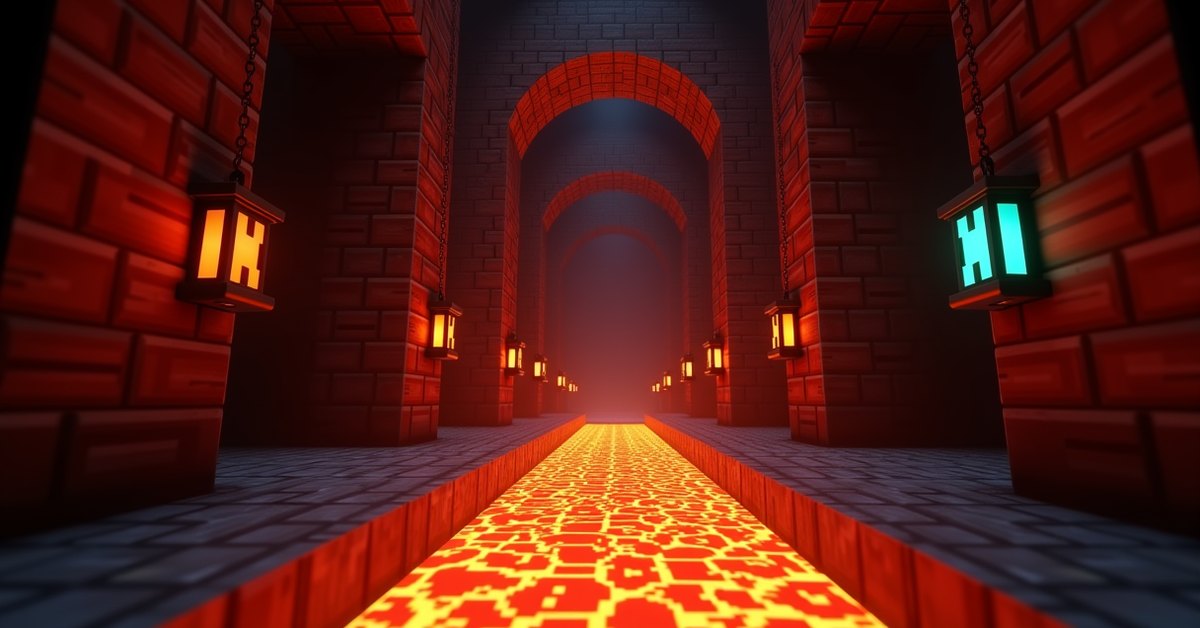
Nether bricks see a lot of use in castles, dungeons, towers, and hellish-themed builds. Their dark color reads well against grass and stone, and the fact that they don’t catch fire makes them safe to use right next to lava streams or fireplaces.
Stairs, slabs, and walls
You can craft the full set of decorative variants from nether bricks blocks:
- Nether brick stairs: 6 nether bricks blocks in a stair pattern yields 4 stairs.
- Nether brick slabs: 3 nether bricks blocks in a horizontal row yields 6 slabs.
- Nether brick walls: 6 nether bricks blocks in a 3×2 pattern yields 6 walls.
A stonecutter is the cleaner option for most of these. It takes one nether bricks block and produces one of any variant (stairs, slab, or wall), trading throughput for storage space.
Nether brick fences
Nether brick fences are the part of this block family that trips up the most players. They’re crafted from 4 nether bricks blocks and 2 nether brick items in a fence pattern, and they have one important rule that wooden fences don’t share: nether brick fences only connect to other nether brick fences and walls. They will not connect to oak, spruce, birch, or any other wood fence.
If you’re trying to fence in an animal pen with a mix of wood and nether brick, the gap between the two fence types will let mobs walk straight through. Pick one or the other for any continuous run.
Mob spawning and other behavior
Hostile mobs can spawn on nether bricks both in the Nether and the Overworld, as long as the lighting allows it. The most common spawn inside a nether fortress is the wither skeleton, which has a small chance of dropping a wither skeleton skull when killed. Nether bricks themselves don’t change the spawn rate, but the fortress structure does: wither skeletons only spawn inside fortresses or on the blocks immediately around them.
Piglins don’t react to nether bricks the way they react to gold, so mining the surrounding masonry near a piglin won’t aggro them. That part is useful when raiding the edges of a fortress that overlaps with piglin territory.
Nether bricks are immune to fire and lava damage to the block itself. Items dropped on top of a burning surface will still burn, and lava placed against the block won’t spread fire to it, which is one reason these blocks see so much use in lava builds.
Tips and common mistakes
A few things worth knowing before you commit to a large nether brick build:
- Bring more netherrack than you think you need. Stack-for-stack conversion to nether bricks is 4-to-1, and that gets expensive fast.
- Use a stonecutter for stairs, slabs, walls, and chiseled blocks. It uses one source block per output, instead of six per four for stairs in a crafting table.
- Plan torch placement with the dark palette in mind. Nether bricks absorb a lot of light visually, and a build that looks fully lit at first glance can hide spawn-friendly dark corners.
- Don’t try to build long fence runs that switch between wood and nether brick. They won’t connect, and mobs will walk through the gap.
- If you want a deeper, redder palette, mix nether bricks with red nether bricks at a 3-to-1 or 4-to-1 ratio instead of using red as the primary block. The red variant is intense enough that walls of pure red can feel oppressive.
- Combine nether bricks with blackstone, polished basalt, or basalt for a layered dark palette. The textures contrast nicely without clashing.
What pairs well with nether bricks?
If you’re building in pure nether brick, the result can feel flat. A few blocks that pair well:
- Blackstone and its variants (polished, chiseled, gilded) read as a neutral dark stone next to nether bricks. Use it for floors or trim.
- Soul lanterns and soul torches give a blue-green glow that pops against the warm red-brown palette without flooding the build with orange light.
- Crimson stems and planks for warm accent wood. Warped works too, but the teal can fight the red-brown more than it complements it.
- Iron bars for windows. They sit in front of nether brick walls cleanly and don’t pull attention.
Lighting is the single biggest factor in how a nether brick build reads. Underlight a section and it disappears. Overlight it and the color drains out. Aim for clusters of light sources at corners and along ceiling lines, and let the middle of a wall stay slightly darker.
Frequently asked questions
Can you make nether bricks without going to the Nether?
Sort of. You need netherrack, which only generates in the Nether, but you only have to go once. Bring back a few stacks, set up a furnace line in the Overworld, and you can produce blocks without re-entering.
Are nether bricks fireproof?
Yes. The block itself can’t be set on fire, and lava won’t damage it. Items dropped on top of it will still burn, so don’t store gear there.
Do mobs spawn on nether bricks?
Yes, where the lighting is dark enough. In the Nether, hostile mobs spawn at light level 11 or below. In the Overworld, they need light level 0. Light the area properly if you don’t want spawns.
Can I mine nether bricks without a pickaxe?
You can break them, but they won’t drop anything. Always use a pickaxe.
Why won’t my nether brick fence connect to my oak fence?
By design. Nether brick fences only connect to other nether brick fences and walls. This holds in both Java and Bedrock.
What’s the easiest way to get cracked nether bricks?
Smelt regular nether bricks in a furnace. One block in, one cracked block out. Coal is fine for fuel.
Are red nether bricks just a recolor?
Visually, mostly. Mechanically they share hardness and blast resistance with regular nether bricks. The difference that matters in builds is the color and the fact that they require nether wart to craft, which makes them a touch more expensive.
Closing note
Once you’ve got a small nether wart farm running and a reliable netherrack supply, nether bricks become one of the cheapest dark building blocks in the game. The fence connection rule is the one thing worth tattooing on the inside of your eyelids before you start a big build, because once a wall is up, fixing it means tearing the run apart and switching the whole fence type at once.