What is polished blackstone?
Polished blackstone is the smooth, crafted form of blackstone, the dark stone block that fills the lower Nether. It arrived in the 1.16 Nether Update and became a go-to material for dark builds, castle walls, and tidy redstone wiring.
Mine raw blackstone and you get a rough, speckled block. Run four of them through a crafting grid and you get polished blackstone: a tighter, even texture that looks like worked stone rather than natural rock. From there it branches into bricks, slabs, stairs, walls, a button, and a pressure plate, which makes it one of the most flexible single blocks you can carry into the Nether.
Polished blackstone keeps the dark, near-black color of raw blackstone but loses the rough specks, leaving a flat, even surface. It is a decorative and redstone block, with a hardness of 1.5 and a blast resistance of 6, the same numbers as ordinary stone. It is not blast proof. A creeper or a ghast fireball will still punch through it.
Where blackstone comes from
You cannot find polished blackstone in the world as a raw block. You craft it. So the real question is where to get blackstone, and the answer is the Nether.
Blackstone generates in large amounts in basalt deltas, the cracked volcanic biome full of basalt pillars and lava. It also forms in blobs near the lava lakes lower in any Nether biome, and it makes up much of bastion remnants, the large dark fortresses where piglins live. Inside a bastion you will see raw blackstone, polished blackstone, polished blackstone bricks, and the chiseled and gilded variants all used together.
Blackstone is renewable. Bartering with piglins using gold ingots can return a batch of blackstone, and since gold is renewable, you will never run permanently short even after clearing every deposit near your base.
How to craft polished blackstone
The recipe is short. Place four blackstone in a 2×2 square, either on a crafting table or in the small grid in your inventory. That gives you four polished blackstone. The ratio is one to one, so nothing is wasted.
A stonecutter does the same job. Drop blackstone into a stonecutter and polished blackstone shows up as one of the cut options, one block in for one block out. The stonecutter has a second use too: it can go straight from raw blackstone to polished blackstone bricks, slabs, stairs, and walls, skipping the polished blackstone step in the middle. If you want bricks in bulk, that is the faster path.
Mining blackstone needs a pickaxe, and any tier works, from wood to netherite. Break it with your hand or the wrong tool and the block shatters without a drop. Silk Touch and Fortune do nothing here, since blackstone always drops itself.
What you can make from polished blackstone
Polished blackstone is a hub block. It feeds a full set of building pieces and two redstone components. Here is every direct crafting recipe:
| Result | Recipe | Yield |
|---|---|---|
| Polished blackstone bricks | 4 polished blackstone in a 2×2 square | 4 |
| Polished blackstone slab | 3 polished blackstone in a horizontal row | 6 |
| Polished blackstone stairs | 6 polished blackstone in a stair pattern | 4 |
| Polished blackstone wall | 6 polished blackstone in two rows of 3 | 6 |
| Polished blackstone button | 1 polished blackstone | 1 |
| Polished blackstone pressure plate | 2 polished blackstone side by side | 1 |
| Chiseled polished blackstone | 2 polished blackstone slabs stacked | 1 |
The stonecutter produces all of the same blocks, often at a better ratio and with no wasted corner slots. Once you have polished blackstone bricks, smelting them in a furnace turns them into cracked polished blackstone bricks, a worn texture that suits ruined or aged builds.
The polished blackstone button and pressure plate
This is where polished blackstone earns a spot in redstone builds. Its button and pressure plate copy the behavior of the stone versions, not the wooden ones, and that difference matters.
Polished blackstone button
The polished blackstone button works exactly like a stone button. Press it and it sends a redstone signal for one second, then pops back out. It cannot be set off by arrows or other projectiles. If you want a button an archer can shoot from a distance, use a wooden button instead.
Polished blackstone pressure plate
The polished blackstone pressure plate matches the stone pressure plate. It reacts only to mobs and players. Dropped items, arrows, and experience orbs will not trip it. While a valid entity stands on it, it outputs a full redstone signal of 15, and the signal falls to 0 the moment that entity steps off.
Why does the stone behavior matter? Wooden buttons and pressure plates react to almost anything, including arrows and dropped items, which can fire a circuit when you did not mean it to. Stone-type components ignore projectiles and items, so a polished blackstone setup only triggers on deliberate input from a player or a mob. For traps, hidden doors, and tidy contraptions, that predictability is the point.
For Nether bases the button and pressure plate have a real edge: both are crafted entirely from Nether materials, so you can wire a whole base without hauling stone back from the Overworld.
Blackstone, polished blackstone, and the brick variants
These blocks are easy to mix up, so here is how they relate.
Blackstone is the raw block you mine. It has one trick the polished version does not: it stands in for cobblestone. You can craft a furnace and all five stone tools using blackstone in place of cobblestone, which makes it a useful early resource if you land in the Nether short on supplies.
Polished blackstone is the crafted middle step. It is purely for decoration and redstone. It does not substitute for cobblestone in any recipe.
Polished blackstone bricks are the next step, with a brick pattern in place of the smooth face. Smelt the bricks for cracked polished blackstone bricks. Separately, two polished blackstone slabs craft into chiseled polished blackstone, a block with a carved face design.
One more block to know about is gilded blackstone. It looks like blackstone flecked with gold and generates in bastion remnants. Mining it has a chance to drop gold nuggets instead of the block itself. It is its own block, cannot be crafted into polished blackstone, and should not be counted on as building stock.
Building with polished blackstone
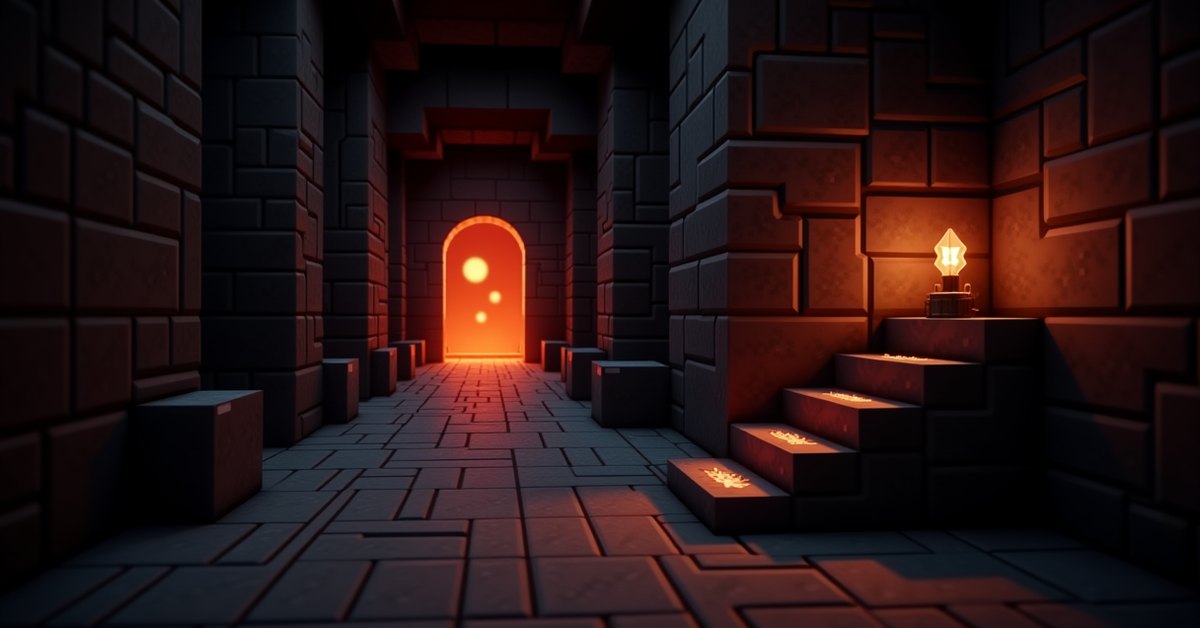
Beyond redstone, polished blackstone is one of the better dark palettes in the game. The smooth face pairs cleanly with the brick and chiseled variants, so you can build walls, floors, and trim from one material family and still get visual texture.
A common approach is to use polished blackstone for large flat surfaces, polished blackstone bricks for detailed walls and pillars, and chiseled polished blackstone as accent blocks around doors and windows. Stairs and slabs handle roofing and edges. Cracked bricks mixed in at random break up the uniform look and make a structure feel old.
The color sits well next to warm Nether blocks. Polished blackstone against gold blocks, shroomlight, or a glowstone strip gives you the same contrast the game uses inside bastion remnants. In the Overworld it works as a stone-gray option for castles, gates, and roads.
Tips and common mistakes
- Use a stonecutter when you need bricks, slabs, or stairs in bulk. It cuts out the two-step crafting and wastes fewer blocks on partial recipes.
- Do not rely on polished blackstone where you need real blast protection. Its blast resistance is ordinary. Obsidian is what holds up to explosions.
- Only raw blackstone replaces cobblestone in recipes. If a furnace or stone tool recipe is not appearing, check that you are holding blackstone and not the polished form.
- The dark texture makes mobs hard to see against polished blackstone surfaces. Light interiors properly so nothing spawns in a corner you cannot spot.
- Blackstone, basalt, deepslate, and obsidian all look dark but behave very differently. If a build or recipe will not work, confirm you grabbed the right block.
Frequently asked questions
Is polished blackstone the same as blackstone?
No. Blackstone is the raw block you mine in the Nether. Polished blackstone is crafted from four blackstone and has a smooth, even texture. They also differ in use: raw blackstone can replace cobblestone in recipes, polished blackstone cannot.
Can you make polished blackstone with a stonecutter?
Yes. Put blackstone in a stonecutter and select polished blackstone. The stonecutter can also cut blackstone straight into polished blackstone bricks, slabs, stairs, and walls without a separate crafting step.
Does polished blackstone work as a cobblestone substitute?
No. That property belongs to raw blackstone only. You can build furnaces and stone tools from raw blackstone, but polished blackstone is limited to decoration and redstone components.
Is polished blackstone renewable?
Yes, indirectly. Blackstone comes from bartering with piglins, and gold ingots are renewable, so you can keep producing blackstone and crafting it into polished blackstone without limit.
Can any pickaxe mine polished blackstone?
Yes. A wooden pickaxe works just as well as a netherite one for getting the block to drop. The tool only needs to be a pickaxe; tier does not change the drop.
What is the difference between polished blackstone and polished blackstone bricks?
Polished blackstone has a smooth, flat face. Polished blackstone bricks are crafted one step further and show a brick pattern. The bricks can also be smelted into a cracked variant, which the smooth block cannot.
Does the polished blackstone button respond to arrows?
No. Like the stone button, it can only be pressed by hand. If you need a button that arrows can trigger, use a wooden button.
Polished blackstone is worth a stack in your pack whenever you build in the Nether. It gives you a clean dark palette and a complete set of redstone parts without a single block carried in from the Overworld. Add the brick and chiseled variants and you can finish a full bastion-style build from one starting material.