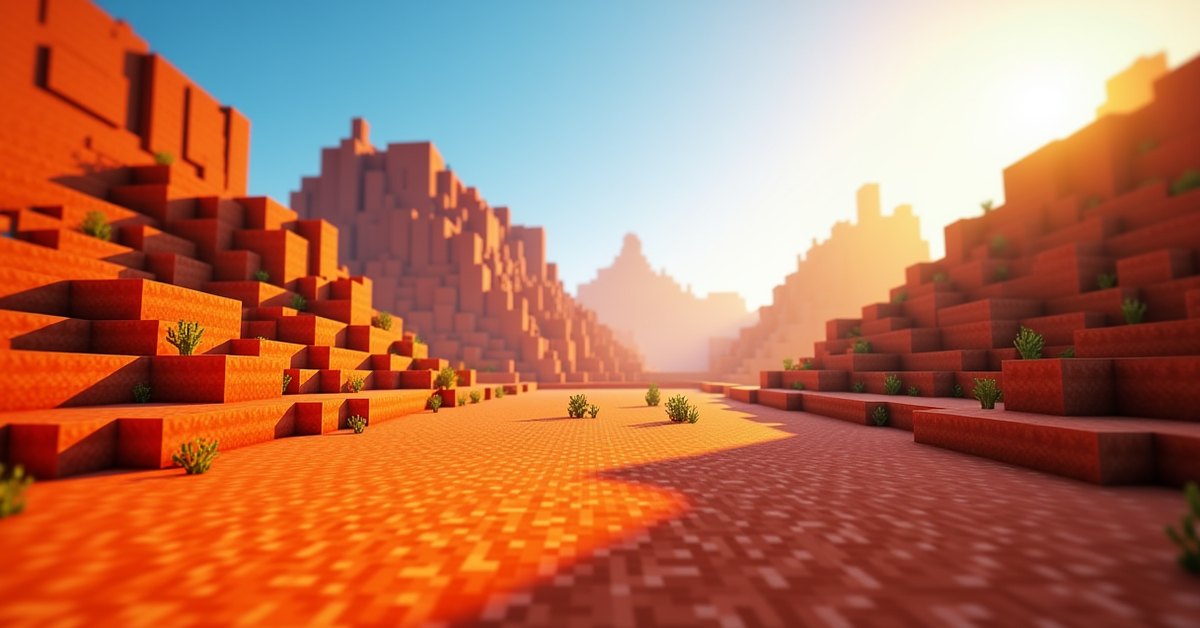
What is red sand?
Red sand is the orange-red cousin of regular sand. It works the same way in almost every situation that matters: it falls when nothing holds it up, you mine it fastest with a shovel, and it always drops itself. The obvious difference is color. Instead of the pale tan of a desert, red sand has a rusty, brick-toned look that suits canyon and mesa builds.
If you have spent any time in a desert, you already know most of how red sand behaves. Gravity, mining speed, and crafting all carry over from regular sand with one exception.
That exception is sandstone. Red sand crafts into red sandstone, and regular sand crafts into regular sandstone. The two are not interchangeable in that recipe, so the color you mine is the color you build with.
Where to find red sand
Red sand spawns in badlands biomes and nowhere else in the Overworld. That covers the regular badlands, the eroded badlands, and the wooded badlands. Deserts, beaches, and the Nether all use regular sand or none at all, so a badlands trip is the only way to gather red sand in quantity.
Inside a badlands biome, red sand sits on the surface and along the canyon floors, usually in wide open flats with dead bushes and the occasional cactus on top. The layered terracotta that badlands are known for fills the cliffs above and around it, so one trip stocks you up on both blocks.
Badlands biomes are not common, so if you spawn far from one, an exploration trip or the /locate biome command is the quickest way to find the nearest patch. A single badlands holds far more red sand than most builds will ever use, so there is no need to ration it once you arrive.
How to mine and collect red sand
A shovel is the right tool. Red sand has very low hardness, so even a wooden shovel clears it quickly, and an iron or diamond shovel with Efficiency breaks it almost instantly. You can break red sand by hand, but it is slow and there is no reason to once you have a shovel.
Red sand always drops itself as an item, so Silk Touch is not needed. Fortune does nothing for it either. Any shovel, enchanted or plain, returns the block every time.
Because red sand obeys gravity, the fast way to clear a tall column is to break the block at the very bottom and let everything above fall. If you place a torch one block below the column first, the falling sand reaches the torch, fails to settle, and pops off as items you can pick up. That trick clears a whole pillar in a couple of seconds.
How gravity affects red sand
Red sand is one of the few blocks in Minecraft affected by gravity. The group is small: sand, red sand, gravel, concrete powder, anvils, and the dragon egg. Place red sand with no solid block beneath it, or mine out the block holding it up, and it turns into a falling block entity that drops until it lands on something solid.
That has a few practical consequences. If falling red sand reaches a non-solid block such as a torch or a rail, it cannot settle there and drops as an item instead. If it falls into the space where a player or mob is standing, it deals suffocation damage until they move clear. Digging straight up into a sand ceiling is the classic way new players hurt themselves with their own tools.
In current versions, falling sand that lands on pointed dripstone is destroyed instead of stacking up. If a sand-based build is not behaving the way you expect, an unnoticed dripstone tip is worth checking.
Builders sometimes use this falling behavior on purpose. A column of red sand held up by a single block becomes a simple gate or trap, since knocking out the support drops the whole stack at once. It is also the reason red sand makes a poor ceiling or overhang in survival, where one stray block update can bring the lot down on your head.
What you can make with red sand
Red sand is more than ground cover. A few recipes turn it into building blocks and useful items, and most of them accept it as a stand-in for regular sand.
Red sandstone
This is the main use. Place four red sand in a 2×2 square on the crafting grid to get one block of red sandstone. From there a stonecutter or crafting table turns red sandstone into cut, chiseled, and smooth variants, along with slabs, stairs, and walls. Smooth red sandstone comes from smelting a red sandstone block in a furnace.
It is worth saying twice: regular sand will not work in this recipe, and red sand will not produce plain sandstone. The color carries straight through to the crafted block.
Glass
Smelt red sand in a furnace and you get glass. Plain, clear glass, the exact same block you get from smelting regular sand. There is no “red glass” that comes from red sand. For red-tinted glass you craft stained glass from clear glass and red dye. This trips up a lot of players, so it is worth stating plainly.
TNT and concrete powder
Red sand counts as sand for the recipes that call for it. TNT, which needs five gunpowder and four sand in an X pattern, accepts red sand in the sand slots. Concrete powder, made from sand, gravel, and a dye, takes red sand as well. You can mix red and regular sand freely in both recipes, and the output is identical either way.
Growing plants on red sand
Red sand supports the same plants regular sand does. Cactus can be placed and grown on it, which is why you see cactus scattered across badlands flats. Sugar cane grows on red sand too, as long as the block sits next to water. Dead bushes can be placed on red sand, and they generate on it naturally throughout the badlands.
What red sand cannot do is grow normal crops. Wheat, carrots, potatoes, and the rest need farmland, and no sand can be hoed into farmland. For a crop farm at a badlands base, bring in dirt or build the farm plot from another block.
Tips and common mistakes
Bring a shovel with Efficiency if you plan to gather red sand in bulk. Hand-mining a few hundred blocks for a large sandstone build turns into a slow afternoon for no reason.
Watch your head while you dig. Mining straight up into red sand drops it onto you, and the suffocation damage adds up fast. Dig at an angle, or break the falling block with a torch before it reaches you.
Do not expect red sand to float. Any red sand without a solid block under it falls as soon as the game updates that block, so an unsupported arch or overhang built from red sand will collapse. Build those shapes from red sandstone, which is an ordinary solid block and stays where you put it.
Keep red sand and red sandstone clear in your head. The sand is the loose, falling block. The sandstone is the solid crafted block. A recipe or build that calls for one will not behave correctly if you reach for the other.
Frequently asked questions
Where do you find red sand in Minecraft?
Only in badlands biomes: the regular badlands, eroded badlands, and wooded badlands. Deserts and beaches use regular sand, so a badlands trip is the only way to collect red sand.
Does red sand make red glass?
No. Smelting red sand produces ordinary clear glass, the same result as regular sand. For red glass, craft stained glass from clear glass and red dye.
Can you make TNT with red sand?
Yes. The TNT recipe accepts red sand in place of regular sand, and the two can be mixed. Five gunpowder and four sand of either type make one block of TNT.
What is the difference between red sand and regular sand?
Mostly color and biome. Red sand is red-orange and spawns in badlands; regular sand is tan and spawns in deserts and beaches. The one mechanical difference is crafting, where red sand makes red sandstone and regular sand makes regular sandstone.
Can cactus grow on red sand?
Yes. Cactus can be placed and grown on red sand exactly as it can on regular sand, and it generates that way naturally across badlands flats.
Does red sand fall like regular sand?
Yes. Red sand is affected by gravity. Remove the block under it and it falls until it lands on something solid, and it can suffocate any player or mob caught in its path.
What tool mines red sand fastest?
A shovel. Any shovel works, and Efficiency makes it close to instant. Silk Touch is never needed, since red sand always drops itself.
Is red sand worth collecting?
For a badlands base or any mesa-themed build, yes, and the smart move is to over-gather on the first trip. Red sandstone and its cut, smooth, and chiseled variants eat through sand quickly, and a second long walk back to the badlands is the kind of errand that is easy to regret skipping.