What is a rail in Minecraft?
A rail is the track that minecarts run on. Lay down a line of rails, set a minecart on top, and you have a transport system that moves you, mobs, or cargo across the world without walking every block of the trip.
Rails come in four types. The plain rail is the one you craft most, and it is the only one that turns corners or climbs hills. The other three (powered, detector, and activator) are straight-only rails with specific jobs in a redstone-driven railway. The plain rail is the focus here, with the other three covered further down.
How to craft rails
You craft rails at a crafting table with six iron ingots and one stick. Place three iron ingots down the left column and three down the right column, then put a single stick in the center square. The recipe gives you 16 rails at once.
Iron is the real cost. One crafting cycle needs six ingots for 16 rails, so a long railway burns through iron quickly. Many players set up an iron farm or stockpile iron before committing to a big track project.
You can also avoid the crafting table entirely. Abandoned mineshafts generate with rails already laid through their tunnels, and you can break those and pick them up. More on that below.
How rails work
A rail has to sit on top of a solid block. Mine the block underneath and the rail pops off as an item. Rails break instantly with any tool or with your bare hand, and they always drop themselves, so pulling up a track and re-laying it somewhere else costs nothing.
Curves and connections
Plain rails connect on their own. Lay a rail next to an existing rail and the two link up automatically. When a rail has neighbors on two sides that meet at a right angle, it bends into a curve by itself. There is no separate curve piece to craft; the game shapes the rail based on what is next to it.
Only the plain rail can curve. Powered, detector, and activator rails are always straight, so every corner on your track has to be built from plain rail.
Slopes
Rails can climb. Place a rail against the side of a block that sits one step higher and it forms an ascending rail at a 45-degree angle. Chain several of these together and the track runs up or down a hillside. A minecart speeds up rolling downhill and loses speed climbing uphill, which decides where your powered rails need to go.
Curves cannot be ascending. A rail that is turning a corner always stays flat, so build your corners on level ground and save the climbs for straight sections.
Momentum and friction
A minecart on plain rail slowly loses speed. Friction drags it down until it stops moving. A track made only of plain rail will not carry a cart very far on its own. To keep a cart rolling you either run it downhill or feed it regular boosts from powered rails.
The four types of rail
Minecraft has four rails. They all snap into the same track, but each one has a different job.
Rail
The plain rail is the track itself. It carries minecarts, forms curves, climbs slopes, and switches direction at a junction. Six iron ingots and a stick make 16 of them, so it is by far the cheapest rail. Every railway is mostly plain rail with the other three types dropped in where they are needed.
Powered rail
A powered rail, sometimes called a golden rail, controls speed. When it gets a redstone signal it pushes any cart on top of it forward. With no signal it does the opposite and brings the cart to a stop, so the same block works as both an engine and a brake. You craft it from six gold ingots, one stick, and one redstone dust, and the recipe yields six. Powered rails are always straight.
Detector rail
A detector rail reports when a cart is on it. While a minecart sits on the rail, it puts out a redstone signal you can wire to doors, lamps, note blocks, or any other contraption. It is the standard way to make a track trigger something as a cart passes. The recipe is six iron ingots, one stone pressure plate, and one redstone dust, for six rails.
Activator rail
An activator rail acts on the cart rather than the track. When the rail is powered and a cart rolls over it, the rail activates that cart. A TNT minecart starts its fuse, a hopper minecart stops collecting items, and a plain minecart ejects whatever rider is inside. You craft it from six iron ingots, two sticks, and one redstone torch, again for six rails.
Switching tracks with redstone
A plain rail can act as a switch. When a rail sits at a T-junction, meaning it has rails leading away on three sides, it can only connect two of those three branches at a time. By default it picks one route. Send the junction rail a redstone signal and it flips to the other route.
You power a junction rail the same way you power anything else in redstone. A lever, a button, a redstone torch, or a signal carried in on redstone dust beside the block all work. Flip the lever and carts coming through the junction take the other branch. This is how players build stations where one line splits toward different destinations.
The plain rail is the only rail that switches like this, and that switching behavior is why rails sit in the Redstone category rather than with ordinary building blocks.
Where rails generate naturally
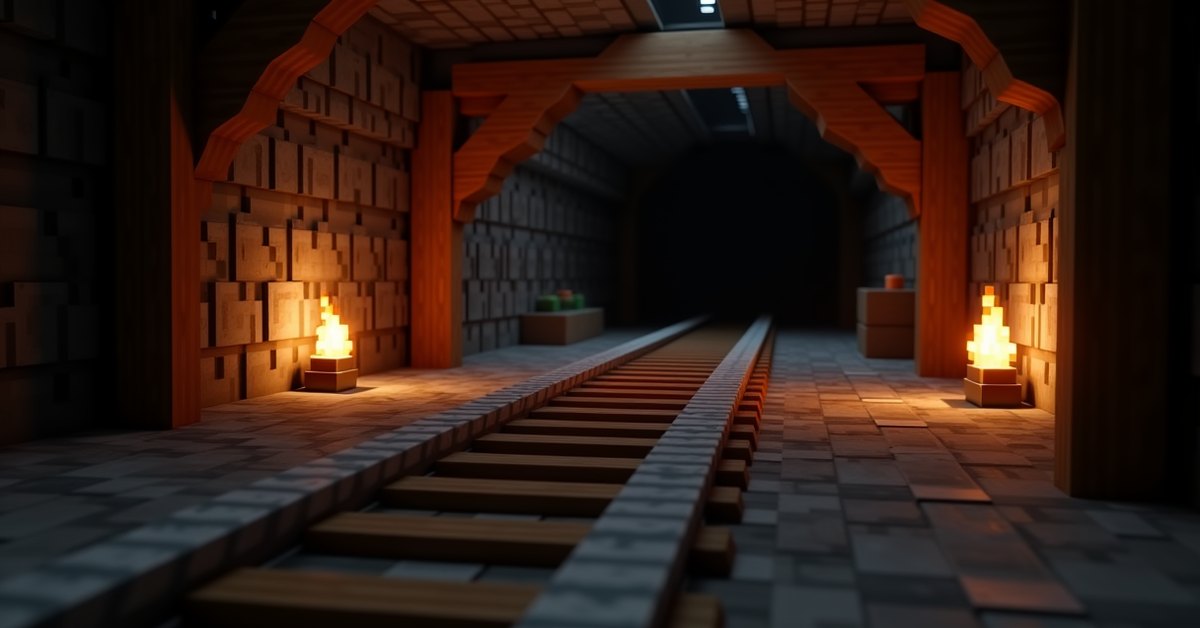
Abandoned mineshafts are full of rails. The wooden tunnels that wind underground are laid with plain rail, and you will often spot a minecart with a chest parked on the track. Break the rails and they drop for you to collect, which can save a lot of iron in a fresh world.
Mineshaft rails are rarely in a clean, continuous line. Cave-ins, gaps, and pockets of water leave the track broken up. Treat a mineshaft as a supply of free rails to pull up and re-lay rather than a finished railway you can ride right away.
Tips and common mistakes
The most common mistake is building a long track out of plain rail and then wondering why the cart stops halfway along it. Plain rail has friction. For any track longer than a few blocks, drop in powered rails to keep the cart at speed. Spacing one powered rail roughly every 30 blocks is a safe starting point for a passenger line, and you need them closer together on climbs.
An occupied minecart coasts much farther between boosts than an empty one. A line carrying you as a passenger needs fewer powered rails than a line pushing empty carts or cargo, so test your specific setup before you commit to the spacing.
A powered rail with no redstone signal stops carts instead of pushing them. If your cart dies on a powered rail, check that the rail is actually powered. A redstone torch or a block of redstone placed next to it is the simplest fix.
Flowing water will wash rails off their blocks. Keep water away from your track, or the rails break and scatter across the floor as items.
Last, remember that corners must be plain rail and corners always stay flat. If you try to turn and climb in the same spot, the track will not form the shape you expect. Keep the turn and the climb on separate sections.
Frequently asked questions
How do you make rails in Minecraft?
Put six iron ingots in the left and right columns of a crafting table and one stick in the center square. That gives you 16 plain rails.
Why does my minecart keep stopping?
Plain rail has friction, so a cart loses speed and eventually stops. Add powered rails along the track to keep it moving, and make sure those powered rails are receiving a redstone signal.
Can rails go uphill?
Yes. Place a rail against a block one step higher and it forms an ascending rail at a 45-degree angle. Carts slow down going up the slope and speed up coming down it.
Do rails need a block underneath them?
Yes. A rail sits on top of a solid block. Remove that block and the rail pops off as a dropped item.
Can powered rails curve?
No. Only plain rail forms curves. Powered, detector, and activator rails are always straight, so every corner has to be made of plain rail.
How do you pick up a rail?
Break it. Rails come up instantly with any tool or with your bare hand, and they always drop themselves so you can place them again.
What is the difference between a rail and a powered rail?
A plain rail carries the cart and can turn corners. A powered rail speeds the cart up when it has a redstone signal and brakes it when it does not, and it cannot turn corners.
Building your first railway
Rails are cheap to make and quick to lay, and the real skill is in spacing your powered rails and planning where the track turns and climbs. Build a short test loop first, count how far a single powered rail carries your cart, then scale that up into the railway you actually want.