What redstone components are
Redstone is the wiring system in Minecraft. Redstone components are the blocks and items that create a signal, carry it, or react to it. Put a few of them together and you get doors that open on a button press, farms that harvest themselves, hidden traps, item sorters, and even working calculators.
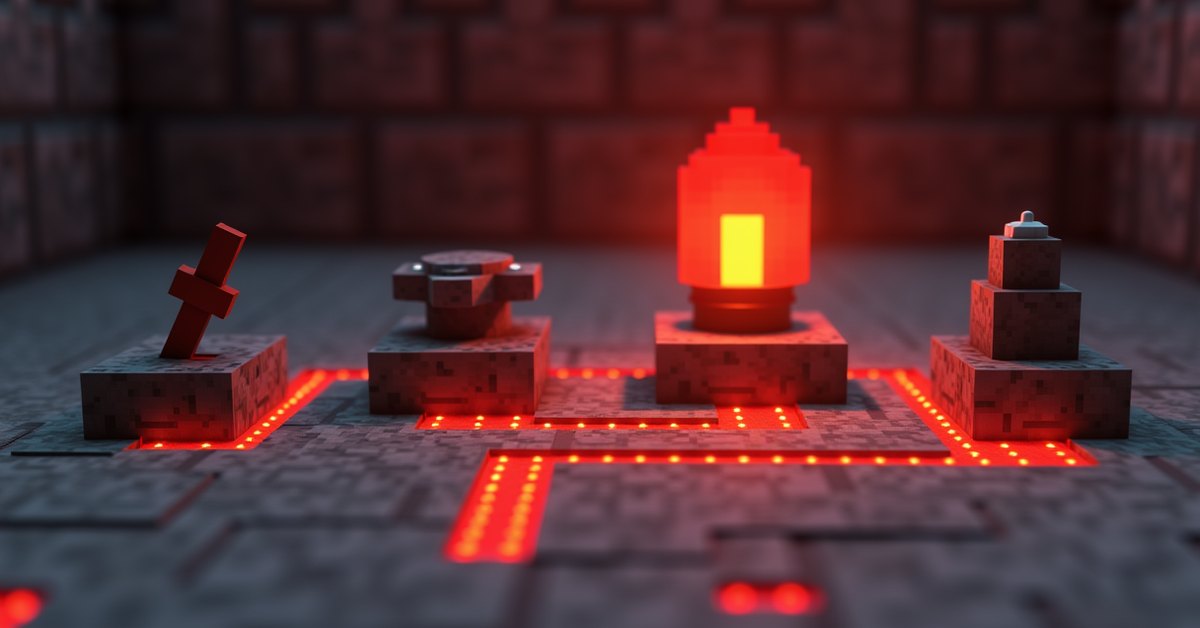
Every redstone build comes down to three jobs. Something makes a signal, something carries it across distance, and something does work when the signal arrives. Once you can drop a component into one of those three buckets, the whole system stops looking like magic and starts looking like plumbing.
This page is the map. It sorts the common redstone components by what they do and points you toward the full guide for each one.
How a redstone signal works
A redstone signal has a strength from 0 to 15. A power source switches on at strength 15, and the signal drops by 1 for every block of redstone dust it crosses. After 15 blocks of dust the signal reaches 0 and dies. That 15-block limit is the single most important number in redstone, and most beginner builds fail because a wire ran too long.
To send a signal farther, you reset it with a redstone repeater, which kicks the strength back up to 15 and passes it along. Signal strength also matters for some outputs: a redstone lamp lights at any strength above 0, but a note block’s pitch and a comparator’s reading both change with the exact number.
Redstone dust also climbs and drops one block at a time, so you can run a wire up a staircase of blocks without any special part. It will not jump a gap, though, so plan your routes as continuous paths and keep them clear of blocks that would accidentally power.
Power sources: components that make a signal
Power sources are where every circuit begins. They turn something in the world (a button press, sunlight, a passing minecart) into a redstone signal.
- A lever flips power on and leaves it on until you flip it back. It is the simplest switch in the game.
- A button sends a short pulse and resets itself. Stone and most buttons stay active for a shorter time than wooden ones, and arrows can press wooden buttons from a distance.
- Pressure plates fire when something stands on them. Stone plates react only to players and mobs, wooden plates react to almost any entity including dropped items, and weighted plates output a strength based on how many entities are on top.
- A redstone torch is an always-on power source. Attach it to the side of a block that gets powered and it flips off, which makes it the standard way to invert a signal.
- A daylight detector outputs a signal scaled to the sunlight hitting it. Right-click it to invert the reading so it powers up at night instead.
- An observer watches the block in front of it and sends one short pulse whenever that block changes. It is the go-to trigger for crop farms and flying machines.
- A target block outputs a signal sized by how close your arrow or snowball lands to the center.
- A trapped chest powers nearby redstone the whole time it sits open, which is handy for sneaky traps.
- A tripwire hook with string between two hooks triggers when a player or mob walks through the line.
- A sculk sensor outputs when it picks up a vibration nearby, such as a footstep or a thrown item.
- A block of redstone is a solid, permanent power source. Because it is a full block, a piston can push it around, which is the basis of many compact circuits.
Transmission: components that carry a signal
Once you have a signal, you need to move it to where the work happens.
- Redstone dust is the wire. It carries the signal along the ground and up or down single steps, losing 1 strength per block.
- A redstone repeater does three jobs: it resets the signal to full strength, it adds a delay you can set from one to four ticks by right-clicking, and it only lets signal pass in one direction. Lock a repeater by powering a second repeater into its side, which freezes its output.
- A redstone comparator is the brain of the group. In compare mode it passes the back signal only if no stronger signal hits its side. In subtract mode it lowers the back signal by the side signal. It also reads how full a container is, so you can measure a chest, furnace, or brewing stand. The comparator only passes signal one way, and the small torch at its front shows which mode it is in.
Comparators are where redstone gets genuinely powerful, because reading a container’s fullness lets a circuit respond to what is inside a chest rather than just an on or off switch.
Mechanisms: components that do the work
These are the payoff. Each one waits for a signal and then performs an action.
- A piston pushes up to 12 blocks in a line. A sticky piston also pulls its block back when the signal cuts out, which makes it the workhorse for doors and elevators.
- A dispenser shoots arrows, splashes potions, places water or lava, fires fireworks, and equips armor on a nearby player. It treats most items as something to use rather than just drop.
- A dropper simply ejects one item per pulse, or pushes it into a container it faces, so it is the standard part for item elevators.
- A hopper moves items between containers on its own, and a redstone signal locks it to stop the flow. That on-off control is the heart of most item sorters.
- A redstone lamp lights up while powered and switches off the moment the signal stops.
- A note block plays a sound when powered or punched, and the block underneath sets the instrument.
- Doors, trapdoors, and fence gates all open when they receive power, which lets you wire entrances to buttons, plates, or hidden levers.
- Powered rails speed up and slow down minecarts depending on whether they are powered, and activator rails trigger functions like dumping a cart’s rider or activating a TNT minecart.
- TNT ignites the instant it is powered, so it is the trigger for both demolition and trap builds.
- A crafter, added in version
1.21, crafts a set recipe each time it gets a pulse, which finally allows fully automatic crafting. - A bell rings when powered, and a command block runs a stored command on each pulse in worlds where commands are allowed.
Tips and common mistakes
The 15-block range trips up almost everyone at first. If a circuit works up close but dies farther out, drop a repeater in the line to refresh it before the signal runs out.
Repeaters and comparators only move signal in one direction, marked by the arrow on top. If your wire does nothing, check that the arrow points away from the source.
A redstone torch will burn out if you flip it on and off too fast, going dark for a short time before it recovers. Spread out rapid pulses or use a different design if you see a torch flicker off.
In Java Edition, dispensers, droppers, and a few other blocks can be triggered by power one block above and to the side, a quirk called quasi-connectivity. Bedrock Edition does not share this behavior, so a circuit copied between versions may need adjusting.
Frequently asked questions
What is the difference between a repeater and a comparator?
A repeater refreshes a signal, adds delay, and can lock. A comparator compares or subtracts signals and can read how full a container is. Use a repeater to extend or time a circuit, and a comparator to make decisions based on signal strength or storage.
How far does a redstone signal travel?
Fifteen blocks of redstone dust before it hits 0. Add a repeater to reset the signal to 15 and keep going as far as you like.
Which blocks count as power sources?
Levers, buttons, pressure plates, redstone torches, daylight detectors, observers, target blocks, trapped chests, tripwire hooks, sculk sensors, and the block of redstone all generate a signal on their own.
Why does my redstone torch keep turning off?
It is burning out from being toggled too quickly. A torch that switches state too many times in a short window goes dark to cool down. Slow the pulses or redesign the clock that is driving it.
Do redstone builds work the same in Java and Bedrock?
Mostly, but not always. Timing can differ, and quasi-connectivity exists only in Java. Most simple builds behave the same, while complex contraptions sometimes need version-specific tweaks.
What is the best redstone component to start with?
Wire a lever to a redstone lamp. It teaches you power, dust, and an output in one tiny build, and everything else grows from there.
Where to go next
Pick the bucket that matches what you are building. If you need a trigger, start with the power sources. If a signal is dying before it arrives, the repeater is your fix. If you want a circuit that reacts to what is in a chest, the comparator is the part to learn next.