What redstone is
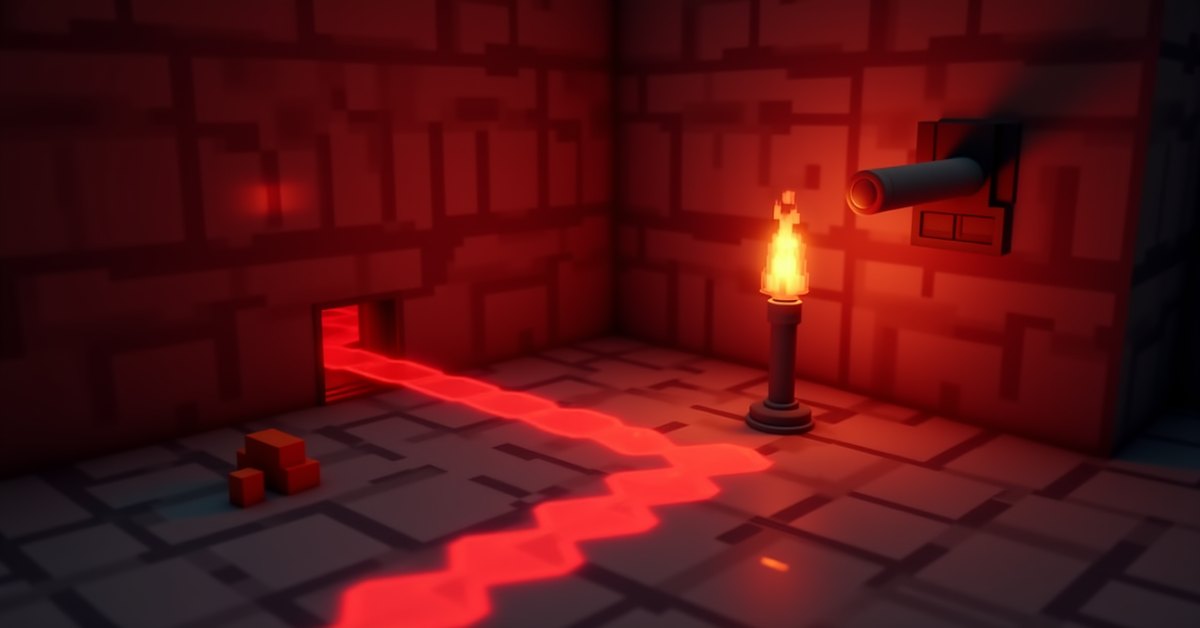
Redstone is the wiring system of Minecraft. In your inventory it shows up as redstone dust, a small pile of glowing red powder. Place that dust on the ground and it turns into redstone wire, a flat line that carries power from one spot to another. That is why the game treats redstone as both an item and a block: the dust is the item, the wire is the block.
You use redstone to make things happen at a distance. A lever by your front door, a hidden piston wall, an automatic farm, a lamp that lights at dusk: all of them run on redstone wire feeding power from a switch to a machine.
This guide covers redstone dust itself. The full storage cube called the Block of Redstone is a separate block with its own page, so it only comes up here as a power source.
How to get redstone
Most redstone comes out of the ground. Redstone ore spawns deep underground, and deepslate redstone ore appears in the deepslate layers below roughly Y 0. Both are common near the bottom of the world, so a mining trip down low will usually fill a stack fast.
You need an iron pickaxe or better to mine redstone ore. A stone or wooden pickaxe breaks the block but drops nothing. Each ore block drops 4 or 5 redstone dust. Fortune raises that number, and Silk Touch lets you collect the ore block itself instead.
Redstone also turns up in other places:
- Chests in mineshafts, dungeons, strongholds, desert temples, and jungle temples.
- Witches drop redstone when killed.
- Cleric villagers sell redstone dust for emeralds.
- One Block of Redstone breaks down into 9 dust on a crafting grid.
Best Y level for redstone ore
Redstone ore becomes more common the deeper you dig. It starts showing up below Y 15 and peaks near the bottom of the world. Branch mining between Y -59 and Y -55 gives you a steady supply, and you will pick up diamonds and lapis on the same trip.
Redstone as an item
As an item, redstone dust stacks to 64 and works as a crafting ingredient for almost every redstone device in the game. A short list of what it builds:
- Redstone torch, the basic always-on power source.
- Redstone repeater and redstone comparator, the two control components.
- Redstone lamp, a bright light you can switch on and off.
- Pistons, dispensers, droppers, and note blocks.
- Clocks and compasses.
- Powered rails and activator rails for minecart tracks.
Redstone has one use that has nothing to do with circuits. In a brewing stand, adding redstone dust to a potion stretches how long the effect lasts. A Potion of Swiftness that normally runs three minutes lasts eight minutes once you brew redstone into it.
Redstone as a block
Right-click redstone dust onto the top of a solid block and it becomes redstone wire. The wire is a real block in the world, but it is flat and you can walk straight through it. It needs a full, opaque block underneath, so it will not sit on glass, on leaves, or on most transparent blocks.
Once placed, wire connects on its own. A piece of dust reaches toward neighboring dust, toward redstone components, and toward power sources. Depending on what is around it, a single piece of dust shows up as a dot, a line, an L bend, a T, or a four-way cross.
Signal strength and the 15-block limit
Every redstone signal has a strength from 0 to 15. A power source puts out a fixed strength, and a lever or a Block of Redstone gives the full 15. Here is the part that trips up new players: redstone wire loses one point of strength for every block it travels. Run a signal 15 blocks down a line of dust and it arrives at strength 0, which counts as off.
To send power further, drop a redstone repeater into the line. A repeater takes whatever signal reaches it and pushes it back out at full strength 15, so you can chain long wires by spacing repeaters every 15 blocks or closer. Repeaters also add a short delay and only let current flow one way.
Running redstone up and down
Redstone wire is not stuck on one flat level. It can climb. Build a staircase of solid blocks, lay dust on each step, and the signal travels up or down the slope. Wire cannot jump a vertical gap on its own, so for a straight vertical run most builders stack redstone torches or other components instead.
What redstone powers and how
Powered redstone wire glows a brighter red and gives off small particles. That power reaches machines in two ways. It can feed a component directly when the wire runs into it, and it can power the solid block the wire sits on, which then passes the signal to anything attached to that block.
Common things a redstone signal switches on: pistons and sticky pistons, iron and copper doors, trapdoors, dispensers and droppers, hoppers, redstone lamps, note blocks, bells, TNT, and powered rails. Pair that with a switch such as a lever, a button, a pressure plate, a tripwire hook, or a daylight detector, and you have a working circuit.
Strong and weak power
One more rule catches people out. A solid block next to powered redstone dust becomes weakly powered. A weakly powered block will run a piston or a lamp, but it will not turn on another piece of redstone dust sitting on top of it. A block becomes strongly powered when a redstone torch sits under it or a repeater points into it, and a strongly powered block can pass current to dust on top. If a circuit works in one spot but dies when you move it onto a block, this is usually why.
Tips and common mistakes
Water destroys redstone wire. A single water source or flow running across your dust washes it off the block and drops it as an item. Keep redstone runs dry, or cover them.
Rain is fine. Redstone wire on the ground works in a storm with no problem, so you do not need a roof over an outdoor circuit.
Forgetting the 15-block limit is the most common beginner mistake. If a long wire stops working halfway down its run, count the blocks and add a repeater.
Redstone dust connects in directions you did not plan for. If two lines join when you wanted them separate, place a block to break the connection, or isolate a dot by clearing the dust around it.
Place dust before you place the machine when wiring is tight. It is easier to see where the wire wants to connect on an empty block than to fix it once a piston is in the way.
Java and Bedrock differences
Redstone dust behaves almost the same on both editions. Mining, signal strength, the 15-block fade, and crafting recipes all match.
The real gap is quasi-connectivity. In Java Edition, a piston or dispenser can fire when a power source sits in the block space above it, even slightly off to the side. Bedrock Edition does not copy this behavior, so a contraption built around quasi-connectivity in Java often needs an extra block of wiring to work in Bedrock. If you follow a redstone tutorial and a piston refuses to move, an edition mismatch is a likely cause.
Frequently asked questions
How far does redstone travel?
A redstone signal moves 15 blocks through wire before it fades to nothing. Add a redstone repeater to reset the signal to full strength and keep it going.
What is the difference between redstone dust and a Block of Redstone?
Redstone dust is the item you place as wire to carry a signal. A Block of Redstone is a solid storage block that also acts as an always-on power source. Nine dust craft one block, and one block breaks back into nine dust.
Can you craft redstone dust?
You cannot craft it from raw materials. The only crafting route is breaking a Block of Redstone back into 9 dust. Everything else comes from mining, chests, witches, or villager trades.
Why does my redstone keep disappearing?
Two usual causes. Water flowed over it, which pops the wire off as an item, or you tried to place it on a block that cannot hold it, such as glass or a fence. Wire needs a full, opaque block underneath.
Does redstone work in the rain?
Yes. Redstone wire on the ground is unaffected by rain or snow. Only flowing or source water removes it.
What pickaxe do I need to mine redstone ore?
An iron pickaxe or better. A diamond or netherite pickaxe works too. Stone and wooden pickaxes break the ore but drop nothing.
Can redstone go straight up a wall?
Not on a flat vertical wall. Wire climbs a staircase of blocks but cannot run up a sheer surface. For a vertical signal, builders stack redstone torches or other components instead.
Where redstone fits in your world
Redstone dust is the cheapest part of any contraption you will ever build, and it is worth carrying a stack at all times. The moment you want a door that opens itself, a farm that harvests on its own, or a light that knows when the sun goes down, the dust in your pocket is what makes it run.