Redstone dust is the wiring of Minecraft. Place it on the ground and it carries a power signal from one spot to another, which is what lets levers open doors, pressure plates fire dispensers, and whole contraptions run on their own.
You get redstone dust by mining redstone ore deep underground, and you will spend it on almost every redstone device in the game, from a single torch to a piston. This guide covers where to find it, how its signal behaves, the recipes that use it, and the wiring habits that keep your builds working.
What is redstone dust?
Redstone dust is an item that drops when you mine redstone ore. In your inventory it sits there like any other resource and stacks to 64. When you place it on top of a block, it turns into redstone wire, a flat red line that connects to nearby wire and to redstone components.
That wire is the whole point. A signal enters the dust from a power source, travels along it, and comes out the other end into whatever you have connected. Think of it as the cable running between a switch and the thing the switch controls.
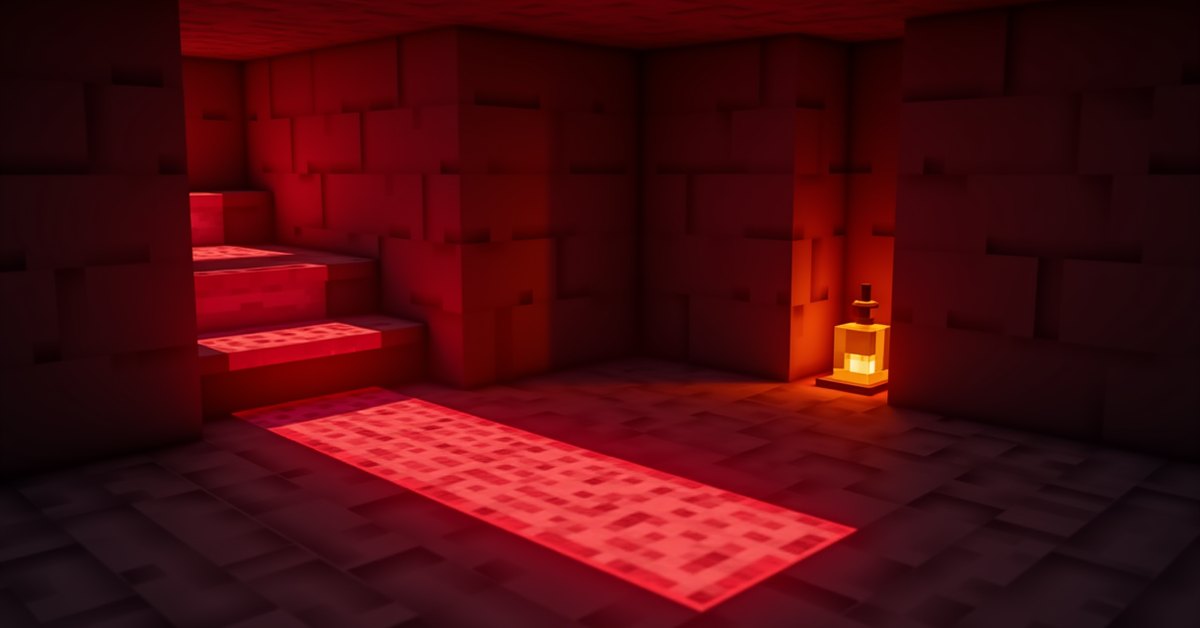
Powered dust glows bright red and gives off a few particles. Unpowered dust is a darker, duller red. That color change is the fastest way to tell at a glance whether a line is carrying a signal.
How to get redstone dust
Mining redstone ore
The main source is redstone ore, a stone block speckled with red. There is also a deepslate version with a darker background that spawns in the deepslate layer. Both are common in the lower part of the world and get more frequent the deeper you dig, with a strong band from around Y -32 down to bedrock. Branch mining between Y -59 and Y -55 gives a steady supply, and you will pick up diamonds and lapis on the same trip.
You need an iron pickaxe or better to mine it. A stone or wooden pickaxe will break the block but drop nothing, so the ore is wasted. Each ore block drops 4 to 5 redstone dust. The Fortune enchantment raises that number, so a Fortune III pickaxe pulls noticeably more dust per block. Silk Touch does the opposite: it drops the ore block itself instead of the dust, which is only useful if you want to relocate the ore.
One quirk to expect: redstone ore lights up and gives off particles when you walk on it or hit it. The glow is harmless and fades after a moment.
Other ways to get it
Mining is not the only option. Redstone dust also turns up in a few other places:
- In generated chests, including mineshafts, dungeons, strongholds, desert and jungle temples, and woodland mansions.
- From witches, which drop a small amount of redstone when killed.
- From cleric villagers, who will trade redstone dust for an emerald once they reach the right trading level.
- By crafting it out of a block of redstone, which gives 9 dust back per block.
If you build up a large stockpile, the block of redstone is a tidy way to store it. Nine dust compresses into one block, and you can break it back down whenever you need the dust again.
How redstone dust works
Every redstone signal has a strength from 0 to 15. A signal of 0 is off. A signal of 15 is full power, the kind you get straight out of a lever, a button, or a block of redstone.
Here is the part that trips up new players: redstone dust loses one level of signal strength for every block it travels. A line that starts at 15 will be down to 0 after 15 blocks, and the wire goes dark. Anything connected past that point gets nothing.
To send a signal farther than 15 blocks, you break the line with a redstone repeater. A repeater takes whatever signal reaches it, even a weak 1, and pushes it back out at full strength 15. It also adds a short delay and forces the signal to travel one way. Place a repeater every 15 blocks and you can run a line as long as you want.
Dust also reacts to the blocks around it. When powered dust sits on top of a solid block, it can power that block, which can then power something attached to the other side. This is how a signal gets around corners and through walls. It is also a common cause of accidental activation when two wires sit too close together.
Strong and weak power
There is a catch to powering blocks with dust. A solid block next to powered dust only becomes weakly powered. A weakly powered block will run a piston, a lamp, or a door, but it will not switch on another piece of dust sitting on top of it. A block becomes strongly powered when a redstone torch sits under it or a repeater points into it, and a strongly powered block does pass current to dust on top. If a circuit works in one spot but dies when you move it onto a block, this is usually why.
What a signal switches on
Powered dust feeds a component directly when the wire runs into it, or through the block it powers. Common targets are pistons and sticky pistons, iron and copper doors, trapdoors, dispensers, droppers, hoppers, redstone lamps, note blocks, bells, TNT, and powered rails. Pair one of those with a lever, button, pressure plate, tripwire hook, or daylight detector and you have a working circuit.
What redstone dust is used for
Beyond wiring, redstone dust is a crafting ingredient in a long list of devices. Here is how much dust the most common ones need:
| Item | Redstone dust needed |
|---|---|
| Redstone torch | 1 |
| Redstone repeater | 1 (plus 2 redstone torches) |
| Redstone lamp | 4 |
| Piston | 1 |
| Dispenser | 1 |
| Dropper | 1 |
| Note block | 1 |
| Observer | 2 |
| Powered rail | 1 |
| Clock | 1 |
| Compass | 1 |
| Block of redstone | 9 |
| Target | 4 |
Redstone dust also has a job at the brewing stand. Adding it to a potion extends how long the effect lasts, so it is the standard duration ingredient for potions like Strength or Night Vision. A Potion of Swiftness that normally runs three minutes lasts eight minutes once you brew redstone into it. Dropping a unit of dust into a plain water bottle makes a Mundane Potion, which is mostly a stepping stone recipe rather than something you drink.
Placing and wiring redstone dust
Redstone dust can only be placed on top of a solid, opaque block with a flat surface. It will not sit on glass, leaves, fences, or a bottom-half slab. A handful of blocks like hoppers are exceptions worth remembering, but the general rule is simple: solid block, flat top.
Once placed, dust connects automatically to any wire or component directly next to it. It will also run up and down the sides of blocks. Place dust at the base of a wall and a line on top, and the signal climbs the wall as long as the block above the lower dust is clear. That is how you move power between floors without a staircase of platforms. Wire cannot jump a sheer vertical wall on its own, though. For a straight vertical run, build a staircase of blocks with dust on each step, or stack redstone torches on a column of blocks and let them relay the signal.
Depending on what is around it, a single piece of dust shows up as a dot, a line, an L bend, a T, or a four-way cross. When a piece of dust has more than one neighbor, it forms a corner or a cross on its own. If you want a line to stay straight and not branch toward a component you did not mean to connect, plan the layout so the dust does not sit next to that connection in the first place.
Common mistakes
The most common mistake is running a wire too far and then wondering why the far end does nothing. If a line is longer than 15 blocks, drop a repeater in before the signal dies.
The next is wires powering each other by accident. Dust powers the block it sits on, so two parallel lines one block apart can leak signal through the block between them. Leave a two-block gap, or break the connection with a non-conductive block like glass.
The third is mining redstone ore with the wrong pickaxe. Stone and wood will destroy the ore and give you nothing back. Always carry an iron pickaxe or better before you go looking for redstone.
Water is another quiet wire killer. A single water source or flow running across your dust washes it off the block and drops it as an item, so keep redstone runs dry or cover them. Rain is fine: wire on the ground works in a storm with no roof needed.
When wiring is tight, place the dust before the machine. It is easier to see where the wire wants to connect on an empty block than to fix it once a piston is in the way.
Redstone dust in Java and Bedrock
The dust itself behaves the same in both editions. It carries a 0 to 15 signal, loses one level per block, and is placed and crafted identically. The well-known differences between Java and Bedrock redstone live in the components, not the wire. Piston timing, observer behavior, and a Java-only quirk called quasi-connectivity can make the same build act differently across editions. In Java, a piston or dispenser can fire when a power source sits in the block space above it, even slightly off to the side; Bedrock does not copy this, so those builds often need an extra block of wiring to work there. If you are following a redstone tutorial, check which edition it was made for, but you do not need to relearn how dust works.
Frequently asked questions
How far does redstone dust carry a signal?
Fifteen blocks. The signal starts at strength 15 from a full power source and drops by one each block, hitting zero after the fifteenth. Use a redstone repeater to reset it to full strength and carry it farther.
What pickaxe do I need to mine redstone ore?
Iron or better, which includes diamond and netherite. Stone and wooden pickaxes will break the ore but drop no dust, so the block is lost for nothing.
Does Fortune work on redstone ore?
Yes. Redstone ore drops 4 to 5 dust normally, and Fortune raises the maximum. A Fortune III pickaxe gives a good bit more dust per block on average, so it is worth enchanting a pickaxe before a big mining run.
Can you place redstone dust on glass or slabs?
Not on glass, and not on a bottom-half slab. Redstone dust needs a solid block with a flat top. A full block or a top-half slab works fine; anything transparent or with a sunken surface does not.
What is the difference between redstone dust and a block of redstone?
Redstone dust is the wire that carries a signal. A block of redstone is a solid block that constantly outputs a full strength 15 signal to everything around it. The block is crafted from nine dust and can be broken back into nine dust.
Why is my redstone dust dark instead of bright red?
Dark dust is not receiving a signal. Bright red dust with particles is powered. If a line you expect to be on stays dark, trace it back to the power source and look for a gap or a run longer than 15 blocks.
Why does my redstone dust keep disappearing?
Two usual causes. Water flowed over it, which pops the wire off as an item, or you tried to place it on a block that cannot hold it, such as glass or a fence. Rain and snow do not remove it; only flowing or source water does.
Getting started with redstone
Once the 15-block rule and the repeater fix click into place, redstone dust stops feeling mysterious and starts feeling like a tool. Lay a short test line with a lever on one end and a redstone lamp on the other, watch the wire light up, and build out from there.