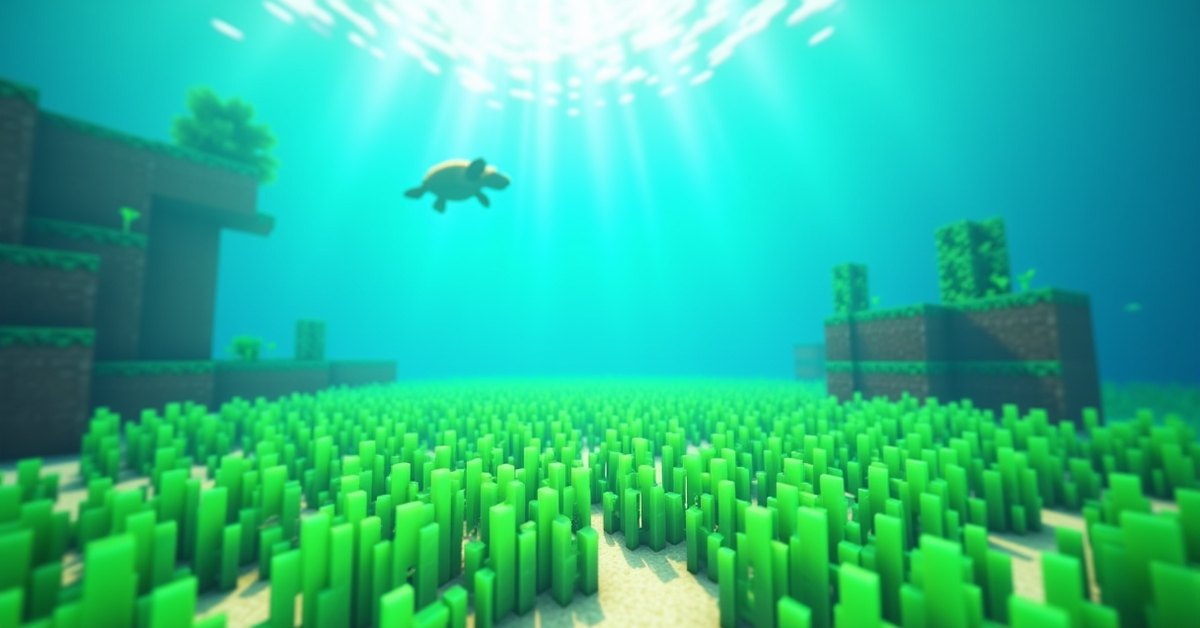
Seagrass is a small underwater plant that covers the floor of Minecraft’s oceans and rivers. It waves with the current and brings a little life to what would otherwise be bare sand and dirt at the bottom of the water.
Most players swim past it without a second thought. But seagrass has one job that makes it worth collecting: it’s the only food that breeds turtles. If you want a turtle farm, or turtle shells for a helmet, you need a steady supply.
This guide covers where seagrass grows, how to break it so it actually drops, how to spread it with bone meal, and what to do with it once you have a stack.
What is seagrass?
Seagrass is a non-solid plant block. You can swim straight through it, mobs ignore it, and it never blocks light or the flow of water. It exists only underwater. Take the water away and the plant pops off the block it was sitting on.
It comes in two heights. Regular seagrass is one block tall. Tall seagrass is two blocks high and appears when you apply bone meal to the short version. Both look like thin green blades that bend and sway with the current.
Because it has no collision and no hardness, seagrass is one of the quickest blocks in the game to break. The catch is what it drops, and that depends entirely on the tool you use.
Where to find seagrass
Seagrass generates naturally on the bottom of almost every water biome. You’ll see it in oceans, in rivers, and in the warm water around coral reefs. Warm oceans and reef biomes tend to have the thickest patches, often mixed in with coral and kelp.
The main exception is cold water. Frozen oceans and frozen rivers generate little to no seagrass, so a polar biome is the wrong place to stock up.
Seagrass sits directly on the seabed. It usually generates on sand, gravel, dirt, or clay, the blocks that make up most ocean and river floors. In any water biome that isn’t frozen, you won’t have to swim far before you spot some.
How to harvest seagrass
This is the part that catches new players. Seagrass only drops as an item when you break it with shears. Hit it with your hand, a sword, a pickaxe, or any other tool, and it disappears with nothing left to pick up.
The rule is simple: bring shears. Equip them, break the seagrass, and it drops itself as an item you can carry off and replant wherever you like.
Shears lose a small amount of durability each time you cut a plant, so a single pair collects plenty of seagrass before it wears out. If you plan to gather a lot, an Unbreaking enchantment stretches a pair of shears much further.
Breaking seagrass is instant no matter what you use, since the block has zero hardness. The shears requirement is only about the drop, not the speed.
How seagrass behaves
Seagrass needs water to survive. It can only sit inside a water source block. It can’t exist in flowing water or in open air. Remove the water around a piece of seagrass and the plant breaks at once, dropping nothing.
You can place seagrass yourself. Hold the item, aim at the top face of a solid block underwater, and it attaches there. Most full blocks work as a base. Seagrass only grows on the top of a block, never the side or the underside.
One thing seagrass never does is spread on its own. Regular grass slowly creeps across dirt, and kelp grows taller over time, but seagrass stays exactly where it generated or where you put it. Left alone, a patch will look the same a thousand in-game days later.
Spreading seagrass with bone meal
Bone meal is the tool for growing more seagrass, and it works two different ways depending on what you point it at.
Use bone meal directly on a piece of seagrass and it grows into tall seagrass, the two-block version. This is useful for decoration and for filling out a dense underwater garden quickly.
Use bone meal on the bare seabed underwater and it scatters new seagrass across the nearby floor, much like bone meal spreads flowers and short grass on land. This is the fastest way to carpet a stretch of seabed with plants.
Since seagrass never regrows by itself, bone meal is also how you refill a patch after you’ve harvested it. Keep a stack on hand if you rely on a particular spot.
Using seagrass to breed turtles
Seagrass is the only item turtles will eat, which makes it the one block every turtle farm depends on.
To breed turtles, hold seagrass and feed it to two adult turtles. Once both have been fed, they enter love mode and pair up. One of the two then swims to a sandy beach, digs into the sand, and lays a clutch of turtle eggs. The eggs sit in the sand until they hatch into baby turtles, usually at night.
Seagrass has a second turtle use. Feeding it to a baby turtle speeds up how fast it grows into an adult. Each piece trims time off the wait.
When a baby turtle finally grows up, it drops a scute. Collect five scutes and you can craft a turtle shell, a helmet that grants a short window of extra underwater breathing and works as a brewing ingredient for the Potion of the Turtle Master. None of that chain starts without seagrass, so keeping a small supply in a chest near any beach base pays off.
Placing and building with seagrass
Outside of turtles, seagrass earns its keep as a decoration block. Dropped into aquariums, moats, underwater bases, and reef builds, it gives the seabed the soft, planted look that bare sand lacks.
Because seagrass is see-through and has no collision, you can layer it freely without worrying about blocking movement or sightlines. Mixing short seagrass, tall seagrass, and kelp produces a more natural underwater scene than any one plant on its own.
Remember that every piece you place needs a water source block around it. If you’re building a dry display and want the look of seagrass, you have to keep the water in place, since draining the tank destroys every plant in it.
Other uses for seagrass
Seagrass can also go into a composter. Each piece has a 30% chance to raise the compost level, the same rate as saplings and most small plants. It isn’t an efficient way to make bone meal compared to wheat or other crops, but if you’ve over-harvested and have spare stacks sitting around, the composter is a place to put them.
Tips and common mistakes
The mistake nearly everyone makes once is breaking seagrass without shears and watching it vanish. If you swam to the ocean floor specifically to collect it, check your hotbar before the first swing.
Carry a water bucket when you gather seagrass far from the surface. Your air runs out quickly down there. Placing and breaking a water source resets your breath, and a helmet with Respiration buys you longer dives.
For a turtle farm, bone meal a wide patch of seabed near a beach instead of hauling seagrass back one stack at a time. It’s faster, and you’ll never run dry in the middle of breeding.
Don’t expect a harvested patch to refill itself. Note where you took seagrass from and bring bone meal back if you want it green again.
Frequently asked questions
How do you get seagrass in Minecraft?
Break it with shears. Seagrass only drops as an item when it’s sheared. Any other tool, or a bare hand, destroys it with no drop.
Can you place seagrass out of water?
No. Seagrass can only exist inside a water source block. Try to place it in air, or drain the water around it, and the plant breaks.
Does seagrass grow back on its own?
No. Once you harvest a spot it stays empty unless you replant seagrass there or use bone meal on the seabed to spread fresh growth.
What do turtles eat in Minecraft?
Seagrass, and nothing else. Feed it to two adult turtles to breed them, or to a baby turtle to speed up its growth.
How do you make tall seagrass?
Use bone meal on a piece of regular seagrass. It grows into tall seagrass, which stands two blocks high.
Can you bone meal the ocean floor?
Yes. Bone meal used on the bare seabed underwater spreads new seagrass across the surrounding blocks.
Does seagrass need light to grow?
No. Seagrass doesn’t need any light level to exist or to be spread with bone meal. Water is the only requirement.
The bottom line on seagrass
Seagrass is easy to swim past, but it’s a single-item bottleneck for anyone who wants turtles. Keep a pair of shears for harvesting and a stack of bone meal for spreading, and you’ll have what you need the day you decide to start a turtle farm.