What is cactus in Minecraft?
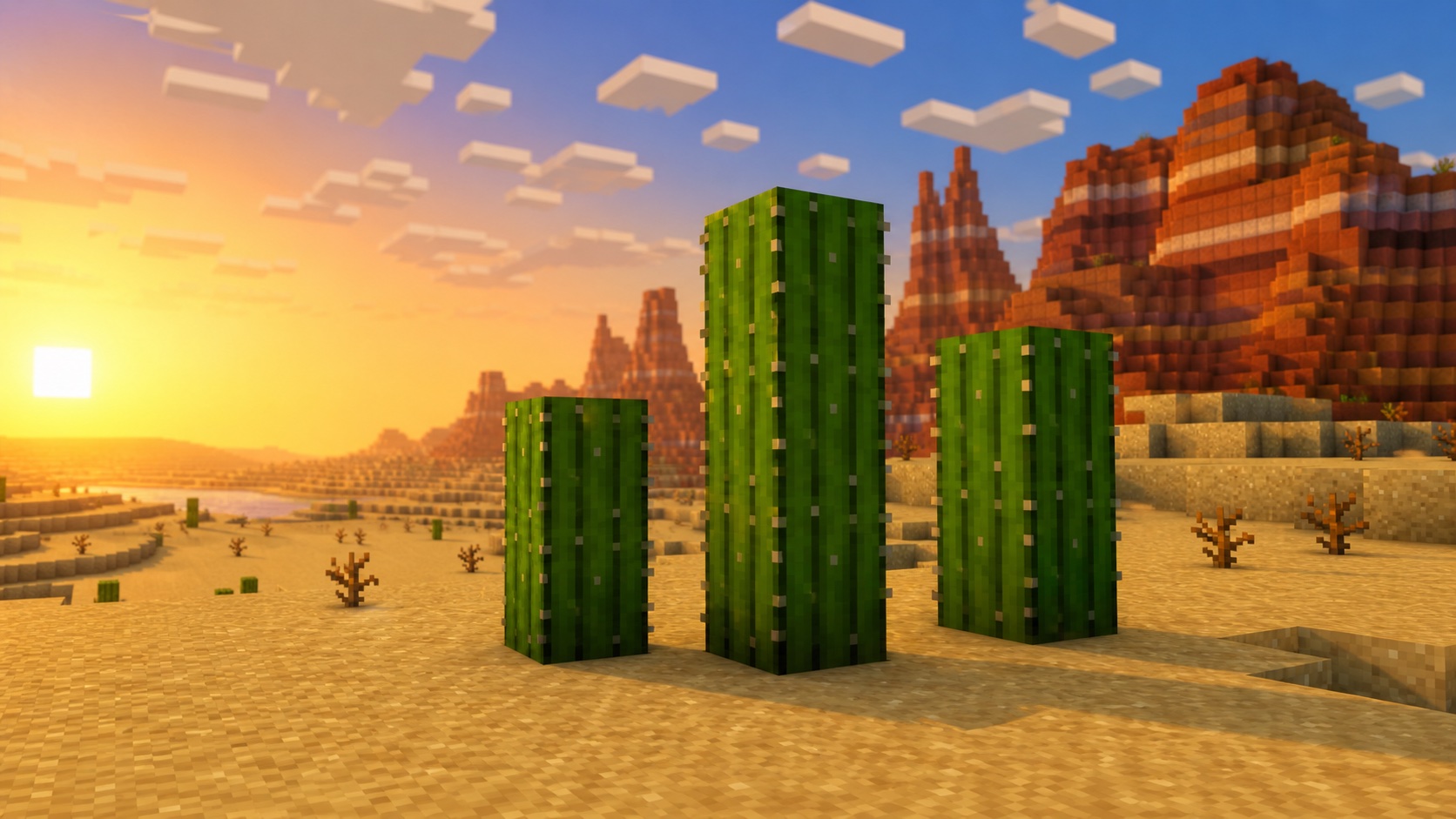
Cactus is a green plant block that grows in dry biomes. It hurts anything that touches it and smelts down to green dye. It is also the only block in the game that destroys items dropped onto it, which is what makes cactus the standard build for trash incinerators and overflow voiders.
You will see cactus most often in deserts, badlands, and the occasional desert village farm. Each cactus block has a slightly smaller hitbox than a full block, which is why you take damage when you brush against one even though it looks like there is empty space around the edges. The plant grows on sand and red sand and nowhere else.
Where to find cactus
Cactus generates naturally in two biomes:
- Desert: tall, thin patches of cactus scattered across the sand.
- Badlands: less common but still present, usually near red sand pockets.
You can also find cactus in desert village farms, where villagers grow it inside fenced plots. Raiding a desert village farm is the fastest way to get a stack of cactus on day one. Wandering traders sometimes sell cactus for an emerald, but that is a poor trade if a desert is anywhere within walking distance.
Cactus does not generate in regular plains, savanna, or jungle even when those biomes border a desert. If you are surrounded by green and you need cactus, you are walking.
How to harvest cactus
Punch it. That is the entire harvest mechanic. Cactus has almost no hardness, so any tool, or no tool, breaks it in a fraction of a second. The block drops itself as an item.
Two warnings worth knowing before you start swinging:
- The cactus will damage you while you mine it. Stand on the side, not flush against it, and aim at the bottom block first so the upper segments break and pop off on their own.
- If you break the bottom of a stack, the entire column above falls and drops as items. That is the easy way to clear out a tall natural cactus pile.
Cactus stacks to 64 in your inventory and never decays in storage.
How cactus grows
Cactus has one growth rule and one strict placement rule. Get either wrong and the plant will refuse to grow or will pop off entirely.
Growth rule: a cactus block has a small chance to grow upward by one block on each random tick, as long as the space directly above is air. Natural cactus columns top out at three blocks tall, but you can manually stack them taller by placing more cactus on top.
Placement rule: a cactus block must sit on sand or red sand, and it cannot have any solid block (or other cactus) directly adjacent on any of its four cardinal sides at the same height. If something pushes against it, the cactus snaps off and drops as an item. That includes a growing crop, a piece of falling sand from above, and a player walking up next to it.
The “no adjacent block” rule is also why a cactus column will not grow taller than three on its own. If two cacti sit close together, the new growth will eventually meet a corner where it cannot survive.
How to build a cactus farm
The basic auto-farm uses a fixed block above the cactus to knock newly grown tops off, plus a hopper to catch the drops.
Minimum viable setup:
- Place a sand block. Put one cactus on top of it.
- Two blocks above the cactus base, place any solid block that sticks out one block from the cactus. When the cactus grows to that height, it will hit that block, get popped, and fall.
- Below the falling path, place a hopper feeding into a chest.
- Surround the cactus base with non-solid spaces, or keep at least one block of separation between farm cells.
To scale up, repeat the cell every two blocks so the cacti never sit adjacent to each other. A two-block gap between cells is the safe spacing. Some players use a flowing water column on the side of each cactus instead of a fixed top block, which works the same way: water flow into the cactus side knocks the top block off and floats it onto a hopper line.
Cactus does not need light to grow. You can build the entire farm underground or inside a wall and it works fine. It also does not respond to bone meal, so do not waste any.
What cactus does (mechanics in detail)
Cactus has a handful of behaviors that show up across survival, farming, and redstone builds.
Damage on contact
Touching cactus deals half a heart of damage every half second. Armor reduces this damage in Java Edition. Bedrock historically applied a flatter amount, though recent updates have brought the two editions closer together. The damage does not bypass invulnerability frames, so you can sprint past a single cactus and only take one tick of damage.
Item destruction
Any item entity that touches a cactus block is destroyed. Drop a stack of dirt onto cactus and it disappears. That is the standard mechanic for trash cans: a hopper points into a cactus, and dropping items into the hopper feeds them onto the plant where they get deleted. Hoppers below cactus pick up nothing, because nothing survives the contact.
Mob hostility
Mobs take cactus damage too, which makes cactus a workable passive defense. A line of cactus around your base is more decorative than effective against zombies, since they walk around or approach from above. Inside a mob farm, though, cactus can be the kill block for low-armor mobs like cave spiders or silverfish.
Use as fuel
Cactus is a valid furnace fuel. One cactus smelts one item. It is not efficient compared to coal, charcoal, or kelp blocks, but if you are stranded in a desert with no trees, a cactus pile keeps your furnace running long enough to find a better source.
Smelting cactus into green dye
Put cactus in the top slot of a furnace or blast furnace, add fuel, and wait. Each cactus produces one green dye and a small amount of experience. The smoker does not work for this; cactus smelts as a non-food item.
Green dye is one of the more useful colors because there is no flower-based shortcut for it. Most other primary colors have a craftable or harvestable source from flowers or other plants. Green only comes from cactus or sea pickles, and sea pickles are harder to gather in volume. If you want green wool, green concrete, green terracotta, or a green shulker box, you need cactus running through a furnace.
For volume dyeing, build a small auto-farm and feed the output directly into a row of blast furnaces. A 16-cell farm can keep three blast furnaces busy on its own.
Building uses for cactus
Beyond the obvious dye and trash incinerator roles, cactus has a few specialized uses:
- Decoration: a cactus placed in a flower pot works as a desert-themed accent on a table or shelf.
- Anti-griefing on multiplayer servers: a cactus ring at spawn discourages new players from running directly into a chest area.
- Item voiding: paired with hoppers and droppers, a cactus voider eats overflow from a sorter.
- Composter input: cactus has a 50% chance to add one level to a composter, making it a reasonable input alongside seeds and saplings.
One thing cactus is not useful for: building walls. The non-solid hitbox and constant damage make it a bad floor or roof material for any actual base, and you cannot put torches or signs on it.
Java vs Bedrock differences
Most cactus behavior is identical across versions, but a few details still matter for builders:
- Damage calculation: Java reduces cactus damage with armor. Older Bedrock versions applied a flatter amount that ignored most armor. Recent Bedrock updates have closed that gap, but on an older world expect cactus to hit harder than it would on Java.
- Random tick handling: Java and Bedrock use slightly different tick logic. In practice, farms run at similar speeds on both editions, and the
/gamerule randomTickSpeedcommand behaves the same way on each. - Wandering trader prices: cactus pricing from wandering traders has shifted across both editions over the years. Do not rely on a fixed cost; check the trade window before paying an emerald for it.
Tips and common mistakes
- Do not plant cactus next to crops. The next growth tick will pop the cactus when wheat, carrots, or beetroots fill the adjacent block.
- Do not put a cactus inside a one-block alcove and expect it to grow. The walls count as adjacent blocks at the same height, which prevents growth.
- Bone meal does nothing to cactus. Save it for trees, kelp, and crops that respond.
- If you are using cactus as a trash can, double-check that no useful items are routed into the hopper. There is no recovery once the cactus eats them.
- If you only need a few green dye for a banner or one block of wool, do not build a farm. Punch out a desert cluster and call it done.
- Cactus does not negate fall damage like a hay bale does. Do not use it as a landing pad. You will land on it, take fall damage, and then take cactus damage on top.
Frequently asked questions
Can cactus grow on regular dirt or grass?
No. Cactus only grows on sand and red sand. Placing it on any other block, including coarse dirt, rooted dirt, or mud, fails and drops the cactus as an item.
How tall can cactus grow on its own?
Three blocks. The plant tracks its own height while growing naturally and stops at three. You can place more cactus on top manually to build a taller column, but the plant will not grow that high on its own.
Does cactus damage you through armor?
In Java Edition, armor reduces cactus damage. In older Bedrock versions it did not, though recent updates have brought Bedrock closer to Java behavior. Either way, walking through a thick cactus patch will hurt.
Can you compost cactus?
Yes. Cactus has a 50% chance to add one level to a composter per piece, which is a decent compost rate compared to weeds or seeds.
Why does my cactus keep breaking?
Something is adjacent to it. Check all four cardinal sides at the cactus’s own height. A sapling that grew into a tree, a piece of falling sand, or a wandering villager bumping into it will all snap the plant off. Cacti need open air on all four sides at every level of their stack.
Can mobs spawn on cactus?
No. Cactus is not a valid spawn surface, and any mob that landed on one would take damage and fall off anyway.
Is cactus the only source of green dye?
Cactus and sea pickles are the two sources. Sea pickles also need to be smelted, and they are harder to gather in bulk than cactus, so most green dye production runs through a desert cactus farm.
Does fire spread to cactus?
Cactus is not flammable, so fire will not spread onto or through a cactus block. Lava set near a cactus farm will not ignite the plants, though it will still ignite anything else nearby.
Quick reference
Cactus drops one item per block when broken, smelts to one green dye in a furnace or blast furnace, and destroys any item entity that touches it. Place it on sand or red sand, keep all four sides clear at every level, and ignore bone meal. That covers most of what you will do with it in survival.