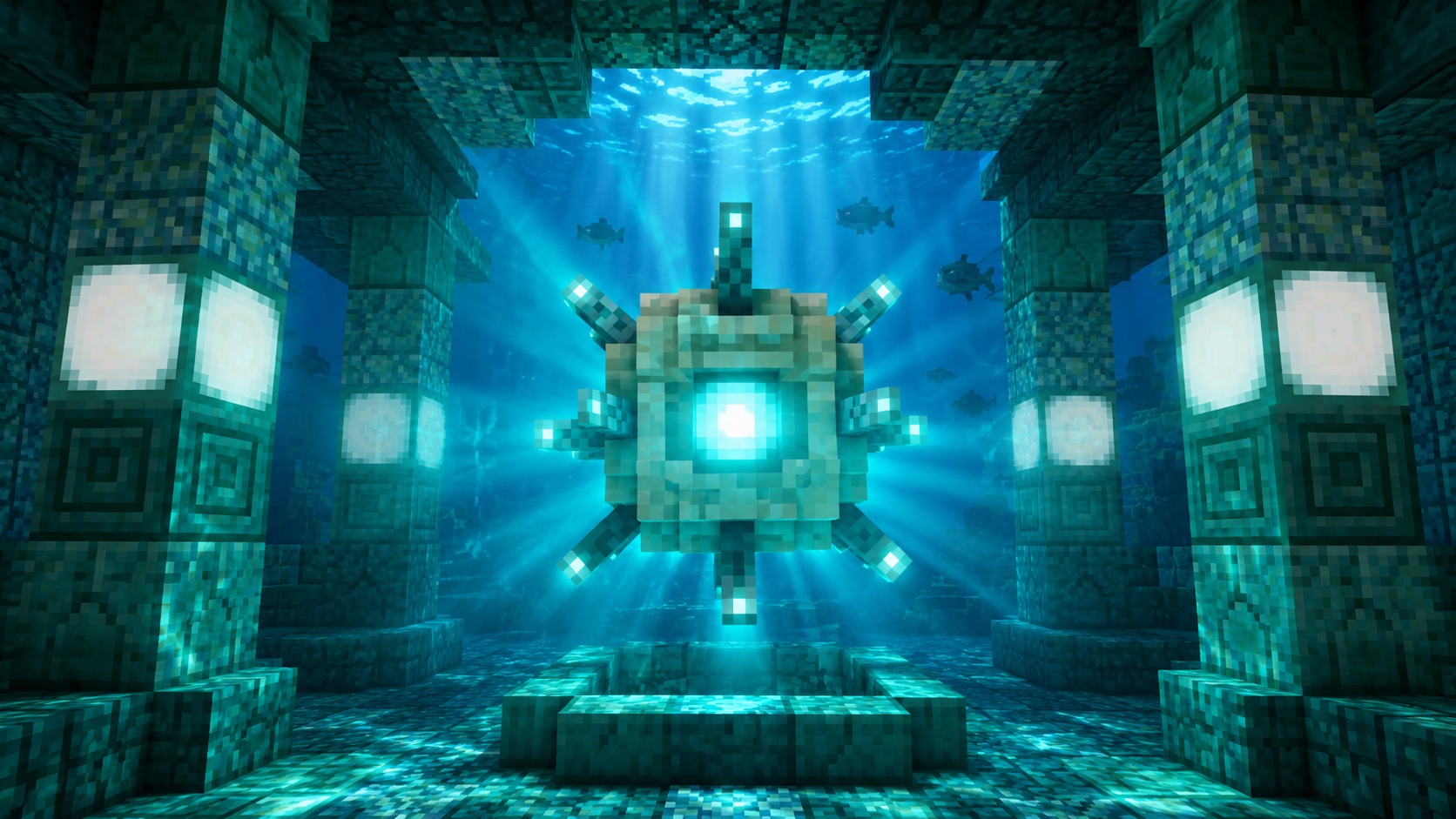
A conduit is the underwater equivalent of a beacon. Place one in water, build a prismarine frame around it, and you get Conduit Power in a sphere around the block. That means you can mine and fight underwater the same way you would on land.
Most players run into conduits when they raid an ocean monument or fish up nautilus shells from drowned. The block is one of the few craftable items that uses a heart of the sea, which makes it feel like a real milestone. Once you set one up near a base, the ocean stops being a survival problem.
This guide covers the crafting recipe, the materials you need, the frame rules for activation, what Conduit Power does, and the small differences between Java and Bedrock.
What a conduit is
The conduit is a utility block that broadcasts a status effect called Conduit Power to nearby players underwater. It only works when it’s placed inside a water source block and surrounded by an activation frame made of prismarine, prismarine bricks, dark prismarine, or sea lanterns.
Conduits do not generate naturally in any structure. The only way to get one is to craft it yourself, which means tracking down the materials before you can drop one into a base or build.
A single active conduit replaces a steady supply of potions of water breathing and night vision. It also damages hostile mobs nearby once you complete a full frame, which makes it useful for clearing drowned and guardians from a build area.
The conduit only activates underwater. You can place it on land, but it sits there with the closed eye animation and does nothing until you flood the area around it.
How to craft a conduit
The recipe needs 8 nautilus shells and 1 heart of the sea. Arrange them in a crafting table like this:
- Top row: nautilus shell, nautilus shell, nautilus shell
- Middle row: nautilus shell, heart of the sea, nautilus shell
- Bottom row: nautilus shell, nautilus shell, nautilus shell
You get one conduit per craft. The recipe is the same in Java and Bedrock.
How to get nautilus shells
Nautilus shells come from a few sources:
- Drowned: a drowned mob occasionally holds a nautilus shell in its off-hand. Killing the drowned drops the shell. Looting III increases the drop chance per kill.
- Fishing: fishing in any open water has a small chance to pull up a nautilus shell as a treasure catch. Lure and Luck of the Sea help over many casts.
- Wandering trader: a wandering trader will sometimes offer nautilus shells for emeralds.
Drowned with shells are the fastest source if you can find a river or warm ocean with a steady drowned population. A simple drowned farm with trapdoors over a kill chamber will produce eight shells in a couple of game days.
How to find a heart of the sea
A heart of the sea drops only from a buried treasure chest. There is exactly one in each chest, and buried treasure is the only place this item generates.
To find buried treasure:
- Get a buried treasure map. You’ll find one in a shipwreck supply chest or an ocean ruin chest.
- Sail or swim to the red X on the map.
- Dig down. The chest is usually buried under a few blocks of sand or gravel near the X.
If you only need one heart of the sea, one buried treasure chest is enough. If you want a backup or plan to build a second conduit later, raid a handful of shipwrecks first and collect a few maps before you start digging. Treasure maps don’t expire, so it’s safe to stockpile a few before you commit to long ocean trips.
How to activate a conduit
Activation has two requirements: water around the conduit, and a prismarine frame around the conduit.
Water rules
The conduit must be inside a water source block, and at least one of the blocks touching it must also be water (not just a flowing water tile). The simplest setup is to dig a 1x1x1 hole, place the conduit inside, and pour a water bucket on top so the block fills with water.
Frame rules
The activation frame is built from prismarine, prismarine bricks, dark prismarine, or sea lanterns, mixed in any combination. The frame must be inside a 5x5x5 area centered on the conduit. The conduit reads how many qualifying blocks sit at the right distances, and the count determines the conduit’s power level.
The thresholds are:
- 16 blocks: minimum to activate. The conduit opens its eye and gives Conduit Power to players within 32 blocks.
- 24 blocks: range increases to 64 blocks.
- 32 blocks: range increases to 96 blocks.
- 42 blocks: full power. The conduit also damages hostile mobs within 8 blocks of itself every 2 seconds.
A common mistake is filling the frame in solid. Blocks beyond the 42-frame count don’t add anything. The conduit reads up to 42 frame blocks and that is the cap.
What Conduit Power does
Conduit Power is a single status effect with several parts:
- Underwater breathing. Your air bar pauses inside the range.
- Night vision underwater. Caves and ocean floors become readable without potions.
- Faster underwater mining. Mining speed underwater matches dry-land speed instead of being five times slower.
- Damage to hostile mobs (full frame only). At 42 frame blocks, drowned, guardians, and elder guardians within 8 blocks of the conduit take 4 damage every 2 seconds.
The effect is a passive aura. You don’t need to drink anything or stand still. As long as you’re inside the range and underwater, you have it.
The damage component is what makes a fully framed conduit so useful when clearing an ocean monument. Elder guardians lose part of their tactical advantage because the conduit slowly chips them down while you swim and build.
Tips and common mistakes
- You can pre-build the frame on land and flood it later. The conduit won’t activate until a water source is in place around it.
- Sea lanterns count as frame blocks. If you have leftover prismarine and sea lanterns from a monument cleanup, mix them however you want.
- The conduit does not need to sit in the exact geometric center of the frame. It only needs frame blocks at the correct positions inside its 5x5x5 read area.
- The conduit only damages hostile mobs in line of sight. Do not trap the conduit inside a sealed wall and expect it to clear a tunnel one block over.
- Conduit Power’s breathing and night vision pieces only apply underwater. Step out of the water and those pieces shut off even inside the range.
- Once you have a working conduit, it makes a good anchor for a guardian farm. Build the kill chamber inside the conduit’s range and you’ll mine, sort, and travel at full speed while collecting prismarine shards and crystals.
Java vs Bedrock differences
The conduit works the same way on both editions: same recipe, same activation rules, same effect, same range thresholds. The open-eye animation has a slightly different mix on each edition and the ambient sound is mixed differently, but there is no practical gameplay difference for normal play.
Frequently asked questions
Does a conduit need to be fully surrounded by water?
The conduit itself has to sit inside a water source block. Players don’t need to be in water to receive Conduit Power, but the breathing and night vision pieces of the effect only apply underwater. Step out of the water and those pieces shut off even inside the range.
How many prismarine blocks do I need for a full conduit?
42. The conduit ignores frame blocks beyond that count, so any extra is decorative.
Can I mix prismarine types in the frame?
Yes. Prismarine, prismarine bricks, dark prismarine, and sea lanterns are all interchangeable for frame purposes. The conduit treats them as the same block type for activation.
Does Conduit Power work in the Nether or End?
You can place a conduit in either dimension, but it needs water sources to work, and water evaporates in the Nether. In practice, the conduit is an Overworld block.
Can a conduit damage players?
No. The damage effect only applies to hostile mobs. Players, villagers, and passive mobs are not affected.
Can I move an active conduit?
Yes. Mine the conduit with any tool, and you’ll get the block back intact. Reactivate it at the new location by rebuilding the frame and adding a water source around it.
Why is my conduit’s eye closed?
The frame has fewer than 16 valid blocks, the conduit isn’t in a water source, or the frame blocks aren’t in the correct positions inside the 5x5x5 area. Walk around the conduit and check every layer of the frame, then patch any holes you spot.
Final notes on conduit setups
A working conduit changes how you treat the ocean. Before one, an underwater monument is a long, careful dive with potions and a constant watch on the air bar. After one, you can clear a whole monument in a single session and build a guardian farm in the shell without burning through a stack of bottles. The materials cost is real, but you only pay it once per conduit, and a single conduit at a base or monument site usually lasts the rest of the world.