If you’ve been mining a lot of copper and wondering what to do with it, the copper trapdoor is one of the easier wins. It’s a 1×1 panel that hinges open like a door, blocks mobs the way you’d expect, and looks great in builds that lean on copper, deepslate, or natural stone. It also changes color slowly as it ages, which is easy to miss until you check back and your bright orange roof has gone teal.
This guide covers how to craft a copper trapdoor, how it oxidizes, how to wax it to keep one specific look, and the small differences in how it behaves compared to iron and wooden trapdoors. By the end you’ll know which version to use for which job, and how to set up automatic doors, hidden hatches, and low-maintenance roofs.
What is a copper trapdoor?
The copper trapdoor was added in Minecraft 1.21, the Tricky Trials update. It’s a metal trapdoor crafted from copper ingots, and it sits between the wooden trapdoor and the iron trapdoor in how it works.
Like a wooden trapdoor, you can right-click it to open it by hand. Like an iron trapdoor, it also responds to redstone power. You can pick whichever method fits the build, which already makes it more flexible than either of the other two.
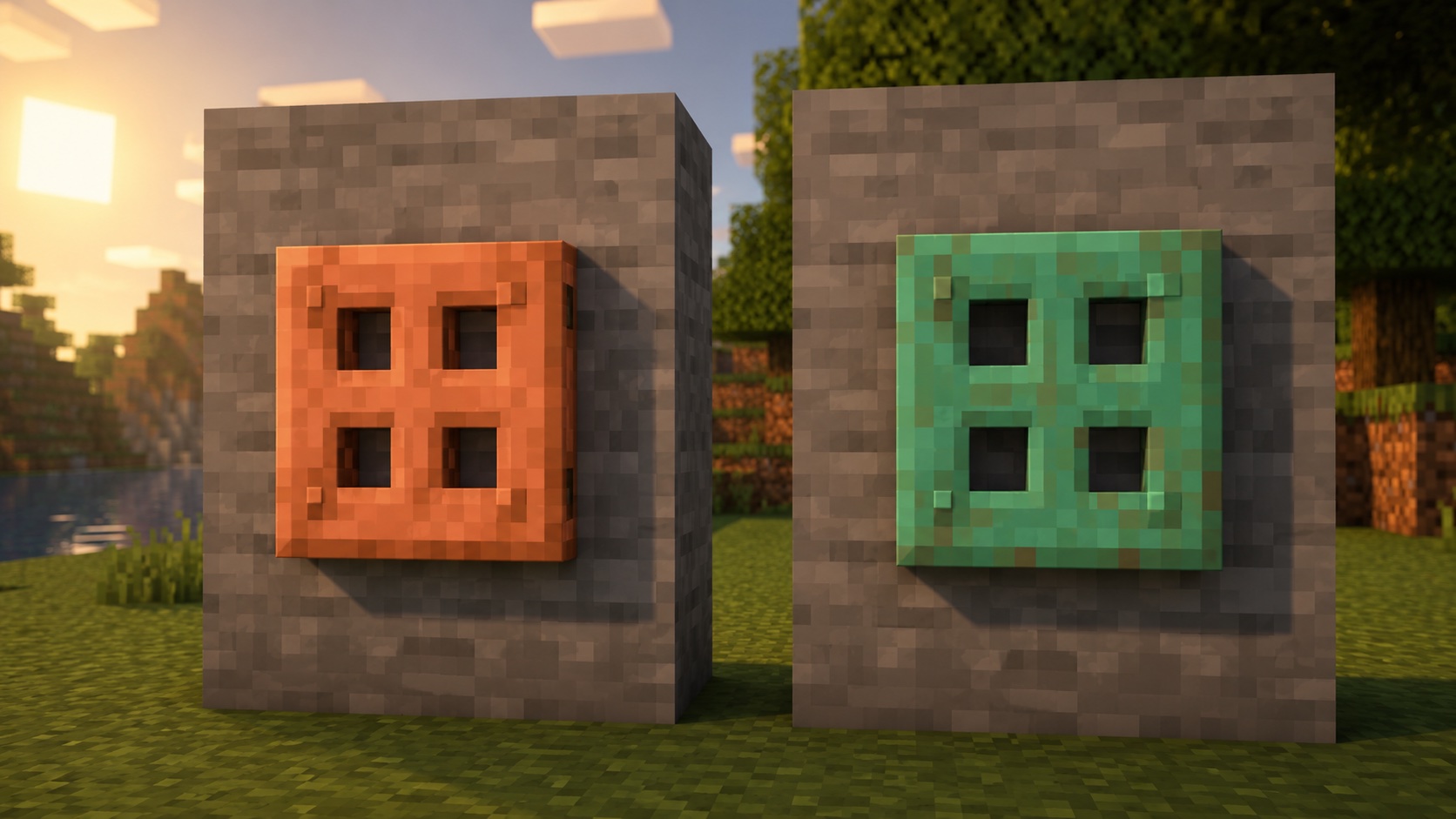
The other thing that sets it apart is how it changes color over time. Like every other copper block in the game, the copper trapdoor goes through four oxidation stages. If you leave it alone, the bright orange shifts down through three darker shades and finishes as a green-tinted patina, the same look you see on real-world copper roofs. You can lock any of the four stages in place with a coat of wax.
How to craft a copper trapdoor
To craft a copper trapdoor, place 4 copper ingots in a 2×2 square in a crafting table. The recipe yields 2 trapdoors per craft, so a stack of 64 ingots gets you 32 trapdoors.
Copper ingots come from smelting raw copper or copper ore in a furnace or blast furnace. Raw copper drops when you mine copper ore with a stone pickaxe or better. If you’ve been raiding cliffs and mountain biomes for copper, you should have plenty of raw copper to convert.
The crafting recipe stays the same regardless of which oxidation stage you want. You always start with the clean, unoxidized version. To get a weathered or oxidized trapdoor, you either let it age naturally over time or you place it next to other partly oxidized copper to speed the process. There’s no recipe that produces an aged trapdoor straight out of the crafting grid.
How copper oxidation works
Every copper block in Minecraft passes through four oxidation stages over time:
- Unoxidized (the bright orange you get when you craft it)
- Exposed (a slightly duller orange-brown)
- Weathered (a green-tinted teal)
- Oxidized (a deeper, fully green patina)
The shift between stages is slow. Each stage advances on a random tick, with an average of a few in-game days between visible changes. The rate is intentionally low, so a copper trapdoor placed today might still be on stage 1 a real-world week from now.
Two things affect oxidation. First, copper blocks oxidize faster when they’re surrounded by air. Copper trapdoors near other copper blocks, especially copper that’s already partly aged, can speed each other along. Second, copper blocks on the same stage tend to stay roughly in sync. If you build a roof of 200 copper trapdoors and check back in a few weeks, most of them will be on the same stage, with a few outliers.
If you’d rather not wait, you don’t have to. You can age a trapdoor manually by mining and replacing copper blocks at the stage you want, or by surrounding fresh copper with already-oxidized copper to push the process along.
How to wax a copper trapdoor
Once a copper trapdoor reaches a stage you like, you can lock it in place with honeycomb. Hold a piece of honeycomb in your hand and right-click the trapdoor. The block becomes “waxed” at that exact stage and will not oxidize further.
Honeycomb comes from beehives. You can collect it with shears, or with a dispenser holding shears aimed at an active beehive. One honeycomb waxes one trapdoor.
Waxing has two big advantages. It freezes the look you want, so if you finally got that perfect dusty-pink stage 1 hue across your roof, waxing keeps it from turning teal in a year. It’s also reversible. Hit the trapdoor with an axe and the wax comes off, and the trapdoor goes back to oxidizing on its normal schedule.
You can also craft a waxed copper trapdoor directly by combining a copper trapdoor and a honeycomb in a crafting grid, but right-click waxing is faster when you’re standing in front of a finished build.
How to place and use copper trapdoors
A copper trapdoor takes up half a block of vertical space. You can place it on the top half or bottom half of any solid block face, including the side. Sneak-place it if you don’t want to interact with the supporting block when you set it down.
Right-click toggles the trapdoor open and closed. It also responds to direct redstone power, like a redstone torch, lever, or pressure plate next to it, and to a signal piped in through a comparator or repeater. Pulse signals from observers, dispensers, or daylight detectors work too.
When the trapdoor is closed, it acts like a solid block face for mobs and players. When it’s open, it leaves a 1-block-wide hole. You can climb up through the gap, and mobs that can climb (like spiders) can use it as a route too.
One trick that gets used a lot in survival builds: place a copper trapdoor on the side of a wall, just above a ladder. When the trapdoor is closed, it caps the ladder so the player can’t accidentally fall in. When you open it, the trapdoor opens flush with the wall and acts as a ladder hatch. This is identical to how wooden trapdoors work in this case, but the copper version looks cleaner if your build’s color palette already uses copper.
Copper trapdoor vs. wooden and iron trapdoors
Here’s where each material fits:
- Wooden trapdoors are the cheapest. They open by right-click or redstone, and they burn, which matters in nether builds.
- Iron trapdoors are mob-proof in the sense that mobs can’t open them by punching, and they only respond to redstone. You can’t open them by hand.
- Copper trapdoors split the difference. They open by right-click and by redstone, and they don’t burn. The trade-off is the oxidation, which you can lock with wax if you want consistency.
For aesthetic builds where you want a metal look without the iron-only redstone restriction, copper is usually the better pick. For mob doors and base entries where you specifically want hand-opening blocked, iron stays the right choice.
Useful builds and tips
Copper trapdoors come up a lot in survival builds because they’re cheap to make and the slim profile fits more designs than full copper blocks do.
Players use them as roof scales when laid flat across the top half of a row of blocks, where the slim profile reads as shingles from a distance. They work as horizontal sliding doors paired with a piston or observer chain, and they cap the top of a ladder route as a hatch. They also stand in for window shutters along the side of a wall, or as covers that hide hoppers, droppers, and item frames inside walls without breaking the line of the build.
Two things to watch for. First, copper blocks oxidize together, but trapdoors tucked into other materials oxidize on their own schedule. If you mix copper trapdoors into a stone roof, they’ll drift to teal while everything else stays the same color. Wax them if you want to lock the look. Second, the trapdoor’s hitbox is smaller than a full block, so light leaks through the gap when it’s open. That’s helpful for windows, less helpful for sealed mob-proof rooms.
Java vs. Bedrock differences
Copper trapdoors behave the same on both Java and Bedrock for most things. The recipe, oxidation stages, waxing, and redstone response all match.
The main difference players run into is timing. Bedrock and Java handle random ticks slightly differently, so the apparent oxidation speed can feel off between the two versions. In practice this doesn’t matter much. Both versions take many in-game days per stage, and waxing covers any visible drift between them long before it becomes noticeable.
Frequently asked questions
Does the copper trapdoor block mobs?
Yes. When closed, it stops mobs from passing through, the same way a wooden or iron trapdoor does.
Can a copper trapdoor be opened by hand?
Yes. Right-click it like a wooden trapdoor. Iron is the only trapdoor in the game you can’t open by hand.
Will a copper trapdoor oxidize if I keep it underground?
Yes, but slower. Copper blocks oxidize on random ticks regardless of light level. Air around the block speeds it up, and being buried doesn’t completely stop it. If you want to freeze the color, wax it.
Does waxing a copper trapdoor change how it works?
No. It only freezes the oxidation stage. Open and close behavior, redstone response, and hitbox all stay the same.
Can copper trapdoors be used as fuel?
No. Unlike wooden trapdoors, copper trapdoors are not flammable and cannot be used as fuel in a furnace.
How do I undo a wax that I applied too early?
Hit the trapdoor with an axe to remove the wax. The trapdoor goes back to oxidizing normally and you can let it age further before re-waxing.
Do copper trapdoors work with redstone like iron ones?
Yes. Copper trapdoors take a redstone signal from any source, including pulses from observers or signals routed through a piston-powered circuit. They’re a clean fit for redstone contraptions where you want a metal aesthetic.
One last note
If you’re doing a copper-themed build, the trapdoor is one of the most useful pieces in the set because it shrinks copper down to a thin panel you can use as roof tiles, shutters, or small inset details. Decide early whether you want a fixed color or a slowly aging look, and wax (or don’t) accordingly. That one decision saves a lot of redo work later.