What dead fire coral is
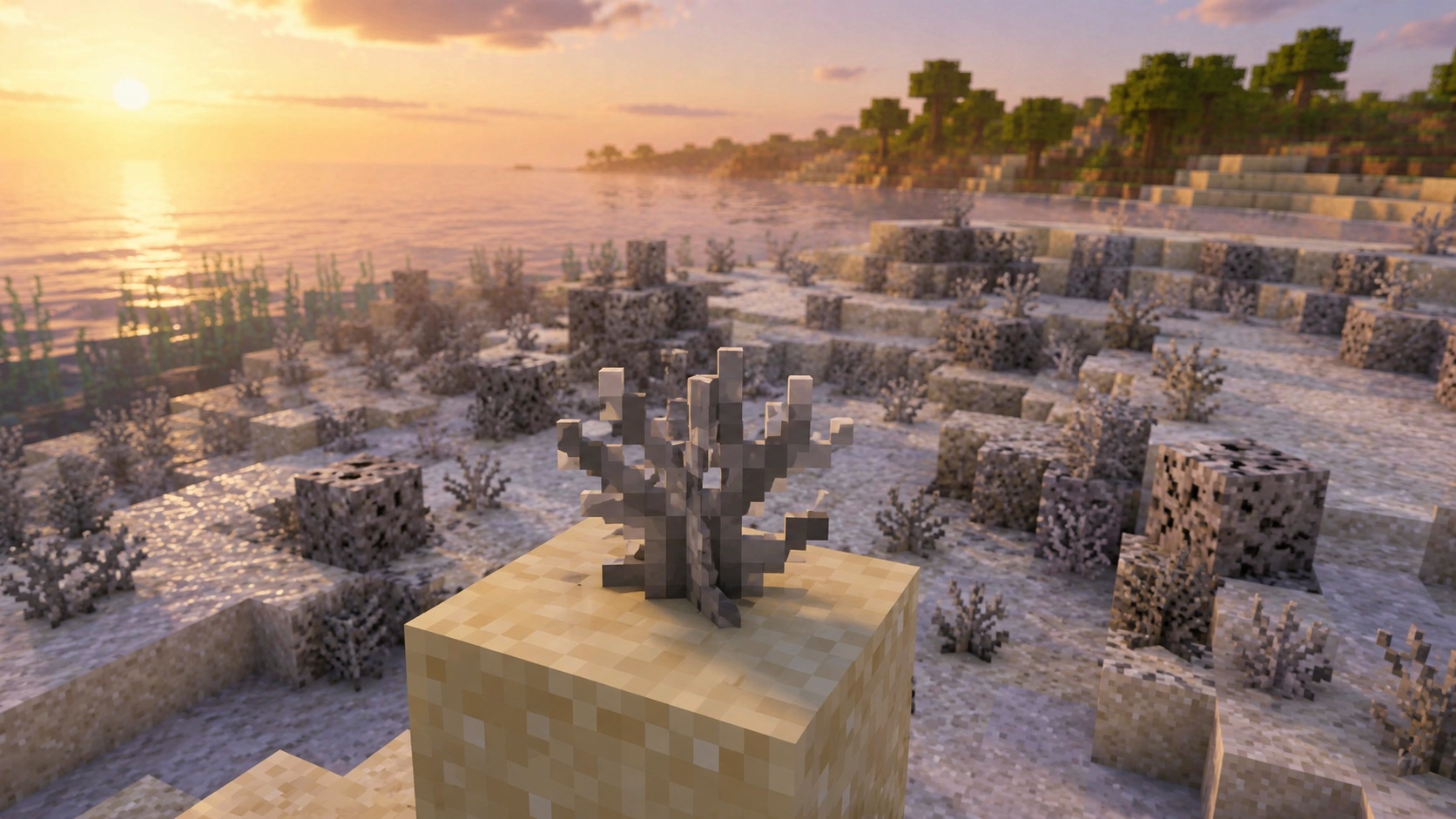
Dead fire coral is the gray, lifeless version of the small fire coral plant. It looks like a stubby red sprig sitting on top of a block, except all the color is gone. The shape stays the same. The life does not.
You get dead fire coral one of two ways: you place alive fire coral where it can’t touch water, and it dies, or you find dead coral that’s already there in an old reef. Once a coral plant goes gray, it stays gray. There is no way to bring it back to life.
Players use dead fire coral mostly for builds where the wet, animated look of living coral isn’t what they want. Stone-gray reef bases, fossil dioramas, post-flood scenery, that kind of thing.
What “fire coral” means in Minecraft
Coral in Minecraft comes in five colors: tube (blue), brain (pink), bubble (purple), fire (red), and horn (yellow). Each color has three forms.
- The coral block itself, a full cube.
- The coral plant, a small upright sprig that sits on top of a block.
- The coral fan, a flat fan shape that attaches to the side or top of a block.
“Dead fire coral” is the plant version. The dead cube is called dead fire coral block and the wall-mounted version is dead fire coral fan. All three share the same gray texture, but they break and place differently, so don’t confuse them.
How dead fire coral is made
Living fire coral needs water to stay alive. The rule is simple: at least one of the six surrounding block positions (north, south, east, west, up, down) must contain a water source or a flowing-water tile. If that requirement isn’t met for about two seconds, the coral turns dead.
This means a few things in practice:
- If you mine alive fire coral with silk touch and put it in a chest, it stays alive as an item. It only dies the moment you place it on a dry block.
- If you waterlog the block underneath or beside fire coral, that counts as the coral having water, and the plant survives.
- If a single water source feeding your reef gets removed or replaced with a non-water block, every coral plant that loses its water connection turns gray within a couple of seconds.
Once it’s gray, it’s gray for good. You can flood water around it later, but the plant won’t change back.
How to get dead fire coral
Mine it from a reef
You can find dead coral plants in two situations: in a reef where alive coral has died from a broken water connection, and around the edges of warm ocean coral reefs where dead patches have formed at world generation. They show up scattered among living coral in warm oceans.
To mine a dead fire coral plant and actually keep it, you need a tool with the Silk Touch enchantment. Any tool with Silk Touch works: pickaxe, axe, shovel, even a hoe will pick it up. Without Silk Touch, the plant breaks instantly and drops nothing, the same as alive coral plants. This catches a lot of new players. Hitting the coral with a normal pickaxe leaves you with empty hands.
Make your own
The faster way is to get alive coral and let it die on purpose.
- Find alive fire coral. Trade with a wandering trader, or mine it from a warm ocean reef with Silk Touch.
- Place the alive coral on a block with no water adjacent.
- Wait two seconds. The plant turns gray.
- If you need it as an item, mine it with Silk Touch.
A lot of builders skip the mining step entirely. They just place the alive plant where they want the dead version, then let it die in place.
How to place dead fire coral
Dead fire coral plants only attach to the top of a solid block. They don’t snap onto walls (that’s what fans are for), and they can’t float in midair. The block underneath has to have a full top face. Anything with a flat top works: stone, sand, dirt, planks, even glass.
The plant is waterloggable. Right-click it with a water bucket and the same block fills with water. That doesn’t bring it back to life, but it lets the plant sit underwater inside a reef or aquarium if that’s the look you want.
A few placement notes worth knowing:
- You can place dead coral plants on dead coral blocks, alive coral blocks, or any normal solid block. The host block doesn’t have to match the coral type.
- Pistons can push and pull dead coral plants. The plant pops off and breaks (no Silk Touch in play), so don’t push them around with redstone unless you’re fine with losing them.
- Water flowing through the same block doesn’t break the plant. It just waterlogs around it.
- Slabs and stairs do not count as a full top face. Place coral plants on full blocks only.
Survival tips and common mistakes
A few things players run into when working with dead fire coral:
- Don’t break it without Silk Touch. The plant drops nothing on a regular hit. If you want the item, enchant a tool first.
- Watch out for water flow. Flowing water can wash dead coral plants off blocks the same way it washes saplings. If you place a plant on a block next to a stream, the current can knock it free.
- Dead coral is not a light source. It’s purely decorative. If your reef is dark, add lanterns or sea lanterns to it.
- Don’t mix it up with the block version. If you wanted a full gray cube and you placed a plant, you’ll get a small sprig instead. Check the item icon before you place.
- Bone meal does nothing on coral, alive or dead. Don’t waste a stack trying to grow a reef out.
- Coral plants do not stack as tall as you might think. Each plant takes the full block above as its space.
Java vs Bedrock differences
Dead fire coral behaves the same way in both editions for almost every interaction. It is a non-tile decoration, it dies instantly without water when alive, it requires Silk Touch to drop, and it waterlogs the same way. The mining tool rules are identical too.
The one thing worth a check on Bedrock is chunk-loading behavior around coral. Bedrock can be quirky about coral life status when chunks unload and reload, sometimes leaving a small reef partially dead even though water is present. After every chunk reload on Bedrock, glance over the reef and look for any new gray patches. If you set up an alive coral display, an extra water-source check after reloading saves headaches later.
Build ideas using dead fire coral
Dead fire coral is small, gray, and has a textured silhouette, so it’s good for any build that wants a weathered or skeletal look. A few ways players use it:
- Dry reef walls. Stack dead coral blocks in front of a sandstone cliff and pepper dead plants on top to mimic a reef stranded above the tideline.
- Bone-yard or fossil scenes. The lifeless gray sits well next to bone blocks and gravel.
- Aquariums on hard mode. Glass tank with live water inside, dead coral as the “this tank has been neglected” set dressing.
- Old shipwreck decks. Dead plants on weathered planks read like crusted-over barnacles.
- Custom statues. The small upright sprig works as a stand-in for spiky decorations on shoulders, helmets, or castle parapets.
The fire variant specifically (even when dead) has a flame-shape silhouette, so if you mix multiple dead coral types in one build, fire is the one that pokes up the highest. Use it where you want a vertical accent in a reef of mostly horizontal pieces.
Frequently asked questions
Can dead fire coral be brought back to life?
No. Once a coral plant turns gray, it stays gray forever, even if you flood the area with water afterward. The state change only runs one direction.
What tool do I need to mine dead fire coral?
Any tool with the Silk Touch enchantment. A Silk Touch pickaxe, axe, shovel, or hoe will all pick it up. Without Silk Touch, the plant breaks but drops nothing.
Does dead fire coral grow on its own?
No. Coral plants don’t spread or grow once placed. Bone meal has no effect on them. The only way to get more dead fire coral is to mine it, kill alive coral on purpose, or trade for alive coral and place it on dry ground.
Can I waterlog dead fire coral?
Yes. Right-click the plant with a water bucket and the block waterlogs. The plant doesn’t change appearance and doesn’t come back to life. It just sits inside a water source like a normal underwater decoration.
What’s the difference between dead fire coral and dead fire coral block?
Dead fire coral is the small upright plant that sits on top of a block. Dead fire coral block is a full gray cube. The cube can be mined with any pickaxe and drops itself without Silk Touch. The plant needs Silk Touch and only sits on top of a host block.
Why does my fire coral keep dying?
The most common cause is the water source it was touching getting removed or replaced. If even one of the six surrounding positions is missing water, the plant dies in about two seconds. Waterlog the block underneath, or put a water source within a block of every coral piece, and they will stay alive.
Where do dead fire coral plants generate naturally?
Mostly in warm ocean coral reefs, in patches mixed with alive coral. They form when reef generation happens to leave a few plants without a water connection at world generation. You will also see them around ruined reefs near shorelines.
Quick recap and one tip
Dead fire coral is fire coral that lost its water and never came back. It needs Silk Touch to drop, sits on top of a solid block, and waterlogs without coming back to life. If you’re farming dead coral on purpose, skip the deep-ocean trip and convert alive coral on dry land. It’s faster than hunting reef edges, and you control which plants die where.