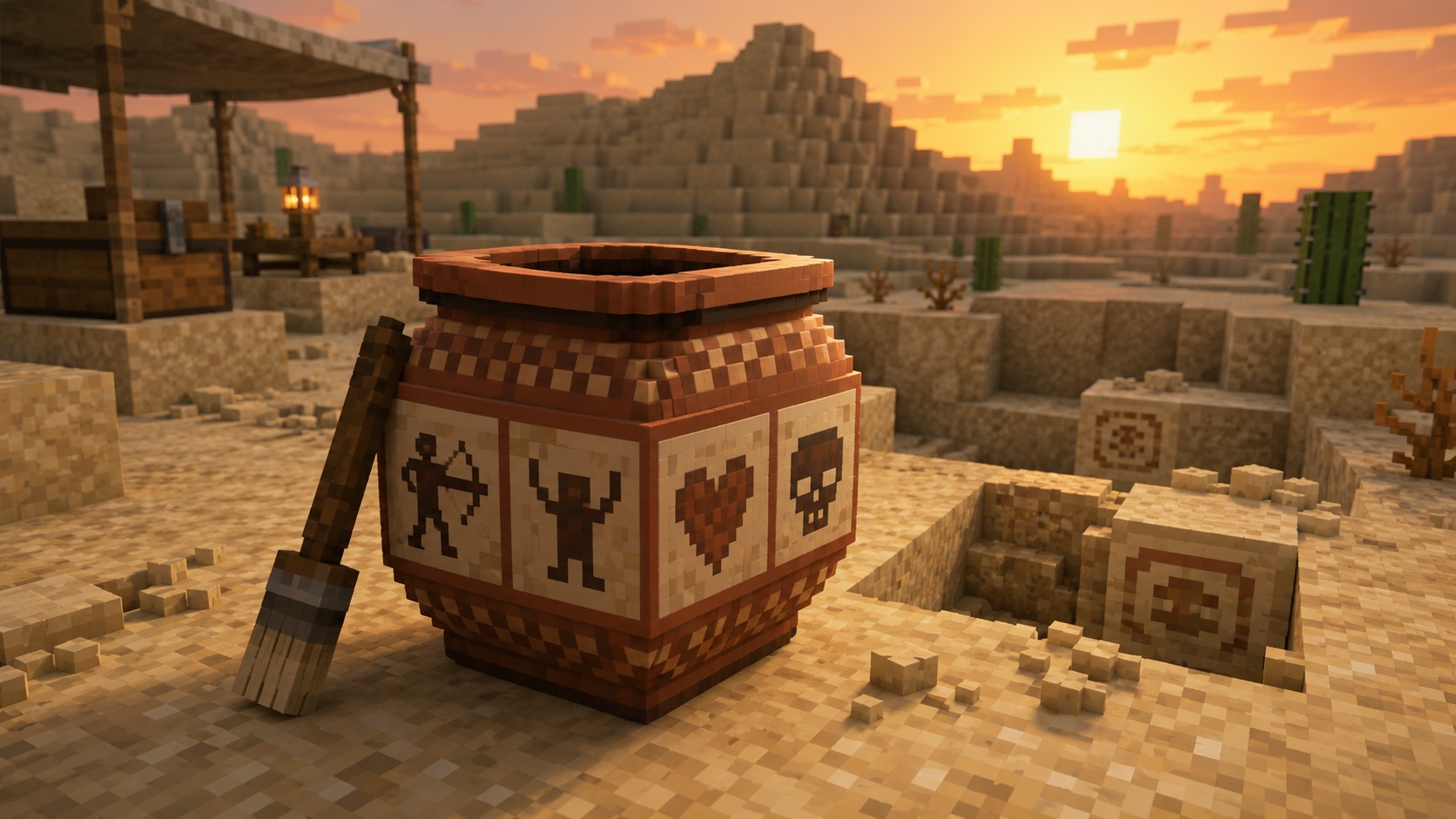
The decorated pot is one of the more underrated blocks added in the 1.20 update. It looks like a piece of pottery and holds a single item stack, and the four sides can be customized with stamped designs from sherds you dig up at archaeology sites.
This guide walks through how to craft a decorated pot, where to find pottery sherds, how the inventory works with hoppers, and how to break one without losing your materials.
What is a decorated pot
The decorated pot is a craftable block added in the 1.20 update. Its base is built from four bricks (the smelted clay item, not brick blocks). Each of the four sides can be customized with a pottery sherd, which is a thin clay tile carved with a specific design. Use only bricks and you get a plain pot with no patterns. Replace any of the four crafting positions with a sherd, and that side shows the sherd’s design.
Pots were added in Java and Bedrock 1.20 (Trails & Tales). The single-slot inventory was added in 1.20.5, which is the version most active worlds are running now.
How to craft a decorated pot
The recipe uses a fixed plus-sign pattern in the crafting grid:
- Top middle: brick or sherd
- Middle left: brick or sherd
- Middle right: brick or sherd
- Bottom middle: brick or sherd
The four corner slots stay empty. Each populated slot maps to one face of the finished pot.
Plain pot recipe: four bricks in the slots above produce one undecorated pot. Useful as cheap storage or as decor.
Decorated recipe: replace any number of bricks with sherds. Each sherd ends up on the matching face of the placed pot. Sherds are consumed in the crafting, so you can’t pop them off later.
You need a regular crafting table. The 2×2 player grid can’t fit the plus-sign arrangement.
Pottery sherds and where to find them
Sherds are dug out of suspicious blocks at archaeology sites. The brush tool slowly reveals them, and the kind of sherd you can pull depends on which site you’re brushing.
There are 20 sherds in the game: Angler, Archer, Arms Up, Blade, Brewer, Burn, Danger, Explorer, Friend, Heart, Heartbreak, Howl, Miner, Mourner, Plenty, Prize, Sheaf, Shelter, Skull, and Snort. Each one has a distinct silhouette stamped on the front. The Heart and Heartbreak sherds are popular for builds because they read clearly from a distance.
The four archaeology sites and what they offer:
- Desert pyramids: suspicious sand inside the loot chamber. Common sherds plus a few patterns weighted toward desert sites.
- Desert wells: a small set of suspicious sand blocks at the bottom of the well. Easy to miss, usually overlooked.
- Ocean ruins: suspicious sand or gravel depending on the ruin variant. Most ocean-flavored sherds come from here.
- Trail ruins: suspicious gravel scattered around the structure. The widest sherd pool and the only place some of the rarer designs reliably show up.
You need a brush in your hotbar to mine suspicious blocks safely. Hit the block with anything else and the contents are destroyed. Brushing takes several seconds per block, so plan to settle in at any major site.
The pot’s inventory
Every decorated pot has a single inventory slot that holds one full stack of any item. You interact with it by sneaking and right-clicking (Java) or by tapping the use button while sneaking (Bedrock). Right-clicking without sneaking pushes the held item into the pot directly.
The slot accepts anything that stacks, plus single non-stackables like tools, beds, and shulker boxes. When the pot is broken with a non-pickaxe tool (or a fist), the stored contents drop on the ground. When it’s broken with any pickaxe, the pot drops as a single placed item with its inventory and sherds intact.
Hoppers interact with pots normally. A hopper above pushes one item per tick into the pot until the slot is full. A hopper below pulls items out one at a time. This is the cheapest auto-storage block in the game by material cost: four bricks plus a few hopper parts.
Item entities can also be funneled into a pot with a water stream and a hopper at the end of the chain. For small storage rooms, that setup runs forever without any redstone.
Breaking a decorated pot safely
This is where most players lose their first set of fancy sherds. The behavior splits in two.
Hit a placed pot with your fist, a sword, a shovel, an axe, or any non-pickaxe tool, and the pot shatters. The block drops the individual bricks and sherds it was crafted from, along with whatever item the inventory was holding. You lose the assembled block and have to recraft it.
Hit a placed pot with any pickaxe (wooden through netherite, no enchantment needed), and the pot drops as a single placed pot item with its full pattern and stored inventory preserved. Silk Touch is not required. This is the only correct way to relocate a built pot.
TNT and creeper explosions shatter pots the same way a fist does. Build pots outside the blast radius if you care about keeping the sherds.
Storing pots inside other containers
You can stack empty decorated pots in chests, barrels, and shulker boxes the same way as any other item. A pot that’s still holding an item won’t stack with empty pots, so empty the slot first if you’re trying to consolidate.
This is mostly useful for hauling a collection of pots from your archaeology base back to your build. Pop them into a shulker box rather than placing and breaking each one along the way.
Decorating with pots
Pots work well as set dressing in builds because the sherd designs read like little icons on the side of the block. A row of pots with the Sheaf sherd looks like a row of grain sacks in a market stall. Pots with the Howl sherd fit well in spooky settings. Heart and Plenty sherds look at home in cottages and farms.
The four faces are oriented to match the recipe slots, so plan the side that will face the player before you craft. If you place the pot down and the wrong design is facing front, break it with a pickaxe, recraft with the sherds rearranged, and place it again. Rotation on the placed pot is set by the direction you’re facing when you place it, which lets you point a particular side toward a path or a window without recrafting.
Java vs. Bedrock
The differences are small in current versions. Java uses sneak plus right-click to open the inventory. Bedrock uses sneak plus the use button on controller, or the touchscreen equivalent. Both platforms let you bypass sneaking by right-clicking with an item to insert it directly.
Bedrock’s recipe book displays the pot recipe with explicit “any brick or sherd” slots, which helps if you’re new to the crafting. Java’s recipe book shows it as a brick-only recipe by default, and you have to know to swap in sherds.
Otherwise, sherd drops, archaeology mechanics, hopper behavior, and break behavior all match across both editions.
Tips and common mistakes
A few things players get wrong with pots more than once.
Confusing brick blocks with brick items. The recipe needs brick items (the smelted clay), not brick blocks. If the recipe isn’t filling in, that’s almost always why.
Forgetting the brush. Mining suspicious sand or gravel with anything other than a brush destroys the loot. Always have a brush in your hotbar, and brush from a stable position so you don’t get knocked off mid-mine.
Using a sword or shovel to dismantle a built pot. As above, that shatters it. Pickaxe only.
Trying to dye sherds or rotate them. You can’t. The sherd’s design is fixed, and the orientation on the face is set by the crafting slot you put it in.
Stacking pots that have items inside. The game doesn’t let you. Empty the pot first, or just place it down.
Frequently asked questions
Can I get a sherd off a pot after I place it?
No. Once a sherd goes into the crafting recipe, it’s part of the pot until the pot is shattered. A pickaxe break gives you the pot back as a single item, not the original sherds.
How big is a decorated pot’s inventory?
One slot. It holds up to a full stack of any single item: 64 for most items, 16 for snowballs and signs, and one for non-stackables like tools or shulker boxes.
Are decorated pots blast-resistant?
No. They have very low blast resistance, similar to other ceramic blocks. A single creeper at close range will destroy a pot and scatter the contents.
Do pots block mob pathing?
Yes. Pots are full block-sized for pathfinding, so mobs treat them like any other solid block. They make for cheap one-block wall caps when you’re sealing off a corner.
Do pots have a comparator output?
Yes. A comparator reading a decorated pot outputs a redstone signal proportional to how full the inventory is. Useful for auto-storage filters or “is the pot empty” alarms.
Can I rename a decorated pot?
Yes. Use an anvil and a name tag, or rename the pot item itself before placing it. The custom name appears in the pot’s interaction UI when you open it.
Do decorated pots work in Realms?
Yes. Realms run on the standard Java or Bedrock builds, so any version that has pots (1.20 and later) supports them on Realms.
Bottom line
The decorated pot is the cheapest single-slot storage in the game, and the sherds give it a personality that no chest has. If you’re running an archaeology trip, bring extra bricks back with you and craft the pots on site so you’re not hauling raw sherds through a long inventory shuffle later.