What deepslate bricks are
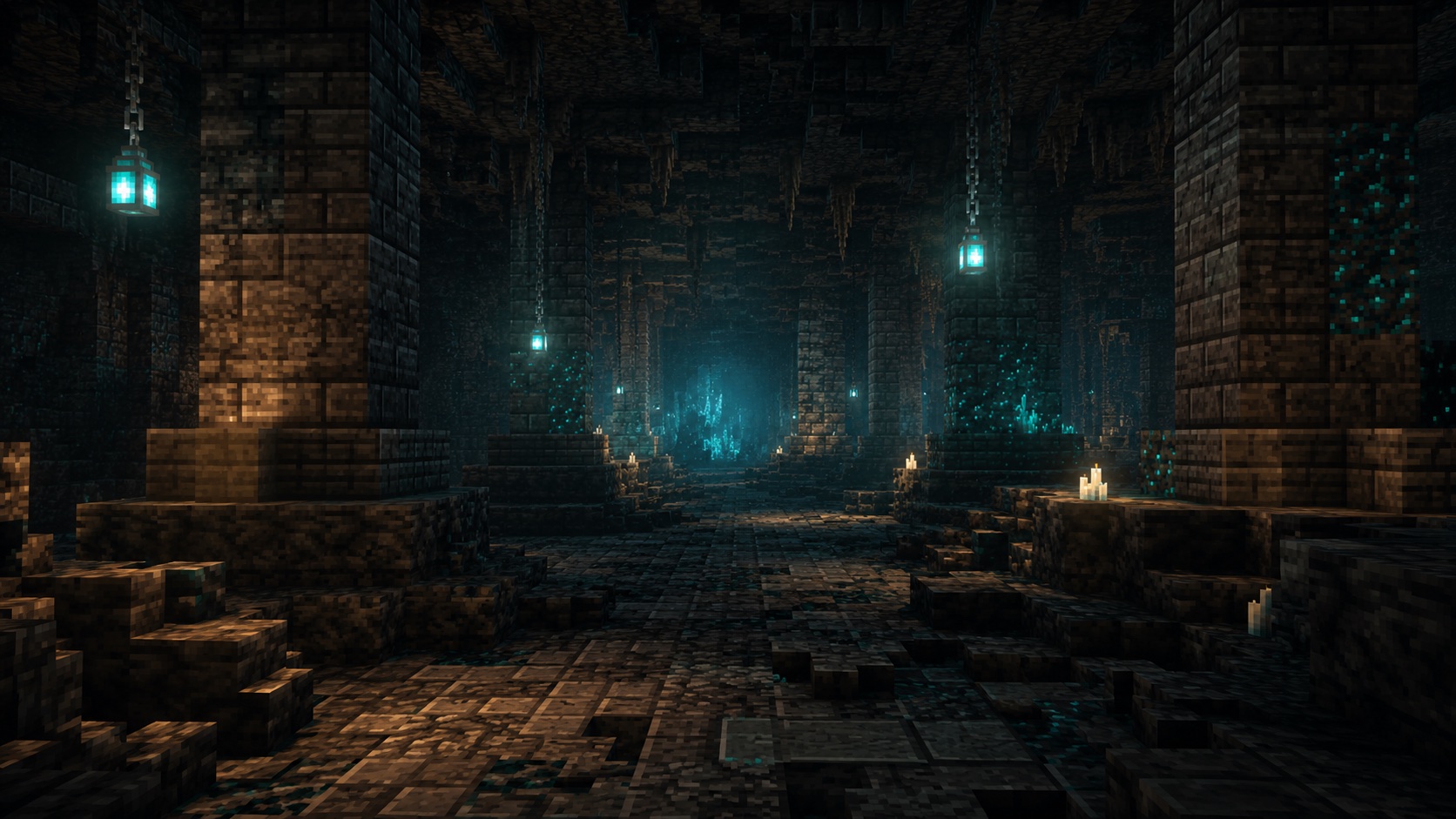
Deepslate bricks are a stone-family building block in Minecraft. They have a dark gray, neatly mortared look that sets them apart from the rougher cobbled deepslate found deep underground. If you have ever seen the floors and walls of an Ancient City, you have already seen deepslate bricks at work.
You can craft them yourself, or harvest them in bulk from Ancient City structures in the Deep Dark biome. Either way, they share the same recipe family as regular stone bricks, just with the darker, cooler stone palette that fits castle towers, dungeon builds, and modern interiors.
How to craft deepslate bricks
Deepslate bricks come from polished deepslate. You cannot make them straight from raw deepslate or cobbled deepslate. The chain looks like this:
- Mine deepslate with a pickaxe (it spawns from Y=0 down to roughly Y=-64). Mining it drops cobbled deepslate.
- Smelt cobbled deepslate in a furnace if you want the full deepslate block back, or skip ahead.
- Place four cobbled deepslate in a 2×2 pattern on a crafting table to get four polished deepslate.
- Place four polished deepslate in a 2×2 pattern to get four deepslate bricks.
If you have a stonecutter, you can skip the second crafting step. One polished deepslate placed in a stonecutter outputs one deepslate brick directly, which is handy when you have a stack of polished deepslate and want to convert it without juggling slots.
Crafting recipe summary:
| Input | Output | Method |
|---|---|---|
| 4 polished deepslate | 4 deepslate bricks | Crafting table (2×2) |
| 1 polished deepslate | 1 deepslate brick | Stonecutter |
| 1 deepslate brick | 1 cracked deepslate brick | Furnace |
Where to find deepslate bricks naturally
Deepslate bricks spawn naturally in Ancient Cities, the giant underground ruins in the Deep Dark biome. The structure is built almost entirely from the deepslate family: cobbled deepslate, polished deepslate, deepslate bricks, deepslate tiles, and their cracked variants. The bricks make up large floor slabs, columns, and stair railings.
Ancient Cities generate between Y=-51 and Y=-1 inside Deep Dark biomes. You can find them by digging straight down past Y=0 once you spot a Deep Dark cave entrance, or by tunneling sideways from deeper mineshafts. Bring a silk touch pickaxe if you want to harvest the bricks intact. Without silk touch, mined deepslate bricks still drop themselves as long as you use any pickaxe.
Loot strategy
If you are visiting an Ancient City for the loot, the building blocks are a free bonus. A single chamber yields several stacks of mixed deepslate variants if you mine the floor. Keep a sneak crouch active so the Warden does not wake up, and avoid stepping on sculk sensors. Cover sensors with wool or place wool blocks under your feet to mask vibrations.
Mining deepslate bricks
Deepslate bricks need a pickaxe to drop anything. Mining them with your fist, a shovel, an axe, or any non-pickaxe tool destroys the block and drops nothing. Use at least a wooden pickaxe; a stone, iron, or netherite pickaxe is faster.
The hardness value is the same as polished deepslate, which is harder than cobbled deepslate. The differences in real time:
- Wooden pickaxe: about 1.15 seconds per block.
- Stone pickaxe: about 0.6 seconds.
- Iron pickaxe: about 0.4 seconds.
- Diamond pickaxe: about 0.3 seconds.
- Netherite pickaxe: about 0.25 seconds.
Efficiency enchantments cut these numbers further. Efficiency V on a netherite pickaxe with Haste II makes deepslate brick farming feel nearly instant. If you are stripping an Ancient City, that combo is what you want.
Building variants: slabs, stairs, and walls
Deepslate bricks have the standard three building variants. You can craft each of them at a regular crafting table, or with less waste, at a stonecutter:
- Deepslate brick slab. Place three deepslate bricks in a row on a crafting table to get six slabs, or use a stonecutter for a 1:2 ratio (one brick yields two slabs).
- Deepslate brick stairs. Place six deepslate bricks in a staircase pattern to get four stairs, or one brick yields one stair on a stonecutter.
- Deepslate brick wall. Place six deepslate bricks in two rows of three to get six walls, or one brick yields one wall on a stonecutter.
The stonecutter is almost always the better choice for stairs and walls because it converts at a one-to-one ratio for both, while the crafting table eats more bricks per output. The crafting table only wins on slabs, where six slabs from three bricks beats the stonecutter when you have a large pile of leftovers and want to spread them out.
Cracked deepslate bricks
Smelt a deepslate brick in a furnace to get a cracked deepslate brick. The recipe takes one fuel charge and gives you one block back, so it is a slow conversion if you are doing many. They also spawn naturally in Ancient Cities, mixed in with the regular bricks for a worn look.
Cracked deepslate bricks have no slab, stair, or wall variants. They are a pure decorative block. If you want a section of wall to look weathered, alternate cracked and standard bricks at random with chiseled deepslate mixed in. The result reads as a ruin without any extra effort.
Build ideas and use cases
Deepslate bricks are one of the most flexible stone palettes in the game because of the dark base color. A few places they shine:
- Castle towers. Use deepslate bricks for the body, deepslate tiles for trim around windows, and chiseled deepslate as accent blocks at corners.
- Modern interiors. Mixed with light oak planks and white concrete, deepslate bricks make a clean gray-and-warm-wood look popular in contemporary builds.
- Dungeons and adventure maps. Cracked deepslate bricks plus deepslate tiles and a few sculk patches give an underground ruin its bones without much effort.
- Roads and floors. Slabs make a tidy pathway that does not feel as plain as stone slab. Stairs let you build smooth ramps and curbs.
- Dark fortresses. Combined with blackstone bricks for accent and crying obsidian as glowing trim, the palette reads as ominous without being all black.
Deepslate bricks also pair well with copper. Weathered or oxidized copper blocks read as green-blue patina against the gray, which makes for handsome roofing on castle towers and accent walls in modern builds. If you want the green to stick, use wax on the copper before placing it next to the bricks.
Another underused combo is deepslate bricks with mud bricks. The warm tan of mud bricks contrasts the cool gray of deepslate, and mud brick stairs work alongside deepslate brick stairs to create two-tone steps. It is a small detail that lifts a plain build.
The block accepts standard light sources. Soul lanterns, candles, and froglights all sit nicely on top of deepslate brick walls without the colors clashing.
Java vs. Bedrock notes
The recipes, drops, and behavior of deepslate bricks are the same on Java and Bedrock. There is no edition-specific quirk you need to know about. The only practical difference is in Ancient City generation seeds, which are not the same between editions, so the exact layout of any one city will look different on the two platforms.
Frequently asked questions
Can you craft deepslate bricks from cobbled deepslate?
Not directly. You have to convert cobbled deepslate into polished deepslate first (or smelt it into deepslate and polish that), and then craft the bricks from polished deepslate. A stonecutter does not accept cobbled deepslate as input for bricks, so the polished step is required.
Do deepslate bricks resist explosions?
Yes. They have the same blast resistance as polished deepslate, which is much higher than regular stone bricks. A creeper at point-blank range will dent a wall of deepslate bricks but is unlikely to break through.
Do you need silk touch to get deepslate bricks?
No. Any pickaxe mines deepslate bricks and drops the block itself. Silk touch matters for harvesting other Ancient City surfaces without converting them, and for picking up cousins like sculk and budding amethyst, but not for plain bricks.
Can mobs spawn on deepslate bricks?
Yes. Deepslate bricks are a solid full block with a normal light filter, so hostile mobs will spawn on them at light level zero, the same as on cobblestone or stone. If you build a base out of deepslate bricks, light it well or expect uninvited guests.
How many deepslate bricks does an Ancient City have?
A single Ancient City has thousands of deepslate brick blocks across its floors, columns, and ruined arches, often mixed with cracked deepslate bricks and tiles. Stripping one city floor is usually enough to build a small castle without ever crafting more.
What is the difference between deepslate bricks and deepslate tiles?
Bricks have a vertical-and-horizontal mortar grid, while tiles have a tighter, more uniform square pattern. Tiles are made from deepslate bricks (four bricks in a 2×2 give four tiles). Mixing both in the same build adds texture without adding new colors.
Does the stonecutter waste any deepslate bricks?
No. The stonecutter converts deepslate bricks one-for-one into stairs, walls, and chiseled variants, and one-for-two into slabs. The crafting table is less efficient for stairs and walls, so the stonecutter is the better default tool.
One last thing
If you only carry one extra block stack when raiding an Ancient City, make it deepslate bricks. They patch up holes in the floors, fill in walls so mobs cannot spawn behind you, and stack to a full pickaxe-mineable barrier between you and any sculk shriekers you would rather not hear. A small pile goes a long way down there.