What a detector rail is
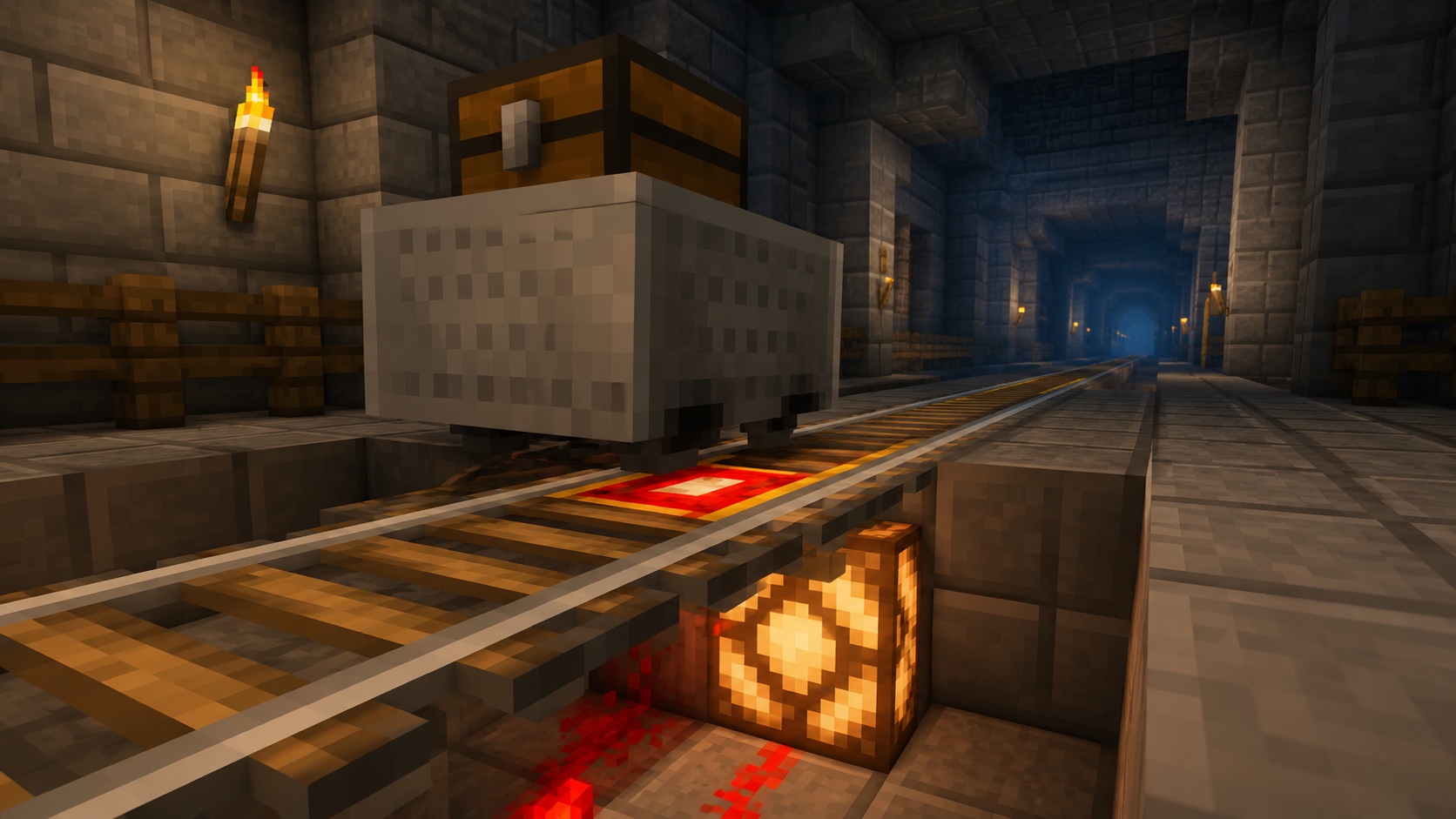
A detector rail is a special rail in Minecraft that sends out a redstone signal the moment a minecart sits on top of it. Place one on a track, hook redstone to it, and any cart that rolls over the rail will trigger whatever you have wired to it. The cart can be empty, full of chickens, loaded with TNT, or carrying a chest of diamonds. The detector rail does not care. If something on rails is on top, it fires.
That makes the detector rail the trigger half of nearly every minecart contraption in the game. The other rails move carts. The detector rail tells the rest of your build that a cart just arrived. Without it, you cannot build a self-running cargo line, an auto-loading station, a TNT cart bomb, or a station-door system that opens only when a cart pulls in.
The detector rail is a redstone block, not a transport block. It counts as a rail for placement and direction, but its job is to fire signals.
How to craft a detector rail
The recipe needs three ingredients and a crafting table.
- 6 iron ingots
- 1 stone pressure plate
- 1 redstone dust
Place iron ingots in the left and right columns of the crafting grid, top to bottom (three on each side, for six total). Put the stone pressure plate in the center of the grid, and one redstone dust below it in the bottom middle slot. The recipe produces 6 detector rails per craft.
The detector rail is one of the cheaper redstone rails. A powered rail costs 6 gold ingots, a stick, and redstone. An activator rail costs 6 iron, 2 sticks, and a redstone torch. So if you are mining for iron anyway, you can stockpile detector rails without much extra effort. The pressure plate is the only piece that needs a side trip to the crafting menu.
How detector rails work
A detector rail acts like a normal rail when no minecart is on it. Carts roll over it the same way they roll over a regular rail. The rail itself is not a powered rail, so it does not boost or slow a cart on its own. Carts coast through it.
The moment a minecart of any type sits on top of the rail, the detector rail switches on. While it is on, three things happen.
First, the rail emits a redstone signal of strength 15. That signal travels through redstone dust placed next to it the same as any other power source.
Second, the rail powers the block directly below it. Place a piston, dispenser, dropper, door, or lamp under a detector rail, wire it up, and that block will fire when the cart arrives.
Third, the rail weakly powers adjacent blocks. Any redstone component touching the rail (or touching the block below it) will react. This means you can wire short circuits without running long redstone dust trails. A door right next to the rail will open. A lamp under it will light.
When the minecart leaves the rail, the signal drops to zero on the next tick. Detector rails do not stay on. They do not have a hold time. They fire only while a cart is physically over them, plus a tick or two of falloff.
Reading what is in the minecart
This is where detector rails get more interesting than a pressure plate. Place a redstone comparator in front of a detector rail and the comparator reads the inventory of whatever cart is on top.
For a regular minecart with no chest, the comparator outputs a small signal when a cart is on the rail (different cart types give slightly different values, but it is low). For a minecart with chest, hopper, or furnace, the comparator outputs a signal strength proportional to how full the inventory is. An empty chest cart gives a low signal. A chest cart packed with items gives a strong one.
You can wire a comparator-set redstone latch to detect “this cart is loaded” versus “this cart is empty” and route the cart to the right station based on its load. That is the whole foundation of automated cargo systems in Minecraft. A loaded cart triggers a different track than an empty one. You can build sorters, station selectors, and item logistics around it.
What detector rails do not do
A detector rail will not turn. All detector rails are straight pieces. They have a north/south or east/west orientation set by the surrounding track when placed. If you try to place one at a corner, the cart will derail. Plan your track so the detector rail sits on a straight section.
Detector rails cannot be powered by redstone the way powered rails or activator rails can. You do not feed them a signal. They produce one. Putting a lever next to a detector rail does nothing. Only a minecart on top triggers it.
A detector rail does not slow, speed up, or eject a cart. The cart’s speed is unchanged by passing over it. If you want to boost or stop a cart, place a powered rail or an activator rail next to your detector rail.
How to use a detector rail
Detector rails sit behind nearly every minecart redstone build in the game. A few of the most common uses follow.
Automatic station doors
Place a detector rail right outside a station. Wire it to the iron doors leading into the station. When a cart pulls up, the doors open. When the cart leaves, they close. No buttons, no levers. It also works as a cart-only entry: players and mobs walking up to the rail will not set it off, only a cart on top does.
TNT cart launchers and traps
A common siege build runs TNT minecarts down a long rail line. Put a detector rail at the end so the moment the cart arrives, it triggers a piston that drops a wall, a dispenser that fires arrows, or a noteblock that chimes for confirmation. For a TNT cart that should detonate on arrival, place a detector rail in the path and wire it to a powered rail facing the target so the cart launches into the obstacle and explodes from speed.
Auto-unloading hopper stations
A chest cart that pulls into a station can be unloaded by a row of hoppers below the rail. The detector rail’s role here is to tell the system the cart has arrived, so a piston pushes the cart against a stop, a hopper unloads it, and a powered rail behind it sends the empty cart back to the start of the loop. This is the basis of large item-shipping rail networks.
Counters and travel logs
A detector rail combined with a comparator and a few repeaters can act as a passenger counter. Every time a cart rolls over the rail, the signal ticks a redstone clock that increments a display. Players have used this to count laps, log items shipped, or chime a noteblock when a cart pulls in.
Hidden alarms
Place a detector rail somewhere a minecart can be sent on a one-shot trip. When the cart triggers the rail, a noteblock plays, a beacon lights, or a sign reveals. It works as a tripwire that only triggers under a minecart, which means players and wandering mobs never set it off.
Tips and common mistakes
A few things trip people up the first time they wire detector rails.
The rail only fires while the cart is on top. If you need the signal to persist after the cart leaves, run the output through a redstone latch (an RS-NOR latch built from two torches and two repeaters works fine). Without a latch, the signal vanishes the moment the cart rolls off.
The rail powers the block directly below it. If that block is a redstone-conductive solid block like stone or wool, the power will travel into anything attached to that block. This can fire a piston you did not want firing. Use a non-conductive block like glass below the rail if you only want the signal to travel through redstone dust, not through the block itself.
Carts that get pushed onto a detector rail at very low speed sometimes do not trigger it cleanly on Bedrock. If you are running slow station builds, place a short powered rail before the detector rail so the cart has consistent speed when it crosses.
Any tool breaks a detector rail, but a pickaxe is fastest. The rail drops itself, so there is no enchantment trick needed to recover it. You can also pick a detector rail up by breaking the block it sits on; it pops off the same way regular rails do.
Java vs. Bedrock differences
The detector rail behaves the same across both editions in most ways. Recipe, signal strength, and comparator behavior all match.
The small difference is timing. Java fires the signal one tick after the cart lands on the rail and lingers for one tick after the cart leaves. Bedrock has slightly tighter timing. For most builds this does not matter, but for fast pulse-based contraptions (rapid-fire dispensers or single-tick counters) you may need a repeater on the output line in Bedrock to stretch the pulse so it actually registers.
Both editions support the comparator read of cart inventory. Both fire on every cart type. There is no edition where the rail only triggers on specific carts.
Frequently asked questions
Does a detector rail work with all minecart types?
Yes. It fires when any minecart sits on it, including regular minecarts, minecarts with chest, hopper, TNT, furnace, or command block. The signal triggers either way; what changes is what a comparator can read off it.
Can a detector rail turn a corner?
No. Detector rails are always straight. Place them on straight sections of track only.
How much redstone signal does a detector rail give?
A detector rail outputs a redstone signal of strength 15 (full power) when triggered, the same as a redstone block or active button. Signal strength drops off with distance through redstone dust the same as any other source.
Can I power a detector rail with redstone?
No. Detector rails generate power; they do not receive it. A lever, button, or torch next to one does nothing. Only a cart on top triggers it.
What does a comparator read from a detector rail?
The comparator reads the inventory of the minecart on top. A chest cart with one stack returns a small signal; a full chest cart returns a strong one. An empty regular minecart returns a low signal too. This is how you sort full carts from empty ones at a station.
How do I make a detector rail signal stay on after the cart leaves?
Use a redstone latch on the output. An RS-NOR latch holds the signal until you reset it. Without a latch, the signal disappears the moment the cart rolls off the rail.
Can mobs trigger a detector rail by standing on it?
No. Only minecarts trigger detector rails. Mobs and players walking on top do nothing. That is what makes detector rails better than pressure plates for cart-only triggers.
Worth knowing
A detector rail is the cheapest way to turn a moving minecart into a redstone event. If you are building any cart system more complex than a one-way line, you will use at least one. Start with a station-door build to learn the timing, then wire in a comparator to read cart contents. From there you can wire just about any cart automation you want.