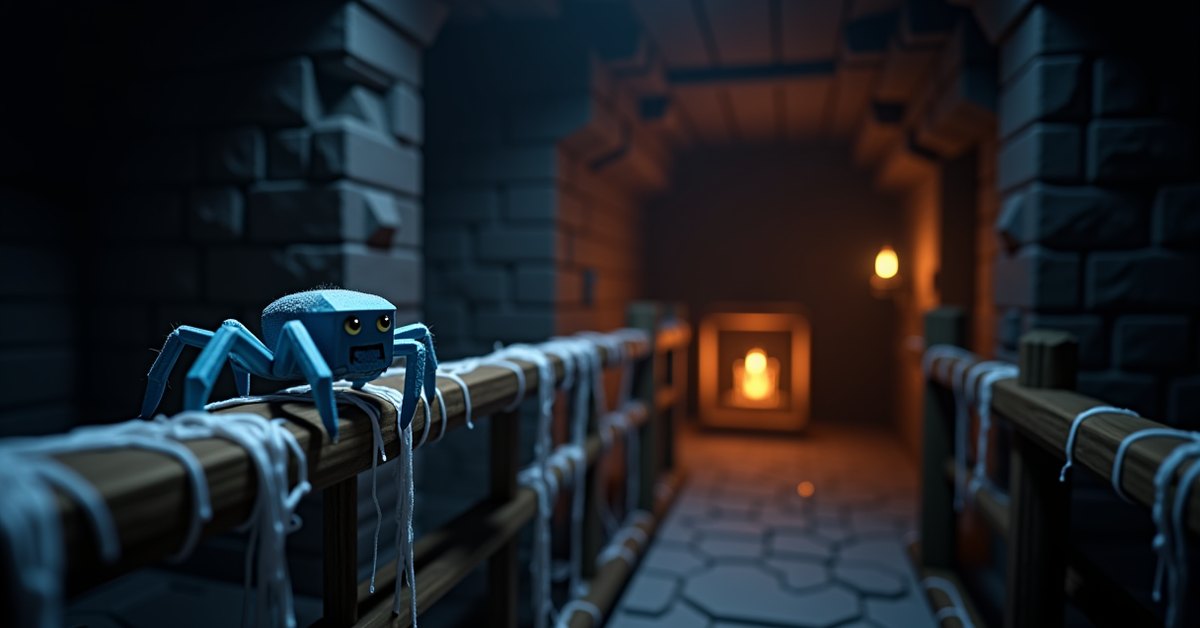
What is a cave spider?
A cave spider is a small hostile mob found only in abandoned mineshafts. It looks like a regular spider shrunk down and tinted blue, and it behaves much the same way: it climbs walls, spots you through walls, and attacks in groups. The difference that matters is the poison. On Normal and Hard difficulty, a cave spider’s bite leaves you poisoned, and that extra damage is what turns a quiet mineshaft into a real threat.
Cave spiders have 12 health (6 hearts), so they die fast once you connect a hit. The danger is rarely a single spider. They pour out of a spawner several at a time, and their small size lets them slip through gaps that would stop almost anything else in the game.
If you have run into one, there is a spawner close by. Everything about handling cave spiders comes back to finding that spawner and deciding what to do with it.
Where cave spiders spawn
Cave spiders come from one source only: the monster spawner found in abandoned mineshafts. You will not meet them wandering open caves the way the name suggests, and they never spawn from the dark on their own.
The spawner sits inside a cluster of cobwebs, usually jammed into the mineshaft’s wooden corridors. The webbing is the warning sign. As soon as you see a thick patch of cobwebs in a mineshaft, slow down and look for the small cage block in the middle with a tiny spinning spider inside it.
The spawner stays active while you are within 16 blocks of it, and it keeps producing spiders until you light it up or wall it off. Because it is the only source, you control the fight by controlling the spawner. Step back out of range and the spiders stop coming. That one fact shapes every safe approach below.
How cave spider poison works
Poison is the whole reason cave spiders earn their reputation. When one hits you, it applies the Poison effect on top of the normal attack damage. Poison drains your health over time, but it can never kill you by itself. It stops at half a heart and leaves the finishing blow to the spider.
Difficulty decides whether you get poisoned at all:
- On Easy, cave spiders deal damage but never apply poison.
- On Normal, a bite poisons you for about 7 seconds.
- On Hard, the poison lasts around 15 seconds.
That makes Easy a reasonable choice the first time you clear a mineshaft. If you are on Normal or Hard, carry a bucket of milk. Drinking milk clears every status effect instantly, poison included, so one swig resets you mid-fight. A couple of buckets of milk in your hotbar turn a cave spider spawner from scary into routine.
How to fight cave spiders
The trick with cave spiders is their hitbox. A cave spider is only about 0.7 blocks wide and 0.5 blocks tall, so it squeezes through a one-block gap you would assume is sealed, and it can reach you through openings a normal mob never could. Walling yourself off does not work the way you expect unless the wall is made of full, solid blocks.
A few habits keep you alive:
- Cut the cobwebs first. Webbing slows you to a crawl, and being stuck in a web while poisoned is how players die here. A sword slices webs instantly and drops string. Use shears instead if you want to collect the cobweb block itself.
- Fight in a lit, open space when you can. Back into a corridor mouth so the spiders come at you one at a time instead of climbing around you.
- Watch the ceiling and walls. Cave spiders climb, so they often drop onto you from above rather than walking straight in.
- Keep milk or healing food ready. Poison stacked with web slowdown is the real danger, not the spiders’ raw damage.
Like regular spiders, cave spiders react to light. In light level 12 or higher they turn neutral and will not attack unless you strike them first. They still spawn in the dark and stay hostile there, but raising the light around your position takes the edge off the fight.
Dealing with a cave spider spawner
Once you find the spawner you have two sensible options: shut it down or turn it into a farm.
Shutting it down
A monster spawner only produces mobs when the spawn conditions are met in the small volume around it. For cave spiders that means low light and open space. Raise the light level to 12 or above by placing torches on and around the spawner and the spawns stop. Filling the nearby air with blocks works too, since the spawner needs room to place a spider. Most players light it up, grab the cobwebs, and move on.
Do not break the spawner unless you have a clear reason to. Once it is gone, it is gone for good, and a live spawner is worth far more as a farm than as a one-time handful of experience.
Building a string and XP farm
A cave spider spawner makes a solid early farm for string and experience. The idea is the same as any spawner farm: give the spawner a dark room to fill with spiders, funnel them into one spot, and weaken them to where a single hit finishes them off.
The catch is, again, the hitbox. Cave spiders fit through half-block gaps, so a design that holds back full-size mobs may leak cave spiders straight into your collection point. Many builders push the spiders down a water channel into a one-block killing slot guarded by a slab or a sign, leaving just enough room to strike them but not enough for them to climb out. Keep the area around the kill spot lit so any spider that wanders outside the trap turns neutral.
If you are early in a world and short on string for bows, wool, and leads, a spawner like this is one of the better reasons to keep it alive instead of destroying it.
Drops and experience
When killed, a cave spider drops 0 to 2 string, and the Looting enchantment raises that maximum. A cave spider killed by the player also has a chance to drop a single spider eye, which you can eat in a pinch or brew into a Potion of Poison or a fermented spider eye for other recipes. Spider eyes only drop from player kills, so a fully automatic farm hands you string and experience but no eyes.
Each cave spider gives 5 experience when you land the killing blow. Across a spawner’s steady output that adds up quickly, which is the main argument for keeping a spawner running rather than tearing it out.
Tips and common mistakes
The most common mistake is rushing into the webs. Players spot the spawner, sprint in to break it, and end up trapped in cobwebs while three poisoned spiders chew through their armor. Clear the webs from the outer edge inward and give yourself a clean floor to stand on before you commit.
The second mistake is trusting a one-block wall. Because cave spiders are shorter and narrower than normal mobs, they reach through gaps you would consider safe. When you block off a corridor, use full blocks with no slab or fence gaps near the floor.
Cave spiders are immune to the poison effect themselves, so a Potion of Poison does nothing to them. Splash potions of Harming still work. And remember that milk cancels your own poison but also wipes any buffs you are running, so drink it for the cure and reapply your potions afterward.
Java and Bedrock differences
Cave spiders behave almost identically across both editions. The biggest practical difference is how poison scales with difficulty, with longer poison on Hard than on Normal and none on Easy in both versions. Spawner mechanics, the cobweb-filled mineshaft setup, and the small hitbox all match on Java and Bedrock, so a farm built for one edition usually carries over to the other with only minor tweaks.
Frequently asked questions
Where do cave spiders spawn in Minecraft?
Only from monster spawners in abandoned mineshafts, surrounded by cobwebs. They do not spawn naturally anywhere else, including ordinary caves.
How do you stop a cave spider spawner?
Raise the light level around it to 12 or higher with torches, or fill the surrounding space with blocks so spiders have nowhere to appear. Both methods stop new spawns without destroying the spawner.
Do cave spiders always poison you?
No. On Easy difficulty they never apply poison. On Normal and Hard they do, and the poison lasts longer on Hard.
How do you cure cave spider poison?
Drink a bucket of milk, which removes poison and every other status effect at once. A honey bottle also clears poison if you have one on hand.
Can cave spiders fit through one-block gaps?
Yes. Their hitbox is shorter and narrower than a normal mob’s, so they slip through half-block openings and attack through gaps you would think are sealed.
Are cave spiders worth farming?
Yes, for string and experience. A spawner gives a steady supply of both. For spider eyes you have to land the kills yourself, since eyes only drop from player kills.
The bottom line
Cave spiders are only as dangerous as the webs and poison around them, and both have simple counters: a sword for the webs, a bucket of milk for the poison. Handle those two and the spawner stops being a hazard and becomes one of the most useful early-game farms you can find.