The chiseled quartz block is one of the easiest decorative blocks to make in Minecraft once you have a steady supply of nether quartz, and it does a lot of visual work for what it costs. The carved face fits clean modern builds, classical columns, palace interiors, and most builds where a plain wall of quartz feels a little too flat.
This guide covers what the block looks like, how to craft it from quartz slabs, the stonecutter shortcut that skips the slab step, where nether quartz comes from, the block’s mining and physics, and the build patterns where the chiseled face actually helps. There is a short FAQ at the end with the questions players ask most.
If the difference between the block of quartz, the chiseled version, the quartz pillar, and quartz bricks has ever been confusing, the family rundown later in the article maps each one to its texture and use case.
What does a chiseled quartz block look like?
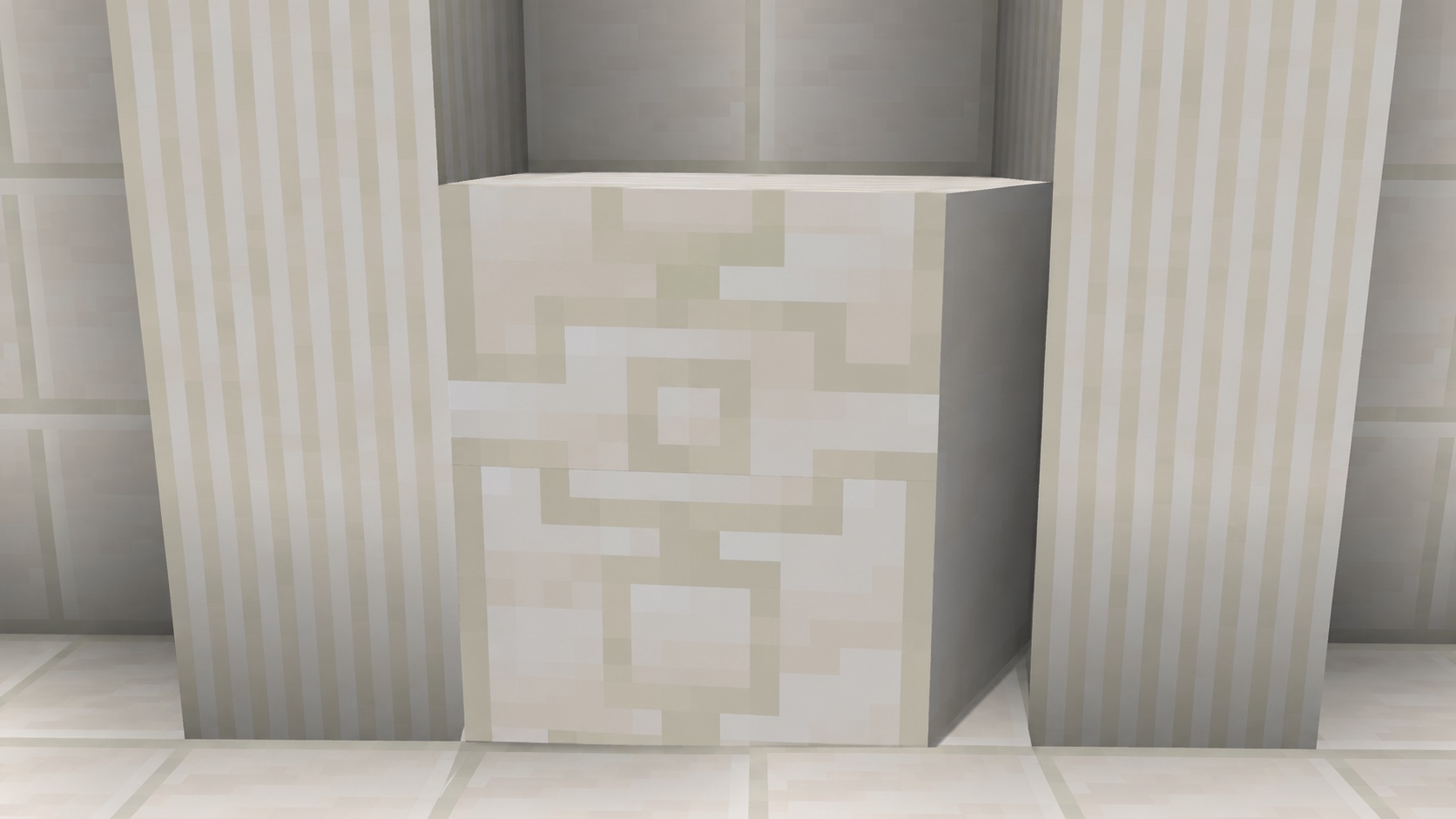
The chiseled quartz block is a decorative block made from nether quartz. It has a smooth pale cream color and a centered carved pattern on the front and back faces, with a horizontal seam running across the middle. The carving is identical on opposite sides, so it reads the same from either direction.
It is available in Java Edition, Bedrock Edition, and Education Edition. The look and the crafting recipe are the same in all three.
Most builders use it for accents in temples, palaces, modern houses, and white-stone interiors. It pairs cleanly with the rest of the quartz family. The carved face is busy enough to act as a frame, a column cap, or a single-row trim. A full wall of nothing but chiseled quartz block can look noisy at scale, so the common pattern is to use it sparingly against a calmer block like the plain block of quartz, smooth quartz, or white concrete.
How to craft a chiseled quartz block
The crafting recipe takes two quartz slabs stacked vertically in a crafting table or your 2×2 inventory grid:
- Place one quartz slab in the middle of the grid.
- Place a second quartz slab directly above it.
- The output is one chiseled quartz block.
Two quartz slabs equal one full block of quartz worth of material, so the cost works out the same as a regular block of quartz, only with the chiseled face as the bonus. The recipe also fits the 2×2 inventory grid because it only uses two cells in a single column.
Quartz slabs themselves come from three blocks of quartz placed in a row in the crafting grid. That gives you six slabs, which is enough for three chiseled quartz blocks.
The stonecutter shortcut
If you have a stonecutter, you can skip the slab step entirely. Place a block of quartz on the stonecutter, and the chiseled quartz block appears as one of the available outputs. One input gives one output, with no leftover slabs.
The stonecutter is the cleanest way to convert raw nether quartz into chiseled quartz block at scale. The chain looks like this: four nether quartz crafts into a block of quartz, then the stonecutter converts that into a chiseled quartz block. The stonecutter recipe was added in version 1.14, so you need a world on that version or later to use it.
You can also use the stonecutter to swap between other quartz family items, including quartz pillar, quartz bricks, smooth quartz, slabs, and stairs, without needing a full crafting table for each conversion.
Where nether quartz comes from
Every variant of quartz starts with nether quartz, and nether quartz only spawns in the Nether dimension.
You get it by mining nether quartz ore. The ore is common in the nether wastes, crimson forest, and warped forest biomes, usually at the same elevations where you find netherrack. A wood pickaxe or better will mine it. Each ore block drops one nether quartz and gives experience, so a long mining session in the Nether is a fast way to bank both quartz and levels.
The renewable source is piglin bartering. Tossing a gold ingot at an adult piglin (or feeding ingots through a dispenser onto a barter pad) sometimes returns nether quartz as one of the possible drops. The drop rate per individual barter is low, but with a gold farm and a piglin barter setup, you can pile up nether quartz without ever leaving the safety of an enclosed room.
Once you have raw quartz, the chain to a chiseled quartz block is short: four nether quartz to one block of quartz, then either two slabs in the crafting grid or one stonecutter step.
Mining and block properties
The chiseled quartz block shares its physical properties with the rest of the quartz family:
- Hardness: 0.8
- Tool: any pickaxe (wood is enough)
- Drops itself when mined with a pickaxe; drops nothing if mined with the wrong tool or with a fist
- Blast resistance: low (it breaks under creeper explosions and TNT)
- Light level: none
- Flammable: no
It can be pushed and pulled by pistons. It is fully solid, so torches, ladders, redstone, and rails all attach to it normally. Mobs will not spawn on a quartz block under normal lighting because the block has the same opacity as any solid full block.
The quartz family at a glance
The quartz blocks are easy to confuse because they all share a pale palette and similar shapes. Here is the short tour of how each one differs:
- Block of quartz: the plain version. Smooth on the top and bottom faces with subtle vertical lines on the sides.
- Chiseled quartz block: the one this article is about. A carved square symbol on the front and back, with a horizontal seam through the middle.
- Quartz pillar: vertical lines on the side faces, flat caps on the top and bottom. Direction-sensitive when placed, so it rotates with the player’s facing.
- Smooth quartz: a uniform pale block with no surface detail. Made by smelting a block of quartz in a furnace or blast furnace.
- Quartz bricks: a tight brick pattern on every face. Crafted from four blocks of quartz in a 2×2 grid, and added later than the rest of the family.
All five share the same color palette, so they layer cleanly in a single build without clashing.
Build ideas and common uses
The carved face is busy enough to draw the eye, so most good builds treat it as an accent rather than a main wall material.
- Pillar caps. A chiseled quartz block at the top and bottom of a quartz pillar reads like a column with a base and a capital, and works well in temple, palace, and Greco-Roman builds.
- Door frames. A vertical strip of chiseled blocks on either side of a door makes the entrance look intentional.
- Temple interiors. The carved square symbol fits classical and fantasy themes without needing a banner or painting on top of it.
- Roof trim. A single row across a flat roof edge gives the roofline a finished look.
- Decorative beacon covers. Beacons cannot use quartz as a power base, but a chiseled quartz casing around the powered base hides the iron, gold, or netherite block underneath while keeping the white-stone palette intact.
- Modern lobbies. White concrete walls with chiseled quartz block as window trim or floor inset look clean in survival or creative.
Two strong palette pairings: deepslate for hard contrast (white on dark grey), and smooth quartz for a quieter monotone look (white on white, with the carved face as the only detail).
Tips and common mistakes
A few things worth knowing before you commit to a chiseled-heavy build:
- Mining without a pickaxe drops nothing. If your inventory is full and the game auto-swaps to your fist or shovel, the block will break and disappear instead of returning to your hotbar.
- It is easy to mistake the chiseled face for the quartz pillar at a glance. The pillar has lines running top to bottom; the chiseled has a carved square symbol with a centered notch. Place a test block before stocking up.
- Quartz blocks of any variant cannot power a beacon. If you build a quartz pyramid under your beacon expecting it to work, the beam will not light. Use iron, gold, emerald, diamond, or netherite for the base.
- Slab math is a wash. The crafting recipe takes two quartz slabs, which is the same material cost as one block of quartz. There is no resource savings; only the visual change.
- Stonecutter is the shortcut. If you already have a block of quartz, the stonecutter does the swap with no slab middle step.
- Silk touch is unnecessary. The block always drops itself with any pickaxe, so silk touch is wasted on it.
Frequently asked questions
Can you craft a chiseled quartz block from nether quartz directly?
No. You have to craft a block of quartz first (four nether quartz in a 2×2 pattern), and then either convert the block into two slabs and craft those into a chiseled quartz block, or run the block of quartz through a stonecutter.
Does silk touch matter on this block?
No. A chiseled quartz block always drops itself when mined with any pickaxe. Silk touch only matters for blocks that drop something different when mined normally, such as coal ore or glass.
Can a chiseled quartz block be used as a beacon base?
No. Beacons only accept iron, gold, emerald, diamond, and netherite blocks as power-base material. Any variant of quartz will not light the beam, no matter how the pyramid is shaped.
Is a chiseled quartz block fireproof?
It is not flammable, so it will not catch fire from a torch, lava, or campfire next to it. It can still be destroyed by an explosion from a creeper, TNT, ghast fireball, or end crystal.
How do you get chiseled quartz block at scale?
Build a piglin bartering farm for renewable nether quartz, smelt or craft your way to a stack of blocks of quartz, and keep a stonecutter near your storage for one-click conversion. The stonecutter is faster than the slab recipe once you are working with stacks at a time.
Does it look the same on every face?
The front and back faces share the same carved square pattern. The top, bottom, and side seams use a simpler line pattern. Place the block with the carved face pointing where players will see it most.
What version added the chiseled quartz block?
Nether quartz and the original quartz family arrived in the 1.5 Redstone Update on Java Edition. Bedrock Edition got the same set during its early console and Pocket Edition rollouts. The stonecutter recipe that converts a block of quartz directly into a chiseled quartz block was added later, in 1.14.
One last tip
If a quartz build ever feels a touch flat, swap a single row at eye level for chiseled quartz block and see what happens. The carved face does most of the visual work without needing more blocks, more time, or a different palette.