How long is a day in Minecraft?
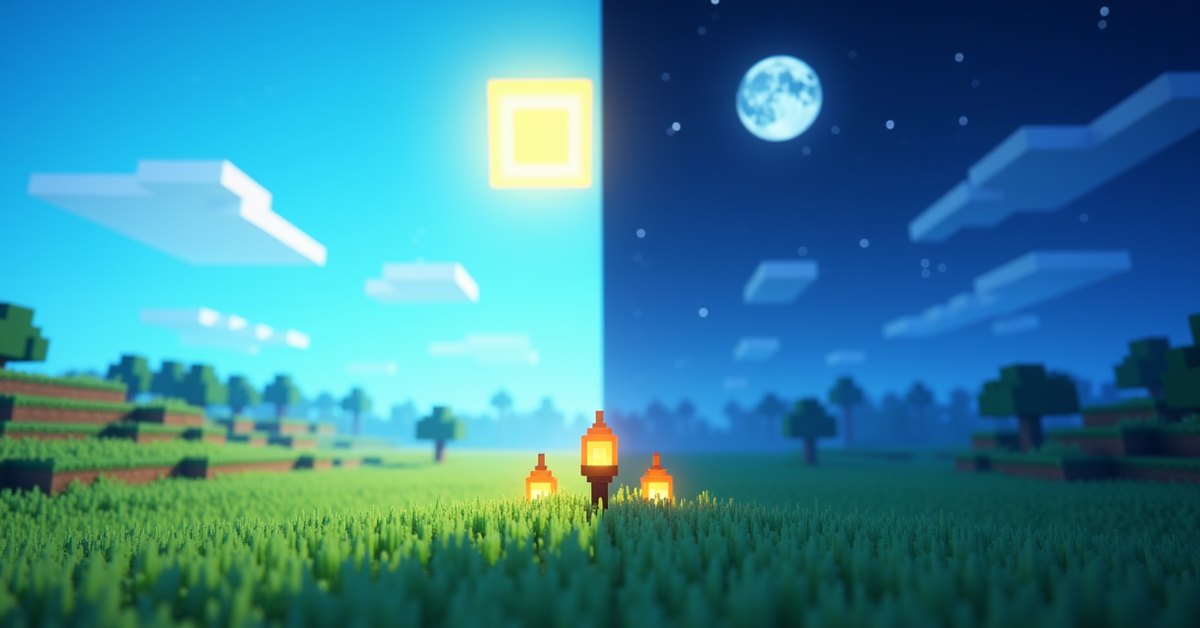
One full day in Minecraft lasts 20 minutes of real time. That covers a stretch of daylight, a sunset, a stretch of night, and a sunrise before the clock loops back to morning. The game tracks all of this in ticks, and it runs at 20 ticks per second, so a complete cycle is 24,000 ticks long.
Of those 20 minutes, you get roughly 10 minutes of usable daylight and about 7 minutes of full night. The leftover time is split between sunset and sunrise, when the sky is changing color and the light level is sliding up or down. Knowing that split matters because night is when the surface fills with hostile mobs, and you want shelter or a bed before the light drops.
The cycle works the same in both Java and Bedrock editions. The Nether and the End have no day-night cycle at all, so the time of day only applies to the Overworld.
The phases of the cycle
Minecraft splits the 24,000-tick day into a few named points. You can jump straight to any of them with the /time set command, which is the fastest way to learn what each stage looks like.
| Phase | Tick value | What happens |
|---|---|---|
| Day | 1000 | Full daylight. Undead mobs start to burn if they are out in the open. |
| Noon | 6000 | The sun sits at its highest point and sky light hits 15. |
| Sunset | 12000 | The sky turns orange and the light begins to fade. |
| Night | 13000 | Full darkness on the surface. Hostile mobs spawn and you can sleep. |
| Midnight | 18000 | The moon sits at its highest point. |
| Sunrise | 23000 | Light returns and night mobs begin to retreat or burn. |
The numbers run from 0 to 24,000 and then reset to 0. Tick 0 is the first moment of morning, which is why /time set day drops you at 1000 rather than 0: it puts you a little past dawn, in clear daylight.
What changes between day and night
The obvious change is light. At noon the sky light level is 15, the brightest the game goes. As night falls, sky light drops to 4, which is dark enough for hostile mobs to spawn on any block that is exposed to the sky.
That spawning is the real reason the cycle matters. Zombies, skeletons, creepers, spiders, and other hostile mobs appear on the surface once it gets dark. Light up your base with torches or other light sources to keep them from spawning nearby, since most hostile mobs need a low light level to appear.
When morning comes, zombies and skeletons standing in direct sunlight catch fire and burn. They can survive if they are in water, standing in shade, wearing a helmet, or holding certain items. Spiders stop being hostile in daylight unless you attack them first, turning neutral until night returns. Creepers do not burn, so a creeper that spawned overnight can still be waiting for you at noon if it found shade.
Villagers follow the cycle too. They get up and work during the day, then head indoors and sleep in their beds at night, which is worth knowing if you are trying to trade or move them around.
Surviving your first night
The very first day in a new world is a race against the clock. You have about 10 minutes of daylight to gather what you need before the surface turns dangerous, and how you spend that time decides whether night one is calm or frantic.
Punch a few trees for wood, make a crafting table, and turn some of that wood into planks and sticks for tools. A wooden or stone pickaxe lets you mine stone, and stone gives you a small upgrade in tools and a furnace. If you can find sheep, three wool plus three planks makes a bed, which is the single best thing to have before dark.
If you cannot find a bed in time, dig into the side of a hill or wall yourself into a small dirt box and place a torch inside. Sealing off the sky and adding a light source stops mobs from spawning next to you, so you can wait out the night safely or mine straight down a little to start gathering ore. The goal on night one is simple: be somewhere dark mobs cannot reach you.
How to control the time
You do not have to wait out every night. There are a few ways to move time forward or stop it completely.
Sleeping in a bed
A bed is the normal way to skip night. You can sleep once it is dark or during a thunderstorm, and sleeping fast-forwards the clock to morning. It also resets the counter that spawns phantoms, so regular sleep keeps those away.
In single-player, one player sleeping is enough. On a multiplayer server it depends on the edition. Bedrock needs a majority of players in bed at the same time. Java uses the playersSleepingPercentage gamerule, so a server admin can lower the share of players required to skip the night instead of demanding everyone sleep at once.
Using commands
If you have cheats on, /time set day and /time set night jump straight to those phases. You can also set an exact tick with /time set 6000 for noon, or push time forward by an amount with /time add 1000. To check the current time, /time query daytime reports where you are in the cycle.
Freezing time
The gamerule /gamerule doDaylightCycle false stops time from moving. The sun or moon freezes wherever it is, which is handy for building or for screenshots. Set it back to true to start the clock again.
Reading the time
A clock item shows the position of the sun and moon, so you can tell roughly what time it is even underground. A daylight detector goes further: it outputs a redstone signal based on how much sunlight is hitting it, and you can right-click it to invert the output so it fires at night instead. That makes it the standard part for automatic lights that switch on after dark.
The moon and its phases
The moon runs through 8 phases, one per night, before the pattern repeats. The phase you see is tied to how many full days have passed in the world.
The phase is not just decoration. On a full moon, slimes spawn more often in swamps, so a swamp slime farm produces noticeably more on those nights. The full moon also raises the chance that a tamed cat leaves you a gift on your bed in the morning. Outside of those cases the moon mostly affects how the night sky looks.
Phantoms and skipping sleep
If you go three in-game days without sleeping, phantoms start to spawn at night. They appear in the open sky above you and dive down to attack, which makes long building or mining streaks risky once that timer is up.
The fix is simple: sleep in a bed. Each time you sleep, the insomnia counter resets to zero and the phantoms stop coming until you skip sleep for another three days. If you would rather not deal with them at all, the /gamerule doInsomnia false command turns phantom spawning off.
Tips and common mistakes
A few things trip players up around the cycle. Beds only work in the Overworld. If you try to sleep in the Nether or the End, the bed explodes, so never treat one as a checkpoint in those dimensions.
Clocks and daylight detectors are tied to the Overworld sky. A clock spins at random in the Nether and the End because there is no sun or moon to track, so it will not help you tell time there.
Lighting your base is the cheapest insurance against night spawns. A ring of torches or any block that gives off light raises the light level high enough that hostile mobs cannot appear on those blocks, which keeps your home quiet even when the surface outside is crawling with zombies.
Frequently asked questions
How long is one Minecraft day in real time?
A full cycle is 20 minutes of real time, made up of about 10 minutes of daylight and 7 minutes of night, with the rest spent on sunrise and sunset.
How long does night last in Minecraft?
Night runs for roughly 7 minutes of real time, from the moment full darkness sets in until the sky starts to brighten at dawn.
Can you stop time in Minecraft?
Yes. Run /gamerule doDaylightCycle false to freeze the sun or moon in place. Switch it back to true to let time move again.
Why do zombies burn in the morning?
Zombies and skeletons catch fire when they stand in direct sunlight. They survive only if they are in water, in shade, wearing a helmet, or holding an item in the head slot.
Does the moon phase actually do anything?
It does. A full moon increases slime spawns in swamps and raises the chance a tamed cat gives you a gift in the morning. The rest of the phases mainly change how the night sky looks.
Why won’t my bed let me sleep?
Beds only work at night or during a thunderstorm, and only in the Overworld. If it is still daytime you cannot sleep yet, and if you are in the Nether or End the bed will explode instead.
Once you have the cycle memorized, the clock turns into a planning tool rather than a threat. Track when noon hits for safe surface work, get a bed down before the first night, and keep sleeping every few days so phantoms never get a foothold.