What is deepslate diamond ore?
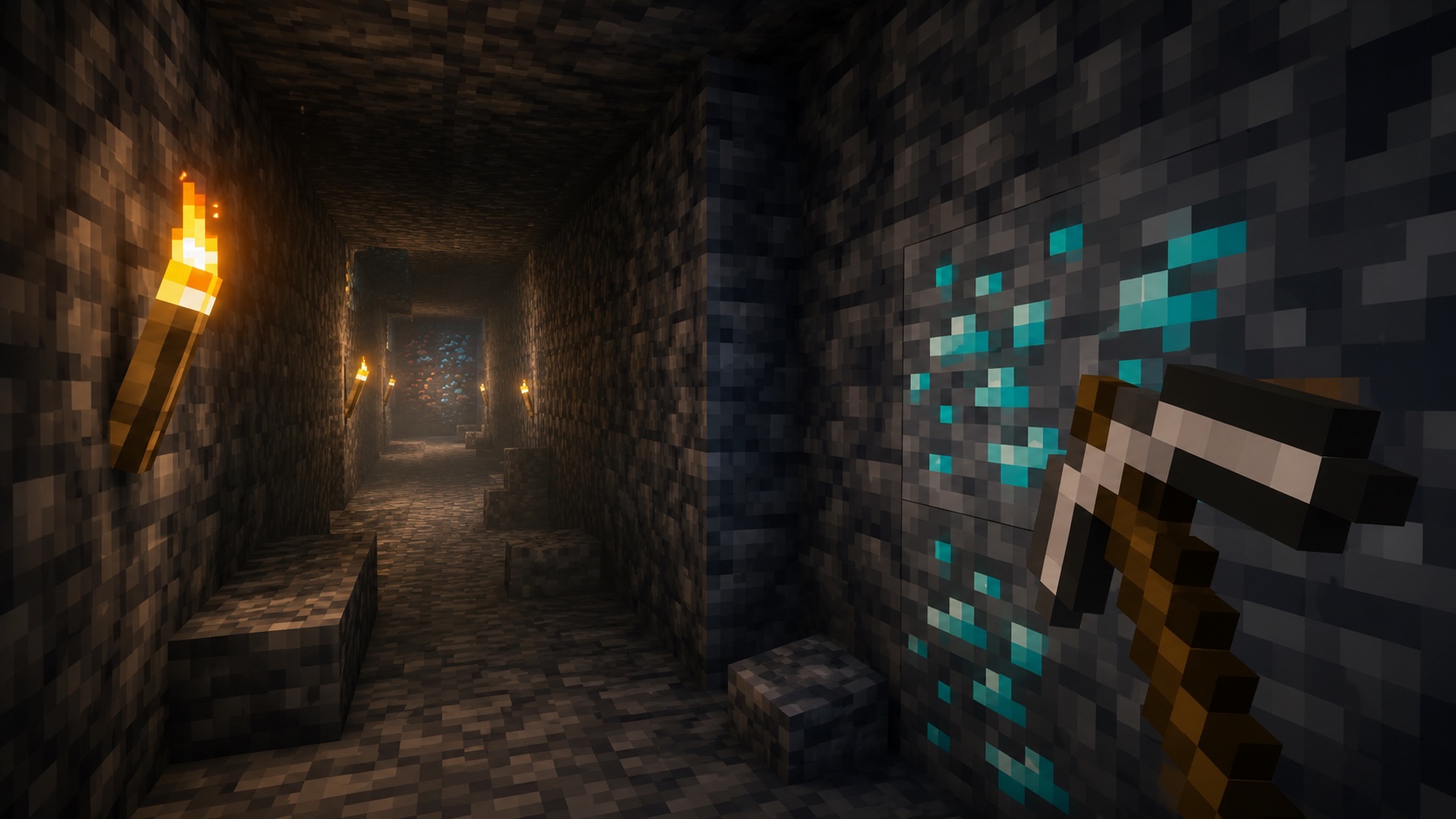
Deepslate diamond ore is the deep-cave version of regular diamond ore. It looks darker, takes longer to mine, and only spawns inside deepslate, the gray-black rock that makes up the lower half of every overworld cave. The block was added in the 1.17 Caves & Cliffs update, and after the 1.18 world generation rewrite, almost every diamond you find will come from this variant instead of the stone-based one.
The block drops a single diamond when broken with an iron or better pickaxe. Drop count scales with Fortune, the same way it does on regular diamond ore. The visual difference is what matters most for navigation: if you see the dark deepslate texture with light-blue diamond crystals embedded in it, you are deep enough to be in prime diamond country.
Where to find deepslate diamond ore
Diamond ore generation in version 1.18 and later was reworked. Diamonds can spawn anywhere from Y=14 down to Y=-64, but the spawn rate is not flat. The highest concentration sits at Y=-58, with the rate climbing steadily as you descend from sea level.
Because deepslate fully replaces stone below Y=0, every diamond ore generated under that line is the deepslate variant. In practice that means roughly 99% of all diamond ore in a fresh 1.18-or-later world is deepslate diamond ore.
Best Y level to mine
Y=-58 is the sweet spot. You get the highest spawn density, and you are still well above bedrock, so you do not waste time mapping around bedrock layers. Y=-59 also works fine. Below Y=-60 you start running into bedrock pockets, which slows progress more than the small extra density gains you back.
To find Y=-58 quickly, press F3 on Java to bring up the debug overlay, or enable the Show Coordinates option in Bedrock world settings. Mine straight down with a water bucket safety net, or stair-step at a 45-degree angle. Stop when the second number reads -58, then start branch mining.
What biomes matter
Surface biome does not affect diamond spawns. A jungle, a desert, and a snowy plains world all have the same diamond density at the same Y level. What does matter is the cave layout under the surface. Dripstone caves, large open caverns, and ravines below Y=0 already expose plenty of deepslate, so they let you skip most of the digging phase.
How to mine deepslate diamond ore
You need an iron pickaxe or better. Stone, wood, and gold pickaxes will break the block but drop nothing, so you waste the ore. Use iron, diamond, or netherite.
Deepslate variants take longer to mine than their stone counterparts. The hardness is 4.5 compared to 3.0 for regular diamond ore. The difference is small per block, but it adds up when you are tearing through a long branch-mining shaft.
Breaking the block with no enchantments drops one diamond and gives 3 to 7 experience points. Fortune III on your pickaxe raises the average drop to about 2.2 diamonds per ore, with a chance of up to 4 diamonds from a single block.
Silk Touch behavior
If you use Silk Touch, the block drops itself instead of a diamond. This is rarely worth it for raw mining, but useful in a few specific cases. You might want to keep ore blocks for decoration, you might want to move a vein to a more convenient location, or you might want to break the block later with a Fortune pickaxe you do not have yet.
Drops and XP
Without enchantments, deepslate diamond ore drops 1 diamond and 3 to 7 experience points. With Fortune I, the maximum drop is 2 diamonds. Fortune II caps at 3 diamonds. Fortune III caps at 4 diamonds. The exact distribution favors lower numbers, so the average gain from Fortune III lands around 2.2x rather than 4x.
The XP drop is identical between deepslate and regular diamond ore, so the variant does not change leveling speed. Diamond drop counts are also identical between the two variants when you break them with the same enchanted pickaxe.
Stack Mending with Fortune
If you are going to mine hundreds of blocks at Y=-58, a Mending enchantment on your pickaxe pays off quickly. The XP from diamonds, redstone, lapis, and emeralds along the way repairs your tool faster than the diamond ore wears it down. Pair Mending with Unbreaking III and Fortune III for the lowest cost-per-diamond setup the game allows.
Best mining methods
Three patterns work well once you are at Y=-58.
Branch mining
Dig a 2-block-tall corridor in a straight line, then cut perpendicular branches every 3 blocks. This covers the most ground per stack of torches and gives you a clean way back out. It is slow but reliable, and it produces a usable tunnel network you can return to later.
Cave exploring
Large cave systems below Y=0 are full of exposed deepslate. Walk through them with a Night Vision potion or a stack of torches and pick off any diamond you spot in the walls or ceiling. This is faster than branch mining if you find a generous cave, slower if you do not.
Strip mining a 1×2 row
If you only care about diamonds, a single 1-block-wide corridor at Y=-58 with no branches still finds ore at a reasonable rate, because most diamond veins are 1 to 4 blocks wide. This is the lowest-effort method and the lowest yield, but the simplest to plan.
Java vs. Bedrock differences
The core mechanics are the same on both editions. Diamonds spawn at the same Y levels, mining requires the same tier of pickaxe, and Fortune and Silk Touch behave the same way. The two real differences are interface-level.
On Java, F3 opens the debug overlay with your Y coordinate. On Bedrock, you have to switch on the Show Coordinates option in world settings before you create the world or change it from the world edit screen. Bedrock also has a slightly different RNG seed treatment for ore generation, so two identical numeric seeds can produce different ore patterns between editions.
Tips and common mistakes
Save your Fortune III pickaxe for the ore itself, and use a cheaper iron pickaxe to dig the long tunnels. Switching tools mid-mine sounds tedious, but it triples the practical value of every block you actually break.
Bring food. Mining at Y=-58 is calm but slow, and the trip back to the surface takes time. A stack of cooked steak per session covers a long mine without running out.
Light up large caverns before exploring. Open caves below Y=0 spawn mobs aggressively, including drowned in flooded sections. Torches every 7 blocks prevents most spawns and gives you a clear path back.
Place a bed and set your spawn before each session. If a creeper catches you in a tight tunnel, you reload at the bed instead of the last sleep point you set on the surface.
Do not use TNT or bed explosions to mine diamond ore in the overworld. The explosion will destroy the ore blocks, so you lose the drop entirely. Bed mining is for ancient debris in the Nether, not for diamonds.
Frequently asked questions
What is the best Y level for deepslate diamond ore?
Y=-58 has the highest spawn rate. Y=-59 is nearly as good. Below Y=-60, bedrock starts breaking up your path, so you lose more time than you gain from a slightly higher density.
Can a gold pickaxe mine deepslate diamond ore?
No. Gold pickaxes mine faster than iron in some cases, but they do not have the tier required to drop diamonds. You need iron, diamond, or netherite.
Does Fortune work on deepslate diamond ore?
Yes, exactly the same way it works on regular diamond ore. Fortune III gives an average of about 2.2 diamonds per block, with a maximum of 4 from a single ore.
Does Silk Touch work on deepslate diamond ore?
Yes. With Silk Touch, the block drops itself instead of a diamond. You can break it later with a Fortune pickaxe, although that requires two passes and is rarely worth the trip.
Are deepslate diamonds more valuable than regular diamonds?
No. A diamond is a diamond. The variant changes the block, not the item. Deepslate diamond ore just takes about 50% longer to mine because deepslate has higher hardness than stone.
Why am I only finding deepslate diamond ore and never the regular kind?
That is expected. After 1.18, diamond ore generates almost entirely below Y=0, which is the deepslate layer. Regular diamond ore can still spawn between Y=14 and Y=-1 in rare cases, but most of your diamonds will be the deepslate variant.
How rare is deepslate diamond ore at Y=-58?
Common enough that an hour of branch mining at that level usually returns at least a stack of diamonds with Fortune III. The exact rate varies by seed and cave layout, but the layer is generous compared to the pre-1.18 distribution.
Closing notes
If you are still mining at Y=11 because that is what older guides told you, move down. The diamond density at Y=-58 is several times higher than the old sweet spot, and the only cost is the trip down. Once you have a Fortune III pickaxe and a stack of torches, the rest is mechanical.