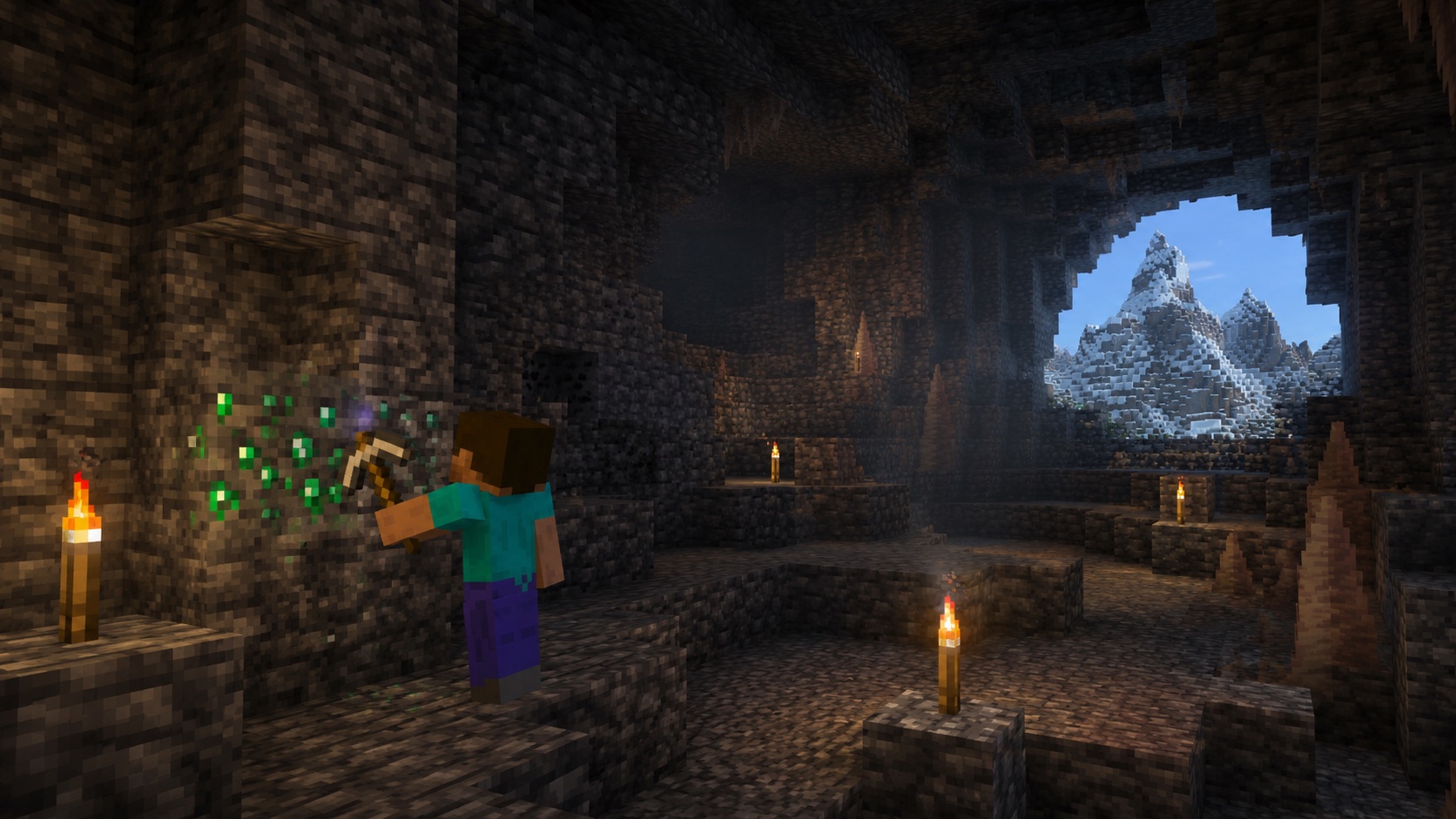
Deepslate emerald ore is the deepslate version of emerald ore, found below Y=0 in mountain biomes. If you’ve been mining under a tall snowy peak and pulled up a darker block with green flecks, that’s the one. It works like regular emerald ore but sits in deepslate territory, which means it takes longer to break and requires the same iron-or-better pickaxe.
Emeralds in Minecraft are valuable because villagers use them as currency. Every emerald you mine here is one trade closer to a Mending book, a Looting III sword, or whatever you’re after. That’s why people obsess over finding the right biome and digging at the right depth.
This guide covers where deepslate emerald ore spawns, how to mine it correctly, what it drops, and which biomes give you the best odds.
What is deepslate emerald ore?
Deepslate emerald ore is one of two emerald ore variants in the game. The other is regular emerald ore, which appears in stone. Both contain the same emerald, but the deepslate version generates deeper underground, embedded in deepslate instead of stone.
The texture is darker than the stone version, with green emerald flecks against the cooler grey of deepslate. If you’re scanning a cave wall, the flecks are smaller and harder to spot than diamond’s clean blue patches, so it pays to mine with a clean line of sight.
In game files, the block ID is deepslate_emerald_ore. You’ll see this name if you use commands like /give @s deepslate_emerald_ore or write any data pack referencing the block.
Where does deepslate emerald ore spawn?
Two things have to be true for deepslate emerald ore to generate. The chunk has to be in a mountain biome, and the block has to be inside the deepslate layer.
The mountain biomes that count are:
- Windswept Hills
- Windswept Forest
- Windswept Gravelly Hills
- Stony Peaks
- Jagged Peaks
- Frozen Peaks
- Snowy Slopes
- Grove
- Meadow
- Cherry Grove
If you’re in any other biome, you won’t find emerald ore of either kind, no matter how deep you dig. Emerald ore is the most biome-restricted ore in the game.
The deepslate layer starts at Y=0 and runs down. Between Y=0 and Y=-8, you get a transition zone where stone and deepslate are mixed. Below Y=-8, it’s pure deepslate. Emerald ore generation peaks much higher up in tall mountain biomes (around Y=232 in newer Minecraft versions), and the veins thin out as you go down. So the deepslate variant is rarer than the stone version, simply because most emerald ore generates above the deepslate line.
Practical takeaway: if you want the deepslate variant specifically, get under a tall mountain biome and dig from Y=-1 down. If you just want emeralds, branch-mining higher up under the same biome is faster.
How to mine deepslate emerald ore
You need at least an iron pickaxe. A stone or wood pickaxe will break the block without giving you anything. This trips up a lot of new players who try to mine emeralds with whatever’s in their hotbar.
Mining time in seconds with each tool:
- Wood pickaxe (won’t drop emerald): 6.75
- Stone pickaxe (won’t drop emerald): 3.4
- Iron pickaxe: 2.25
- Diamond pickaxe: 1.7
- Netherite pickaxe: 1.5
- Gold pickaxe (fast but won’t drop emerald): 1.15
Gold is fast but doesn’t meet the harvest level, so don’t use it. Stick with iron, diamond, or netherite.
Efficiency makes a big difference on deepslate, which is significantly harder than stone. An Efficiency V diamond pickaxe paired with Haste II clears blocks in well under a second, which matters when you’re chasing veins through a cave wall.
If you have Fortune III on your pickaxe, you’ll get more emeralds per ore block (more on that below). If you have Silk Touch, you’ll get the block itself instead of the emerald, which is useful if you want to display it in a build or move ore for later XP farming.
What does deepslate emerald ore drop?
Mined with a regular iron, diamond, or netherite pickaxe (no Silk Touch, no Fortune), one block drops:
- 1 emerald
- 3 to 7 experience orbs
With Fortune, the emerald count goes up:
- Fortune I: 1 to 2 emeralds (average around 1.33)
- Fortune II: 1 to 3 emeralds (average around 1.75)
- Fortune III: 1 to 4 emeralds (average around 2.20)
These are weighted averages, not flat probabilities. Fortune doesn’t always feel like it’s doing something, but over a few hundred blocks it adds up.
Silk Touch changes the drop to the block itself: one deepslate emerald ore. No emerald, no XP. The block becomes useful in two ways. You can stash it and mine it later for delayed XP, or you can use it as a decorative block in builds where the green flecks fit the look you’re after.
Best biomes for emerald hunting
Not every mountain biome gives you the same odds. Here’s how the common ones compare:
- Windswept Hills and Windswept Gravelly Hills are reliable and easy to identify above ground. Solid first choice for new players.
- Jagged Peaks and Frozen Peaks have higher peak elevation, so the mountain extends further both above and below sea level. More chunks intersect the deepslate layer, which makes them the strongest pick for the deepslate variant.
- Meadow and Cherry Grove have shallower mountain depth, so the deepslate variant is rarer there. Better for above-ground emerald hunting.
If your goal is the deepslate variant, target Jagged Peaks or Frozen Peaks with a tall enough range that the mountain extends well below sea level. Dig straight down from inside the biome (after checking for lava with a torch) until you hit Y=0, then branch-mine outward.
Tips and common mistakes
A few things that catch players out:
Bring a water bucket. Mountain mining means lava pockets and long falls. A water bucket placed under your feet stops fall damage in Java. In Bedrock, it works the same way most of the time, but isn’t quite as forgiving on diagonal landings.
Don’t confuse the texture with copper ore at a glance. Both have flecks against a deepslate background. Emerald is green, copper is orange and chunkier. If you’re not sure, mine it with Silk Touch off and check the drop.
Use night vision potions if you have them. Caves under mountain biomes are dark, and a missed emerald ore on a wall costs you a trip back.
Don’t tunnel sideways through deepslate just to find emerald. Branch mining is slower per emerald than caving, because emerald ore generates as one-block veins, not the 2x2x2 or larger clumps that diamond and iron form. You’re better off following natural cave systems with a clear sightline.
Mark explored caves. Dropping a torch on the wall or placing a single block in the entrance saves you hours of repeating loops.
Java vs Bedrock differences
Behavior is identical in both editions in most ways. The block has the same harvest level, the same drops, the same mining speed scaling, and the same biome requirements.
One small difference: Bedrock occasionally generates slightly different ore distributions due to its different chunk generator. In practice, this doesn’t change your strategy. Mine in mountain biomes, dig below Y=0 if you want the deepslate variant, and use an iron pickaxe or better.
Frequently asked questions
Is deepslate emerald ore rarer than regular emerald ore?
Yes. Emerald ore generation peaks at higher Y levels in mountain biomes, and the deepslate variant only generates in chunks where the deepslate layer intersects emerald ore spawning ranges. Most emerald ore you’ll see is the stone variant.
Can you mine deepslate emerald ore with a stone pickaxe?
No. You need iron, diamond, or netherite. A stone pickaxe will break the block without giving you anything.
Does Fortune work on deepslate emerald ore?
Yes. Fortune I, II, and III all increase emerald drops the same way as on regular emerald ore.
What’s the maximum drop from one block?
With Fortune III, the highest single drop is 4 emeralds. The average is closer to 2.2 emeralds per block over many breaks.
Does deepslate emerald ore drop XP?
Yes, between 3 and 7 experience orbs per block when mined without Silk Touch. With Silk Touch, you get no XP at the time of mining, but you can break the stored block later for the XP.
Can you find deepslate emerald ore in caves, or only by branch mining?
Both. Natural caves under mountain biomes expose the ore on cave walls. Caving is usually faster than dedicated branch mining for emerald.
Where’s the best Y level to find it?
Right at Y=-1 to Y=-16 inside a tall mountain biome. Lower than that and you’re past the peak generation range for emerald ore.
The bottom line
If you’ve already pillaged a couple of villages and want to set up trades for serious gear, mountain biomes are the answer, and the deepslate variant rewards the players who dig deeper. Pick a Jagged Peaks or Frozen Peaks chunk, get under Y=0, and run your pickaxe along a long sightline. The emeralds add up faster than people expect.