Minecraft has three worlds you can stand in, and the game calls them dimensions. You start in the Overworld, build a portal to reach the Nether, and find a hidden portal to reach the End. Each one runs on its own rules for terrain, mobs, lighting, and even how distance and time work.
Understanding how the three connect is what turns a survival world into a full playthrough. The Nether is your shortcut for fast travel and rare materials, and the End is where the game’s main boss fight and credits live. This guide covers what each dimension is, how to get there, and the quirks that trip players up.
What is a dimension in Minecraft?
A dimension is a separate, self-contained world with its own map, its own generation rules, and its own set of mobs and blocks. When you travel between dimensions you are not walking to a far-off part of the same map. You are loading an entirely different world that shares nothing with the one you left except the items in your inventory.
The three dimensions are the Overworld, the Nether, and the End. Each has a separate coordinate grid, so the same X and Z numbers point to different places depending on which world you are standing in. That detail matters a lot once you start building portals, and we will come back to it.
The Overworld
The Overworld is your home dimension and where every new world begins. It holds the widest range of biomes, from plains and deserts to oceans, jungles, and snowy mountains. It runs a normal day and night cycle, and most of your early survival happens here: gathering wood, mining stone and ore, farming food, and building a base.
The Overworld is the only dimension with a working sky, weather, and a full day and night loop. It is also the only place you can sleep through the night in a bed without anything going wrong. Almost everything you need to prepare for the other two dimensions comes from here first, including the obsidian and the materials for portals.
The Nether
The Nether is a hostile underground world of lava seas, fire, and aggressive mobs. There is no sky, no day or night, and water evaporates the instant you place it. Mobs like ghasts, blazes, piglins, and wither skeletons live here, and several items you need for late-game progress can only be found in the Nether.
How to reach the Nether
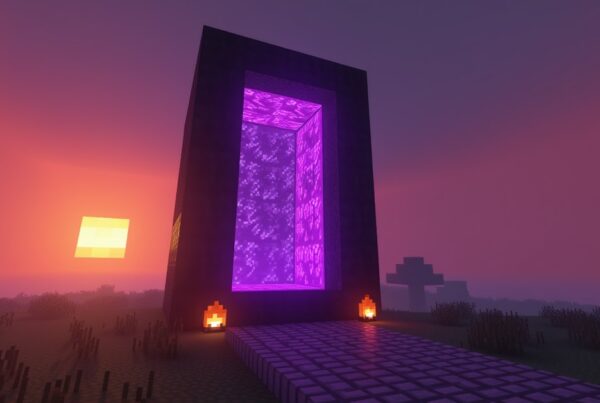
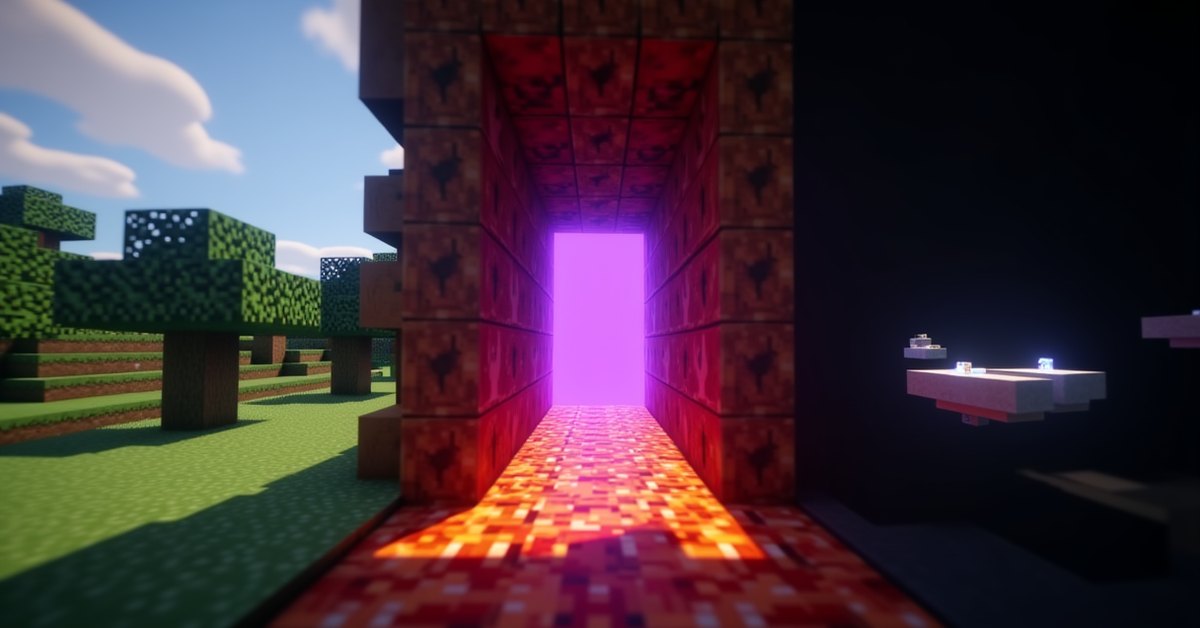
You build a nether portal out of obsidian. The standard frame is a rectangle with at least 4 obsidian blocks across the bottom, 5 up each side, and 4 across the top, which works out to a minimum of 10 blocks if you leave the corners empty. Once the frame is built, you light the inside with flint and steel, and the empty space fills with a purple swirling field. Step in, wait a couple of seconds, and you load into the Nether.
A common early trick is to make obsidian without a diamond pickaxe. You can pour water over a lava source to harden it into obsidian, then mine it with a diamond or netherite pickaxe later. You still need that pickaxe to collect the obsidian, so the Nether usually comes after your first diamonds.
Why players go to the Nether
The Nether is the only source of several important materials. Blaze rods, dropped by blazes in nether fortresses, are required to brew potions and to craft the eyes of ender that unlock the End. Nether wart, the base ingredient for most potions, grows in fortresses and bastions. Ancient debris, which smelts into netherite, hides deep in the lava layers and gives you the strongest gear in the game.
The Nether is also the fastest way to travel long distances, thanks to how its coordinates scale against the Overworld.
The End
The End is a dark void dimension made of pale end stone islands floating in empty space. The central island is home to the ender dragon, the game’s main boss. Beating the dragon triggers the end credits, which is as close as Minecraft gets to a traditional ending, though you can keep playing forever after.
How to reach the End
You cannot build an end portal by hand in survival. You have to find one, already built, inside a stronghold buried underground. To locate a stronghold you throw eyes of ender, which float toward the nearest one. Each end portal frame has 12 slots, and some already hold an eye when you find them. You fill the empty slots with your own eyes of ender, and the portal activates on its own once all 12 are in place.
Step into the active portal and you drop straight onto the central End island, usually within sight of the dragon. Bring a bed only if you want a fight, because beds do not work the way you expect in the End.
What is in the End
Beyond the dragon, the outer End islands are covered in end cities and end ships. These hold valuable loot, including elytra, the wings that let you glide and, with fireworks, fly. Shulkers live in end cities too, and their dropped shells let you craft shulker boxes for portable storage. You reach the outer islands through an end gateway portal that appears after the dragon dies.
How travel and coordinates work between dimensions
The single most useful thing to understand about dimensions is the coordinate ratio between the Overworld and the Nether. One block in the Nether equals 8 blocks in the Overworld along the X and Z axes. If you walk 100 blocks in the Nether and build a portal, you come out roughly 800 blocks away in the Overworld.
This is why experienced players build a network of linked nether portals. To cross a huge distance in the Overworld, you go into the Nether, travel one-eighth of the distance, and step back out near your destination. A short walk in the Nether covers ground that would take many minutes on the surface.
The End does not use this ratio. Its coordinates line up one-to-one with the Overworld, but since you always arrive at a fixed spot near the center island, the numbers rarely matter for travel.
Portal linking and why portals sometimes connect oddly
When you light a nether portal and walk through, the game looks for an existing portal near the matching coordinates in the other dimension. If it finds one within range, it links you to it. If it does not, it builds a new portal for you on the spot. Because of the 8-to-1 ratio, two Overworld portals built close together can both link to the same Nether portal, which sends you to the wrong place. Spacing your portals out, or building the Nether side by hand at exact coordinates, keeps the links clean.
Mechanics that change between dimensions
A few mechanics behave differently depending on which dimension you are in, and forgetting them causes real damage.
Beds only let you sleep in the Overworld. If you try to use a bed in the Nether or the End, it explodes with roughly the force of TNT. Players have died and lost full inventories this way, so leave the bed in your chest unless you are deliberately using it as a weapon against the dragon.
Compasses and clocks do not work normally outside the Overworld. A clock spins uselessly in the Nether and the End because there is no day and night cycle to track. A regular compass also fails to point home in those dimensions, though a lodestone compass still works if you have set it.
Water cannot be placed in the Nether. It evaporates instantly, which removes a lot of your usual tools for fighting fire, slowing falls, or farming. Plan around having no water before you go.
Tips and common mistakes
Carry a stack of cobblestone or another cheap block in the Nether. Ghasts can knock you off ledges and break your portal, and you will want to wall off corridors fast. Cobblestone resists ghast fireballs, while netherrack and wood do not.
Write down your portal coordinates the moment you build one. The Nether is easy to get lost in, and a missing portal can strand you. Press F3 on Java or turn on coordinates in the world settings on Bedrock to see your position.
Do not bring your best gear on your first End trip. The ender dragon is a real fight, the void below the islands kills instantly, and falling in means losing everything you carried. Practice the fight once with gear you can afford to lose.
Bring blocks to the End for the same reason. The gaps between the central island and the outer islands are wide, and a few stacks of a throwaway block let you bridge across safely.
Java and Bedrock differences
The three dimensions exist in both Java and Bedrock editions and work the same way at a high level. The portal recipes, the coordinate ratio, and the bed behavior are identical across both.
The clearest difference is how the End respawn works after you beat the dragon. The mechanics of regenerating the dragon with end crystals are the same, but small timing and platform details vary between editions and between versions. The safest rule is to treat the core loop as identical and check the specifics for your exact version if you are doing something advanced.
Frequently asked questions
How many dimensions are in Minecraft?
There are three: the Overworld, the Nether, and the End. The Overworld is where you start, and the other two require portals to reach.
Do you need to go to the Nether to beat the game?
Yes. The eyes of ender that activate the end portal are crafted from blaze powder, and blazes only spawn in the Nether. You also need ender pearls, which come from endermen, so a full run touches all three dimensions.
Why did my bed blow up?
Beds only function as beds in the Overworld. In the Nether and the End, trying to sleep in one causes an explosion strong enough to kill you and destroy nearby blocks. Carry a bed in those dimensions only if you mean to use it as a weapon.
How far is one Nether block in the Overworld?
One block traveled in the Nether equals 8 blocks in the Overworld along the horizontal axes. This ratio is what makes the Nether a fast-travel shortcut for long distances.
Can you build an end portal in survival?
No. You can only place the activating eyes of ender into a portal frame that already exists in a stronghold. The frame itself cannot be crafted or placed in survival mode. In creative you can place frame blocks, but in survival you have to find one.
What happens after you kill the ender dragon?
A return portal appears that sends you back to the Overworld, and an end gateway opens nearby that leads to the outer End islands, where end cities and elytra wait. You can respawn the dragon later with end crystals if you want to fight it again.
Where to go from here
If you have never left the Overworld, the next milestone is your first diamonds, since they unlock the obsidian mining that opens the Nether. Once you can brew potions and gather blaze rods, the End is only a stronghold search away. Treat each dimension as a gate to the next, and the whole progression starts to feel like one connected route rather than three separate worlds.