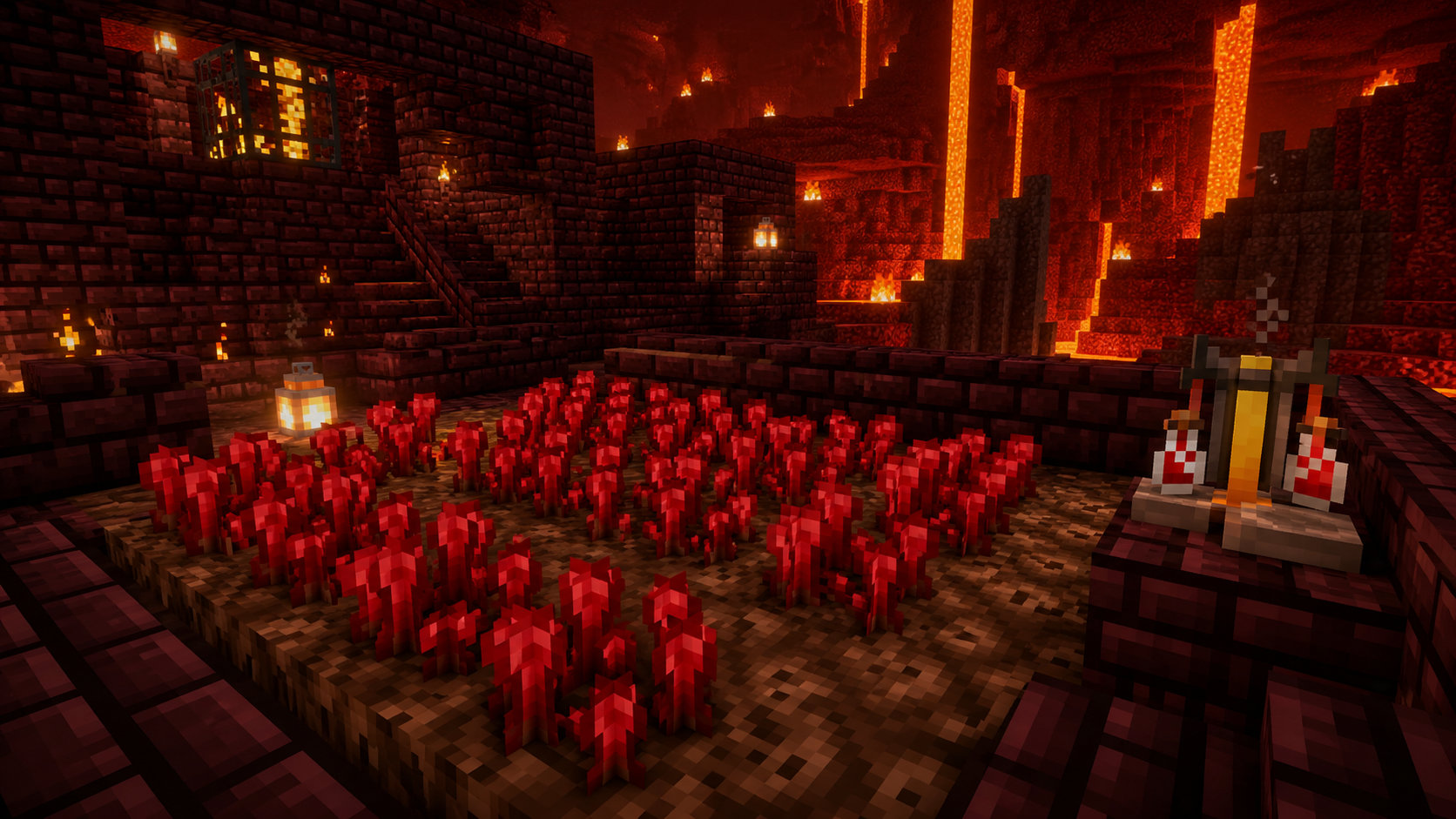
Nether Wart is one of those Minecraft items that looks small but unlocks a huge part of the game. If you want to brew powerful potions, build a proper brewing room, or prepare for tougher survival challenges, you need Nether Wart.
This red Nether fungus is best known for one thing: brewing Awkward Potions. Awkward Potions are the base for many of Minecraft’s most useful potions, including Strength, Fire Resistance, Swiftness, Night Vision, Water Breathing, Regeneration, and more.
The good news? Once you find your first Nether Wart, you can grow it yourself almost anywhere.
Quick Facts About Nether Wart
| Feature | Details |
|---|---|
| Item type | Brewing and farming ingredient |
| Found in | Nether Fortresses, some Bastion Remnants, structure chests |
| Grows on | Soul sand |
| Needs water? | No |
| Needs light? | No |
| Bone meal works? | No |
| Main use | Brewing Awkward Potions |
| Renewable? | Yes, once planted and farmed |
What Is Nether Wart in Minecraft?
Nether Wart is a crop-like fungus from the Nether. It is mainly used in brewing, but it can also be used for crafting, trading, and composting.
Its most important role is turning water bottles into Awkward Potions. That might not sound exciting at first, but Awkward Potions are the starting point for many of the best potions in the game.
Without Nether Wart, your brewing options are much more limited.
Where to Find Nether Wart
Nether Wart does not grow randomly across the Nether. Even though it grows on soul sand, you usually will not find it just by exploring soul sand valleys. You need to search specific structures.
Nether Fortresses
Nether Fortresses are the most reliable place to find Nether Wart.
Look for interior stairwell rooms with soul sand patches beside the stairs. Nether Wart often grows in these small garden-like areas.
Nether Fortresses are especially useful because they also contain Blazes. You need Blaze Rods to craft a brewing stand and blaze powder to fuel it, so a fortress can give you multiple brewing essentials in one trip.
Tips for Searching Nether Fortresses
Bring strong gear before entering. Nether Fortresses can contain Blazes, Wither Skeletons, regular Skeletons, and Magma Cubes.
Useful items include:
- Shield
- Bow or crossbow
- Food
- Fire Resistance potion, if you already have one
- Blocks for bridging and blocking paths
- Gold armor for safer Nether travel around Piglins
- A marked path back to your portal
Once you find Nether Wart, collect all of it and take the soul sand too if you do not already have some.
Bastion Remnants
Nether Wart can also appear in certain Bastion Remnants, especially housing-unit areas with courtyards.
Bastions can be rewarding, but they are dangerous. Piglin Brutes hit hard and do not care if you are wearing gold armor. If you are early in your world, a Nether Fortress is usually the safer Nether Wart target.
Chest Loot
You may also find Nether Wart in loot chests inside Nether structures. This can be helpful if the fortress or bastion you discover does not have an obvious Nether Wart patch.
Do not assume every fortress or bastion will contain visible Nether Wart. If you cannot find any, keep exploring the structure or search another one.
How to Harvest Nether Wart
Nether Wart is easy to harvest. You can break it by hand or with any tool.
The key is timing.
Fully grown Nether Wart drops more than immature Nether Wart. If you harvest too early, you get a poor return and slow down your farm growth.
A mature Nether Wart crop appears taller and more developed than the early growth stages. Once you recognize the final stage, wait for that look before harvesting.
Can Fortune Increase Nether Wart Drops?
Yes. Using a Fortune-enchanted tool can increase Nether Wart drops from mature crops.
This is most useful once you already have a decent farm and want to quickly expand your supply for brewing, trading, or crafting.
How to Grow Nether Wart
Growing Nether Wart is simple once you have the right block.
You need:
| Material | Why You Need It |
|---|---|
| Nether Wart | The crop to plant |
| Soul Sand | The only block it grows on |
| Open space | Any safe farm area |
Place soul sand on the ground, then plant Nether Wart on top. After that, wait for it to grow.
Does Nether Wart Need Water?
No. Nether Wart does not need water.
This makes it different from crops like wheat, carrots, and potatoes. You do not need irrigation, farmland, or nearby water blocks.
Does Nether Wart Need Light?
No. Nether Wart does not need sunlight or torchlight to grow.
You can grow it in a basement, castle, cave, Nether base, or hidden brewing room. Lighting is still useful to stop hostile mobs from spawning nearby, but it is not required for the Nether Wart itself.
Can You Use Bone Meal on Nether Wart?
No. Bone meal does not speed up Nether Wart growth.
The crop grows over time, so the best strategy is to plant a larger farm instead of trying to force faster growth.
Can Nether Wart Grow in the Overworld?
Yes. Nether Wart can grow in the Overworld, the Nether, or the End as long as it is planted on soul sand.
This is great for survival worlds because you only need to visit the Nether long enough to collect your first Nether Wart. After that, you can build a safe farm at your main base.
How to Build a Simple Nether Wart Farm
A basic Nether Wart farm is one of the easiest farms to build in Minecraft.
Simple Starter Farm
- Place a row of soul sand.
- Plant Nether Wart on each soul sand block.
- Wait for it to fully mature.
- Harvest the mature crops.
- Replant part of your harvest.
A small farm is enough for casual brewing. Even a few rows can produce plenty of Nether Wart over time.
Compact Indoor Farm
Because Nether Wart does not need water or light, it is perfect for tight indoor builds.
Good locations include:
- Basement brewing room
- Nether-themed tower
- Hidden survival bunker
- Potion shop build
- Underground base
- Villager trading hall
You can place soul sand in neat rows with slabs or blocks between them for walking paths.
Large Nether Wart Farm
For bigger worlds, servers, or potion-heavy gameplay, build a larger farm with multiple rows.
A practical layout is:
| Farm Size | Best For |
|---|---|
| 3×3 | First farm or starter base |
| 9×9 | Regular potion brewing |
| Long rows | Easy harvesting and expansion |
| Multi-level farm | Large bases or servers |
A multi-level farm works well because Nether Wart does not need sky access. You can stack farm floors vertically inside a tower or underground room.
Best Uses for Nether Wart
Nether Wart is most valuable for brewing, but it has a few other uses too.
Brewing Awkward Potions
Nether Wart’s main job is creating Awkward Potions.
To brew one:
- Place water bottles in a brewing stand.
- Add blaze powder to fuel the brewing stand.
- Place Nether Wart in the ingredient slot.
- Wait for the water bottles to become Awkward Potions.
Once you have Awkward Potions, you can add other ingredients to create useful potions.
Examples include:
| Potion | Why It’s Useful |
|---|---|
| Strength | Better melee damage |
| Fire Resistance | Safer Nether travel and lava survival |
| Swiftness | Faster movement |
| Night Vision | Better cave and ocean visibility |
| Water Breathing | Underwater exploration |
| Regeneration | Healing during tough fights |
| Leaping | Higher jumps |
If you plan to fight bosses, raid structures, explore oceans, or spend time in the Nether, Nether Wart becomes extremely valuable.
Crafting Red Nether Bricks
Nether Wart can be used to craft Red Nether Bricks with Nether Bricks.
Red Nether Bricks are decorative blocks with a darker, richer red tone than regular Nether Brick. They work well in:
- Nether castles
- Evil fortresses
- Wizard towers
- Dungeon builds
- Gothic bases
- Potion rooms
If you like building with Nether-themed blocks, a Nether Wart farm gives you a renewable supply for this style.
Trading with Cleric Villagers
Cleric villagers can buy Nether Wart in exchange for emeralds.
This makes Nether Wart useful beyond brewing. With a large enough farm, it can become part of your emerald economy.
A Nether Wart farm near a cleric trading hall can be a smart setup if you regularly trade for redstone, lapis lazuli, ender pearls, or other cleric items.
Composting Nether Wart
Nether Wart can also be placed in a composter.
This is not usually the best use, especially early on, because Nether Wart is more valuable for brewing. But if you have a large farm and extra supply, composting can turn surplus Nether Wart into bone meal.
Important Nether Wart Mistakes to Avoid
Mistake 1: Searching Random Soul Sand for Nether Wart
Nether Wart grows on soul sand, but that does not mean every soul sand area has Nether Wart.
Soul sand valleys are great for collecting soul sand, but they are not reliable places to find Nether Wart. Search Nether Fortresses and certain Bastion Remnants instead.
Mistake 2: Harvesting Too Early
Immature Nether Wart gives a much smaller return. Wait until it is fully grown before harvesting.
This helps your farm expand faster and gives you more Nether Wart for brewing.
Mistake 3: Turning Too Much Nether Wart Into Blocks
Nether Wart Blocks are decorative, but they cannot be turned back into regular Nether Wart.
Do not use Nether Wart Blocks as storage. If you want to store Nether Wart, keep it in chests, barrels, or shulker boxes.
Mistake 4: Forgetting Soul Sand
You need soul sand to grow Nether Wart. When you find your first Nether Wart, make sure you also collect soul sand if you do not already have some.
Mistake 5: Expecting Bone Meal to Work
Bone meal does not grow Nether Wart faster. If you want more Nether Wart, build a bigger farm and harvest when mature.
Best Time to Get Nether Wart
The best time to get Nether Wart is after you have basic Nether survival gear but before you start serious potion brewing.
A good progression path is:
- Build a Nether portal.
- Collect gold armor for Piglin safety.
- Find a Nether Fortress.
- Collect Nether Wart and soul sand.
- Defeat Blazes for Blaze Rods.
- Return home and build a brewing area.
- Start a Nether Wart farm.
Once this setup is complete, you are ready to brew potions consistently.
Nether Wart Farm Design Ideas
Nether Wart farms do not have to be boring. Since they fit naturally into dark, magical, and Nether-themed builds, you can make them part of your base design.
Try building your farm inside:
- A witch hut
- A potion laboratory
- A Nether castle
- A redstone-powered alchemy room
- A hidden underground garden
- A cleric villager trading hall
- A spooky fantasy tower
Use blocks like Nether Brick, Red Nether Brick, Blackstone, Basalt, Soul Lanterns, and Crimson wood to match the theme.
FAQ
What is Nether Wart used for in Minecraft?
Nether Wart is mainly used to brew Awkward Potions, which are the base for many useful potions. It can also be used for crafting Red Nether Bricks, trading with cleric villagers, and composting.
Where do you find Nether Wart?
You can find Nether Wart in Nether Fortresses, certain Bastion Remnants, and sometimes in structure chests.
Can Nether Wart grow in the Overworld?
Yes. Nether Wart can grow in the Overworld as long as it is planted on soul sand.
Does Nether Wart need water to grow?
No. Nether Wart does not need water.
Does Nether Wart need light to grow?
No. Nether Wart does not need light, although lighting your farm area can help prevent hostile mobs from spawning.
Can bone meal speed up Nether Wart?
No. Bone meal does not work on Nether Wart.
What block does Nether Wart grow on?
Nether Wart grows on soul sand.
Can Nether Wart grow on soul soil?
No. Nether Wart grows on soul sand, not soul soil.
Can you craft Nether Wart from Nether Wart Blocks?
No. Nether Wart Blocks cannot be crafted back into regular Nether Wart.
Is Nether Wart required for every potion?
No, but it is required for Awkward Potions, which are the base for many of the most useful potions in Minecraft.