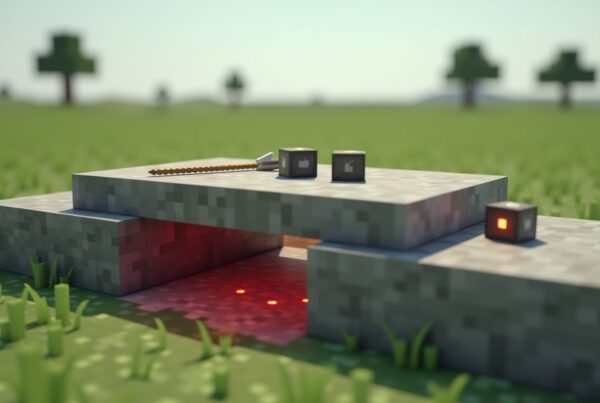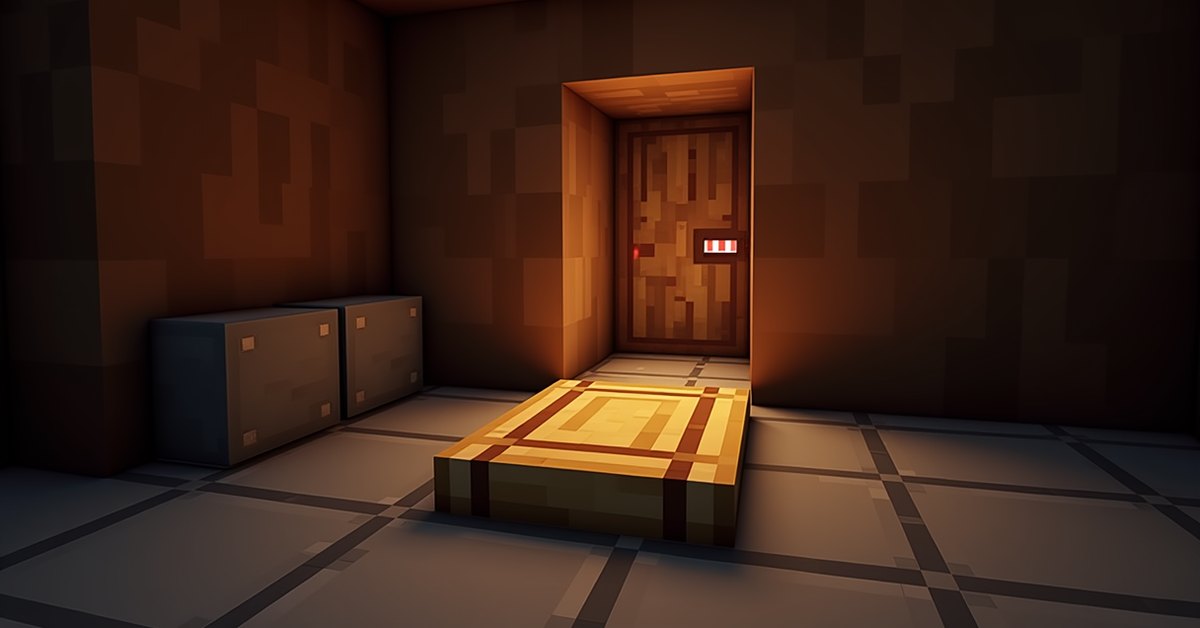
A pressure plate is a flat block that sends out a redstone signal whenever something stands on it. Step onto one and it powers whatever it is wired to, whether that is a door, a dispenser, or a charge of TNT. Step off and the signal stops. That plain on/off behavior makes the pressure plate one of the first pieces of redstone most players use without thinking of it as redstone at all.
Minecraft has four pressure plates, and they are not interchangeable. Two give a simple on/off signal, and two give a signal that changes with how many entities are standing on top. Choosing the wrong one is why a trap fires when a chicken wanders past, or why a counter never moves.
This guide covers what each plate detects, how to craft all four, how the weighted plates measure entities, and the builds where a pressure plate actually earns its spot.
What a pressure plate does
A pressure plate sits on top of a block and watches the space directly above itself. When an entity moves into that space, the plate goes active and sends out a redstone signal. That signal feeds into the block the plate rests on and into any redstone part next to it. When the entity steps away, the plate switches off after a short delay, usually under a second.
You do not need redstone dust to use a pressure plate. The plate powers nearby blocks on its own. Put one beside a door and the door opens. Put one next to a redstone lamp and the lamp lights. Dust only matters when you want to carry the signal somewhere farther away.
Every plate breaks fast and drops itself when you mine it. An axe is quickest on wooden plates and a pickaxe is quickest on stone and weighted plates, but you get the plate back as an item whatever tool you use.
The four types of pressure plate
The four plates differ on two points: what sets them off, and how strong a signal they send.
| Plate | What it detects | Signal output |
|---|---|---|
| Wooden pressure plate | Any entity, including players, mobs, dropped items, arrows, and experience orbs | Full strength (15) when anything is on it |
| Stone pressure plate | Players and living mobs only | Full strength (15) when a player or mob is on it |
| Light weighted pressure plate (gold) | Any entity | Scales with the count: 1 per entity, up to 15 |
| Heavy weighted pressure plate (iron) | Any entity | Scales with the count: 1 per 10 entities, up to 15 |
The wooden plate is the sensitive one. It reacts to anything with a hitbox, including an item you dropped or an arrow you fired at it. That makes it a cheap item detector, and also the plate most likely to trigger by accident.
The stone plate ignores items, arrows, and experience orbs. Only a living mob or a player sets it off. If you want a trap that fires for a creeper but not for a stray item drifting past, stone is the plate to use.
The two weighted plates, made from gold and iron, react to every entity the way the wooden plate does. The difference is that they do not give a plain on/off signal. They report a number, which the next section covers.
How to craft pressure plates
Every pressure plate uses the same recipe shape: two blocks of one material set side by side in the crafting grid. The two blocks can sit in any row as long as they touch horizontally, and each recipe gives you one plate.
A wooden pressure plate takes two matching wood planks. Every wood type has its own plate, so two oak planks make an oak plate and two spruce planks make a spruce one. They behave the same, so the choice is only about looks. A stone pressure plate takes two blocks of stone, the kind you get by smelting cobblestone in a furnace, not raw cobblestone. The light weighted pressure plate takes two gold ingots, and the heavy weighted pressure plate takes two iron ingots.
How weighted pressure plates measure entities
A wooden or stone plate has two states: off, or on at full strength. A weighted plate works differently. It counts the entities standing on it and turns that count into a redstone signal somewhere between 1 and 15.
The light weighted pressure plate, the gold one, adds 1 to its signal for each entity. One item on the plate gives a signal of 1. Five items give a signal of 5. Once 15 or more entities pile on, the output stops at its maximum of 15. Because a single dropped item registers, the gold plate is the usual pick for counting items in sorting machines and spotting small numbers of mobs.
The heavy weighted pressure plate, the iron one, is far less sensitive. It adds 1 to its signal for every 10 entities. One through ten entities all give a signal of 1, and it takes 150 entities on the plate to reach the full signal of 15. The iron plate is built for crowd detection, like noticing when a mob farm has stacked up a large group.
Both weighted plates feed their numeric output into a comparator, which is how a contraption reads the count and acts on it.
Placing and powering
A pressure plate needs a surface under it. It goes on top of full blocks, and it also sits on top of fences, walls, and hoppers, plus the upper half of a slab or upside-down stairs. It will not stick to the side of a block or hang from a ceiling. Pressure plates are top-of-block parts only.
An active plate powers the block directly beneath it and any redstone part placed right next to the plate. That is enough to open a door set into the floor beside it, fire a dispenser, or light a lamp with no dust at all. To send the signal farther, run redstone dust off the block the plate sits on.
What to build with pressure plates
The classic use is an automatic door. Set a plate in the floor on each side of a door and it opens as you walk up, then closes once you pass. Iron doors do not respond to a hand at all, so a pressure plate is the standard way to make one work as a base entrance. One thing to know: a plate opens that door for any mob as well, so an iron door on a plate is not zombie-proof.
Stone plates make good mob detectors because they skip dropped items. Lay one in a mob farm corridor or at the mouth of a cave, wire it to a lamp or a note block, and you get a quiet heads-up when something living walks through.
Wooden plates and the gold weighted plate both read item drops, so they show up in item elevators, drop counters, and auto-sorters. A gold plate under a single item slot tells a comparator exactly how many items are sitting there, which is the backbone of a lot of sorting redstone.
Pressure plates also run traps. A plate over a pit, wired to TNT or to dispensers loaded with arrows, fires the moment a target steps on. Use a stone plate for a mob-only trap so a dropped item cannot waste the charge.
Tips and common mistakes
The most common mistake is putting a wooden plate where items can land on it. A wooden plate stays active as long as anything sits on top, so one dropped item locks it on and the door it controls never closes. If items might end up nearby, use a stone plate instead.
Players also forget that pressure plates mount only on the top of a block. If a plate refuses to place, check that there is a solid surface under it and that you are aiming at the top face.
Mobs walk straight over pressure plates and set them off, which is helpful for a detector and a headache for a door. If you want a door no mob can open, skip the plate and use a lever or a button placed where only you can reach it.
The iron plate trips people up too. It barely reacts to a few entities because it needs 10 of them just to reach a signal of 1. If you place an iron plate expecting a single item to register and nothing happens, that is the plate working as designed. Reach for the gold plate when you need fine counting.
Frequently asked questions
What is the difference between wooden and stone pressure plates?
A wooden plate reacts to every entity, including dropped items, arrows, and experience orbs. A stone plate reacts only to players and living mobs. Both send a full strength signal of 15 when active.
Can an arrow trigger a pressure plate?
Yes, on a wooden plate or either weighted plate. Fire an arrow so it lands on the plate and it counts as an entity. A stone plate ignores arrows.
How do gold and iron pressure plates work?
Both send a signal that scales with the number of entities on top. The gold light plate adds 1 per entity. The iron heavy plate adds 1 per 10 entities. Read the result with a comparator.
Can you put a pressure plate on a fence?
Yes. Pressure plates sit on top of fences, walls, and hoppers, as well as on full blocks and the top half of slabs and upside-down stairs.
Do pressure plates open iron doors?
Yes. An iron door responds only to redstone power, and a pressure plate is the simplest way to supply it. Remember that the door will open for any mob that steps on the plate.
Why does my pressure plate stay on?
Something is still on top of it. A dropped item, a stuck mob, or any other entity keeps the plate active. Clear whatever is on the plate and it turns off after a short delay.
If you remember one thing, make it the matchup: wooden and gold plates read everything, stone reads only mobs and players, and the iron plate needs a crowd before it says much. Match the plate to what you want to detect and most pressure plate trouble never starts.