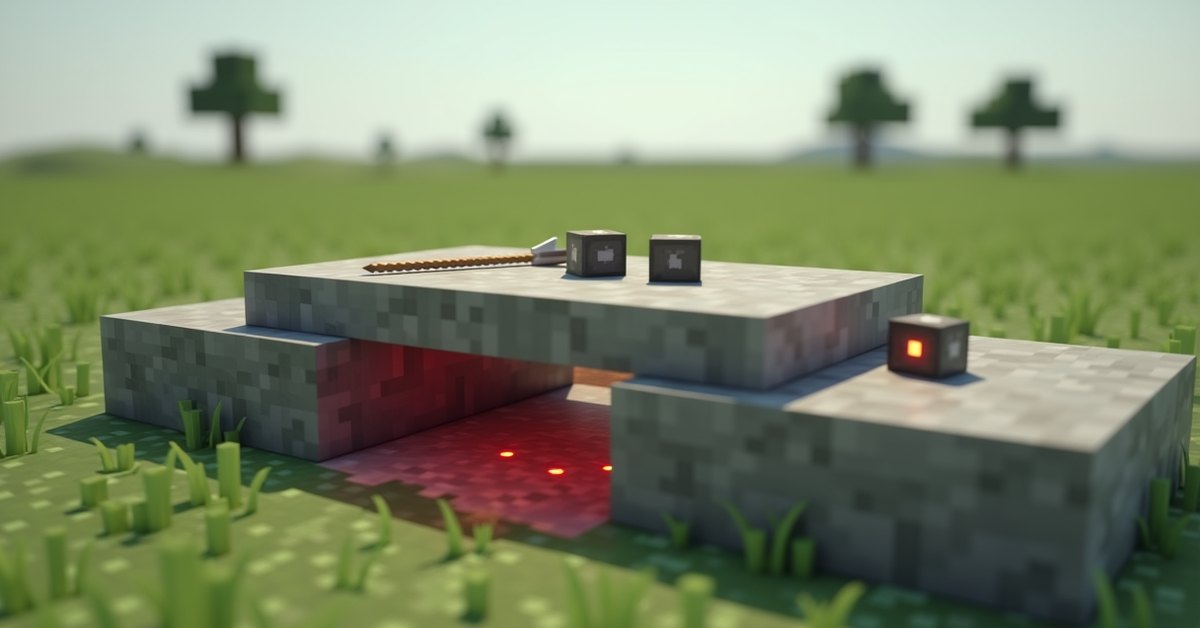
What the heavy weighted pressure plate is
The heavy weighted pressure plate is a redstone-output block made from iron. It looks like a flat iron tile, sits on top of most solid blocks, and emits a redstone signal whose strength depends on how many entities (players, mobs, dropped items, arrows) are on it. Unlike a regular wooden or stone plate that just toggles on and off, this one gives you a variable signal between 1 and 15.
It’s part of the redstone family of blocks. Its companion, the light weighted pressure plate, is made from gold and reacts to far fewer entities. The heavy plate is the one you reach for when you need to count or measure large groups of things.
If you’re trying to detect a single player walking past a spot, this is the wrong block. Use a tripwire, a wooden pressure plate, or a target. The heavy plate exists for counting, not for triggering once.
How to craft a heavy weighted pressure plate
The recipe is straightforward: two iron ingots placed side by side in any two horizontally adjacent slots of a crafting grid. That makes one plate. There’s no shaped pattern beyond “two iron next to each other,” so the recipe works fine in the 2×2 inventory grid or in a full crafting table.
Iron is the only material it needs. A short trip to a cave, or a few hours next to a basic iron farm, gives you enough to set up several detectors. There’s no smelting variation and no enchanted version. One recipe, one block.
Hardness is 0.5, so it breaks fast. You’ll need a pickaxe (any tier, wood and up) to actually get the block back when you mine it. Break it with anything other than a pickaxe and the plate is gone, which is annoying if you placed one experimentally and then changed your mind.
How the signal strength works
This is where the heavy plate earns its name. The signal it outputs is the number of entities currently on the plate, divided by 10, rounded up, and capped at 15. In practice that gives you:
- 1 to 10 entities on the plate: signal strength 1
- 11 to 20 entities: signal strength 2
- 21 to 30 entities: signal strength 3
- …and so on, up to 141 to 150 entities: signal strength 15
Anything past 150 still reads 15. The plate caps out the same way any redstone signal does.
The signal travels through redstone dust like any other, but the more common pattern is to read the plate with a redstone comparator. The comparator turns the analog signal into something you can use in a circuit: a counter, or a threshold trigger that fires when the count crosses a chosen level.
Every entity counts the same. A baby zombie, a dropped iron ingot, an arrow, and a player all add 1 to the entity count. That’s useful when you want to count “anything,” and frustrating when you accidentally tally an arrow that’s been sitting on the plate for almost a minute.
Heavy plate vs. light weighted pressure plate
The two weighted plates look almost the same and use the same general idea, but the numbers are different. The light plate (gold) reads 1 entity as signal 1, 2 entities as signal 2, all the way to 15 entities for signal 15. Beyond 15 entities, it stays at 15.
The heavy plate (iron) needs 10 times as many entities to reach the same signal level. Where the light plate maxes out at 15 entities, the heavy plate maxes out at 150.
Practically: if you’re counting items in a hopper line and the count is usually under 15, the light plate is the right tool. If you’re counting mobs in a farm where 100 or more entities pile up, the heavy plate is what you want. The light plate would just instantly hit 15 and tell you nothing useful past that point.
Practical uses in redstone
The heavy weighted pressure plate is a counting tool. Most of what people build with it falls into a handful of categories.
Item counters
Drop items onto the plate and read the signal with a comparator. The signal climbs as items pile up. Pair it with a hopper underneath, and you can build a circuit that pulls items in one at a time, then fires once the count hits a threshold.
Mob farm output meters
In a big mob farm, the kill chamber can hold dozens of mobs at any moment. Put a heavy plate at the bottom of the chamber, run a comparator out of it, and you have a live readout of how full the chamber is. If your farm is humming along, the signal won’t change much. If the rate drops, the signal drops with it.
Storage-system fullness checks
A common build is a hopper chain that dumps overflow items onto a plate. The plate’s signal tells you how clogged the system is. If the signal stays at 0, the chain is flowing freely. If it climbs, something downstream is stuck.
Crowd-triggered effects
You can place a heavy plate at a chokepoint and only have something fire when, say, 10 or more entities show up. That filters out a single mob wandering through and only triggers on a real crowd. It works well for raid defenses, large-scale mob sorters, and ambush traps in PvP maps.
Tips and common mistakes
A few things trip people up. Skeletons in a farm sometimes shoot arrows that land on the plate. Each arrow persists for about 60 seconds before despawning, and during that time it counts as one entity on the plate. If your readings are noisier than they should be, this is usually why.
Dropped items don’t sit forever either. An item lasts roughly 5 minutes on the ground in Minecraft before vanishing. If your circuit relies on items piling up, plan for that lifetime.
Plates don’t stack vertically. You only get one plate per top-of-block face, so for more counting capacity you need more plates placed side by side, with their signals combined through redstone wire or a small OR-gate setup.
Comparator placement is the most common point of failure. The comparator has to be touching the plate, with the comparator’s arrow pointing away from the plate. Place it the wrong way around and the circuit reads 0 forever.
Hoppers and plates work together but don’t substitute for each other. A hopper above or below the plate moves items in and out, but the items only count toward the signal when they’re physically on top of the plate. A hopper full of items contributes nothing on its own.
Java vs. Bedrock differences
The heavy weighted pressure plate behaves the same way in both editions for normal use. The recipe is identical, the signal formula is identical, and the block can be placed on the same surfaces in both versions. Entity despawn timings are very close between editions, so long-running counters tend to behave similarly. In tight-timing redstone, a few ticks of difference can matter, but the underlying mechanics of the plate itself don’t change.
Frequently asked questions
Can you craft a heavy weighted pressure plate without an iron block?
Yes. The recipe uses two iron ingots, not an iron block. Place the ingots in any two horizontally adjacent crafting slots and you get one plate.
How many entities does it take to get a signal of 15?
150 entities. The signal climbs by 1 for every additional 10 entities and caps at 15 once you hit 150.
Do arrows trigger a heavy weighted pressure plate?
Yes. Any entity sitting on top of the plate counts, including arrows, dropped items, mobs, and players. Stuck arrows count for the full 60 seconds before they despawn.
What’s the difference between heavy and light weighted pressure plates?
The light plate (gold) gives 1 signal per entity and caps at 15 entities. The heavy plate (iron) gives 1 signal per 10 entities and caps at 150. Use the light one for small counts and the heavy one for large ones.
Can I place a heavy weighted pressure plate on a fence or wall?
Yes. Pressure plates of any type can sit on top of fences, walls, hoppers, slabs (with the flat side up), and most other solid-top blocks. The plate works the same way regardless of what it’s sitting on.
Why isn’t my heavy weighted pressure plate sending a signal?
The most common cause is comparator placement. The comparator has to be directly next to the plate with its arrow pointing away from the plate. If it’s facing the wrong direction, or if you’ve used a redstone repeater instead of a comparator, you’ll read nothing.
Does the heavy weighted pressure plate work in water?
It can be waterlogged. The water doesn’t break the function: the plate still detects entities and emits its signal. Items inside the same block space as the plate still register, even though they may visually appear to be floating in water.
The short version
The heavy weighted pressure plate is a counting tool, not a trigger. Two iron ingots make one plate, and the signal it outputs scales with how many entities pile up on top, in batches of 10. If you’re counting items in a farm or measuring crowd size at a chokepoint, this is the block you want. If you only need a “someone stepped here” trigger, pick a different plate.