What is chiseled polished blackstone?
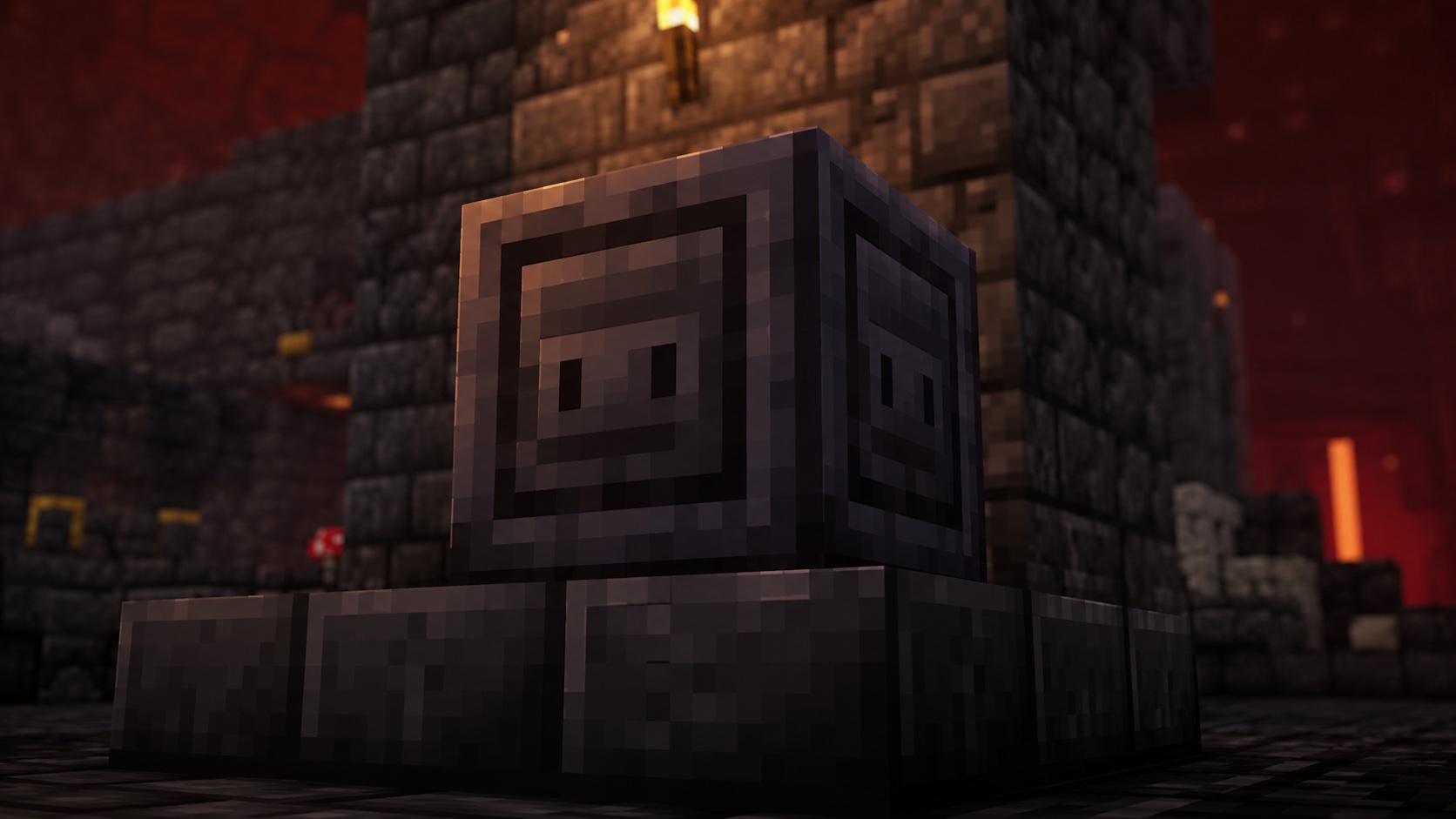
Chiseled polished blackstone is a decorative block in Minecraft. It is the most ornate member of the polished blackstone family, with a stylized face carved into each of its four sides. The top and bottom of the block use a separate, plainer pattern.
Mojang added the polished blackstone family in the Nether Update (version 1.16). All of these blocks share the same dark, slightly purple-gray tone, which makes them useful for Nether-themed builds, castles, and any project where you want a heavier, more imposing color than gray stone or cobblestone.
This guide covers where the block spawns, how to craft it, how to mine it, what it does in a build, and a handful of common mistakes to avoid.
Where to find chiseled polished blackstone
You can find chiseled polished blackstone in two structures that generate naturally:
- Bastion remnants in the Nether. The block shows up in walls, floors, and decorative panels inside bastions. It is most common in the bridge and treasure variants of bastions, where it appears as part of larger ornamental walls.
- Ruined portals in both the Overworld and the Nether. A few chiseled polished blackstone blocks usually spawn in the rubble pile next to the portal frame, mixed in with regular polished blackstone, gilded blackstone, and gold blocks.
If you only need a few blocks for a quick decoration, raiding a ruined portal is faster and safer than fighting through a bastion. If you want a stack or more, crafting them yourself is much faster than scavenging in either structure.
How to craft chiseled polished blackstone
You have two ways to make this block, and they take different inputs.
Crafting recipe with slabs
Place two polished blackstone slabs in a vertical stack in any 1×2 column of a crafting table. The recipe gives one chiseled polished blackstone block per craft. The slab stack does not need to sit in a specific column; the leftmost, middle, or rightmost column all work.
The slabs themselves come from polished blackstone. Three polished blackstone in a row across the crafting table gives six slabs. Six polished blackstone produces enough slabs for six chiseled blocks total, which is the cheapest crafting path if you already have polished blackstone in stock.
Stonecutter recipe
You can also use a stonecutter. Drop one polished blackstone into the input slot and pick the chiseled polished blackstone option. This gives one chiseled polished blackstone for one polished blackstone, with no slab step in between.
The stonecutter is the more efficient path if you already have polished blackstone in your inventory and want a quick batch of chiseled blocks. It also avoids the chance of misclicking the slab recipe in the crafting table.
You cannot put regular blackstone or gilded blackstone in the stonecutter and get this block. The recipe only accepts polished blackstone as the input.
Mining and tool requirements
Chiseled polished blackstone needs a pickaxe to drop as an item. Any tier of pickaxe works, from wood up through netherite. If you break the block with your bare hand, an axe, a shovel, or any non-pickaxe tool, the block breaks but nothing drops, and the work is wasted.
The block has a hardness of 1.5 and a blast resistance of 6, the same as cobblestone. A creeper explosion or a ghast fireball will break it the way they break cobblestone. It is not blast-resistant the way obsidian, ancient debris, or reinforced deepslate are, so do not rely on it for any kind of bunker wall or anti-griefing barrier.
Silk Touch is not required to keep the block intact. With or without Silk Touch, any pickaxe drops the block as itself.
Properties and behavior
Chiseled polished blackstone is a full, solid, opaque block. That has a few practical effects:
- Mobs can walk on it like any normal full block.
- You can place torches, redstone dust, buttons, levers, and other attachable items on its top, sides, or underside.
- It blocks light, so it casts a normal shadow during the day.
- Pistons can push and pull it like any other movable block.
- It counts as a valid beacon base block. The polished blackstone family is included in the list of materials that work for a beacon pyramid, alongside iron, gold, diamond, emerald, and netherite blocks.
The face appears on all four side faces of the block. The top and bottom faces show a separate pattern. The block has no rotation property, so you cannot pick which side the face is on; placing it always gives you faces on the four sides and the alternate texture on the top and bottom.
Related blocks in the polished blackstone family
Chiseled polished blackstone is one of several blocks made from polished blackstone. The full family:
- Polished blackstone: the base smooth block, made from regular blackstone in the crafting table or stonecutter.
- Polished blackstone slab: a half-block version of the smooth block.
- Polished blackstone stairs: the stair version, useful for stepped builds and roofs.
- Polished blackstone wall: a wall block that connects to other walls, fences, and full blocks.
- Polished blackstone bricks: a brick-textured variant of polished blackstone.
- Polished blackstone brick slab, stairs, and wall: brick-textured versions of those shapes.
- Cracked polished blackstone bricks: a weathered version of the bricks, made by smelting normal polished blackstone bricks in a furnace.
- Chiseled polished blackstone: this block, the decorative face variant.
- Polished blackstone pressure plate: a pressure plate that detects players, mobs, and items.
- Polished blackstone button: a button that emits a brief redstone signal when pressed.
All of these share the same color and pair well with gilded blackstone, basalt, and netherite blocks for a Nether-themed palette.
Build ideas and uses
The face design makes the block stand out, so it works best as an accent rather than as a fill block. A wall built entirely from chiseled polished blackstone gets repetitive fast, and the face pattern loses impact when it is repeated dozens of times in a row.
A few ways players use it well in builds:
- As pillars on either side of an entrance, with one chiseled block at eye level on each side and regular polished blackstone or polished blackstone bricks above and below.
- As medallions inset into a flat wall of polished blackstone bricks, spaced four to eight blocks apart.
- As floor tiles in a temple-style build, alternating with a contrasting block such as basalt or smooth basalt.
- As a “guardian” face above a doorway, with a soul lantern hanging just below for ambient blue light.
- As decoration on the upper levels of a Nether outpost, where the dark stone blends with surrounding netherrack and basalt.
Because the block is the same shape and footprint as a normal full block, you can swap it into any build that uses polished blackstone or polished blackstone bricks without changing the layout or breaking adjacent connections.
Java and Bedrock differences
The block behaves identically in Java Edition and Bedrock Edition. Recipes, hardness, blast resistance, beacon eligibility, and tool requirements all match. The only practical difference is the user interface for the stonecutter, which looks slightly different on each platform but accepts the same input and gives the same output.
Tips and common mistakes
A few things that trip players up:
- If you mine the block with a wooden axe by accident, it breaks but does not drop. Always check your hotbar and switch to a pickaxe before you swing.
- The crafting recipe needs polished blackstone slabs, not regular polished blackstone. Mixing the two up is the most common reason a craft fails to register in the table.
- The stonecutter recipe is the most efficient. Two polished blackstone slabs in a crafting table give one chiseled block. One polished blackstone in a stonecutter also gives one chiseled block. The stonecutter saves a step and one slab.
- Smelting blackstone in a furnace does not turn it into polished blackstone. You craft polished blackstone from regular blackstone in a 2×2 grid, or run blackstone through a stonecutter.
- The face does not glow, emit redstone, or function as anything other than a decoration. It is not a sensor, a spawner, or a trigger of any kind.
- If you are gathering polished blackstone variants from a ruined portal, watch for lava. Many ruined portals spawn with their portal frames partially or fully filled with lava, and stepping into one without fire resistance is the fastest way to lose your loot.
Frequently asked questions
Can chiseled polished blackstone be used in a beacon base?
Yes. Like every block in the polished blackstone family, it counts as a valid beacon pyramid block in both Java Edition and Bedrock Edition.
Does Silk Touch matter for this block?
No. The block drops itself when mined with any pickaxe at any tier, with or without Silk Touch.
Where does it spawn naturally?
In bastion remnants in the Nether and in the rubble piles next to ruined portals in both the Overworld and the Nether.
How do I make a lot of it quickly?
Use a stonecutter. One polished blackstone gives one chiseled polished blackstone, with no slab step. If you have a stack of polished blackstone, you can convert the whole stack to chiseled blocks in a few seconds of clicking.
Can I get it from regular blackstone in a stonecutter?
No. The stonecutter recipe only accepts polished blackstone. You have to polish the blackstone first, either in a crafting table or in the stonecutter, then run the polished version through to get the chiseled block.
Is it blast-resistant?
No. Its blast resistance is 6, the same as cobblestone. A creeper or a ghast can break it. If you need a blast-resistant block in the Nether, use obsidian, ancient debris, or reinforced deepslate instead.
Can the face on the block be rotated?
No. The block has no rotation property. The face appears on all four side faces of the block, and the top and bottom show a different pattern. You cannot pick which side the face appears on because every side face already has it.
Final note
If you build often in the Nether or you like dark color palettes, keep a stack of polished blackstone on hand. It feeds the entire family of polished blackstone blocks, including this one, and a stonecutter turns it into whatever shape your build needs in a single click.