What is deepslate?
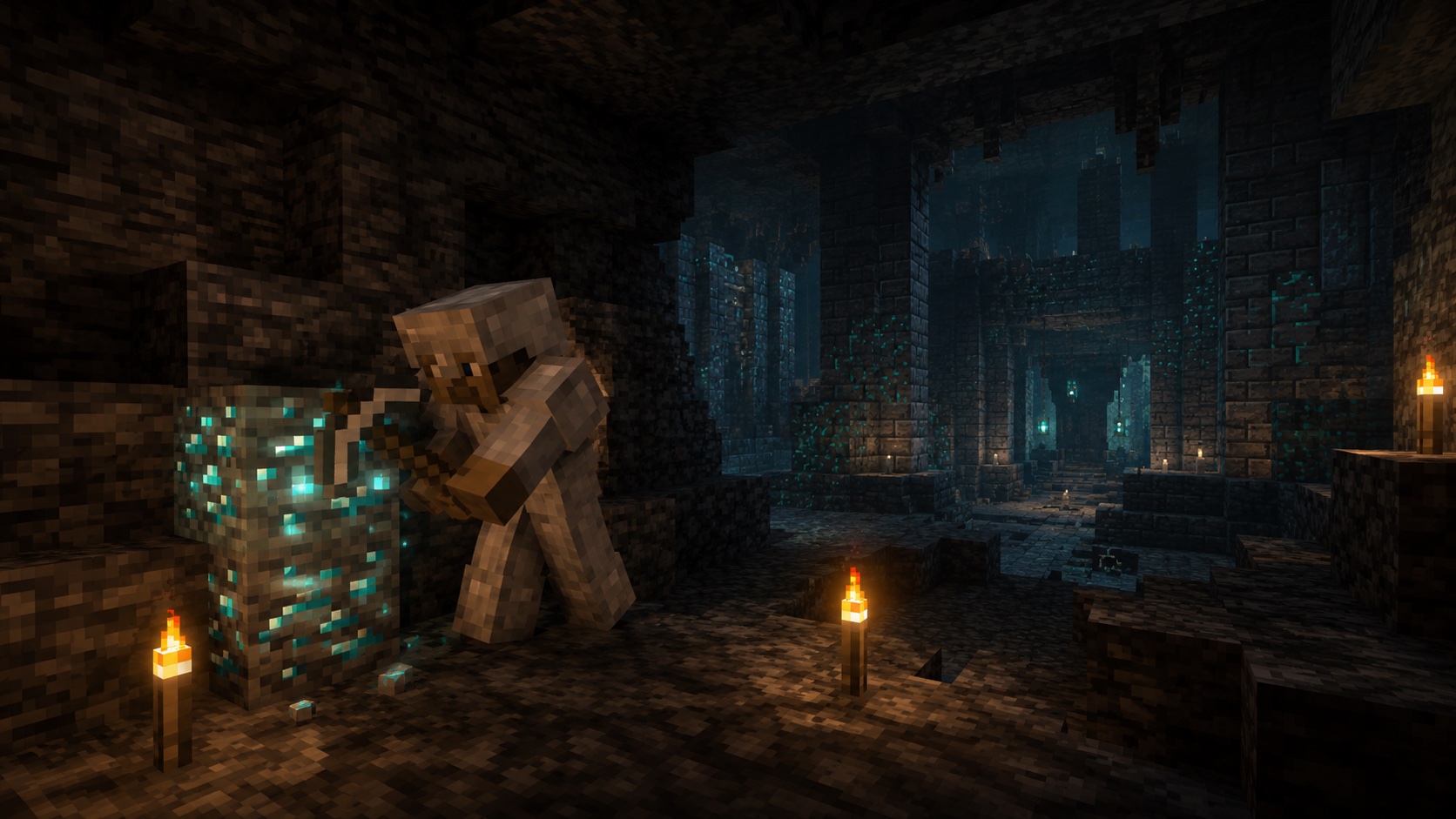
Deepslate is a dark, dense stone block that fills the lower section of every Overworld in Minecraft. It looks like a moodier cousin of regular stone: nearly black with a faint horizontal banding. The block was added in the 1.17 Caves & Cliffs update and reshaped what the bottom of the world looks like.
If you have ever dug a deep mine and noticed the rock suddenly turning darker and your pickaxe slowing down, you hit deepslate. It is the same idea as stone, but tougher, deeper, and with its own family of crafted variants for building.
Where deepslate generates
Deepslate replaces stone in the lower part of the Overworld. The exact bands look like this:
- Y=0 and below: the deepslate layer begins.
- Y=-1 to Y=-7: a mixed transition zone where stone and deepslate blend together.
- Y=-8 down to Y=-64: almost pure deepslate, with ore pockets scattered through it.
Bedrock starts forming at Y=-59 and reaches its hard floor at Y=-64, so the very last few layers of mining are a mix of deepslate, ore, and bedrock. Deepslate also shows up in ancient cities, the giant Warden-haunted structures that generate in the Deep Dark biome. Those builds use cobbled deepslate, deepslate bricks, deepslate tiles, and reinforced deepslate.
How to mine deepslate
Deepslate behaves like stone with a longer cooldown. You need a stone pickaxe or better; a wooden pickaxe will not drop the block. The hardness is roughly twice that of normal stone, so plan for a slower mining pass when you reach the dark layer.
When you mine plain deepslate without Silk Touch, you get cobbled deepslate, the same way regular stone drops cobblestone. With Silk Touch, the block drops as deepslate itself, keeping its smoother texture.
Deepslate has a pillar-style orientation. The top and bottom faces share one texture, and the four side faces share another. When you place it, it locks to the direction you are facing, so if you want clean vertical lines in a wall you may need to place each block from the top or bottom face. Most other variants in the family do not have this orientation issue.
Cobbled deepslate vs. deepslate
These two look similar at first glance, but they behave differently.
Plain deepslate is the natural block. It has the directional texture and the smoother surface. It does not break down into cobblestone form unless you explicitly mine it without Silk Touch.
Cobbled deepslate is the dropped version, the equivalent of cobblestone. It looks rougher, has no orientation, and acts as the starting point for the entire deepslate building set. You craft it into all the polished and brick variants. You can also smelt cobbled deepslate back into deepslate in a furnace, mirroring the cobblestone-to-stone path.
Deepslate variants and crafting
Deepslate has one of the deepest build sets in Minecraft. Starting from cobbled deepslate, you can craft:
- Polished deepslate (4 cobbled deepslate in a 2×2 grid)
- Deepslate bricks (4 polished deepslate in a 2×2 grid)
- Deepslate tiles (4 deepslate bricks in a 2×2 grid)
- Chiseled deepslate (2 cobbled deepslate slabs stacked vertically)
Every one of those variants also has a slab, a stair, and a wall version, which gives you roughly 16 distinct deepslate-family blocks for building. A stonecutter shortcuts most of this: drop in cobbled deepslate and you can cut directly to any of the variants without going through every intermediate step. The stonecutter recipe is also a touch cheaper than the crafting table recipe in terms of materials per output.
Deepslate ores
Below Y=0, all the normal Overworld ores have deepslate versions: deepslate coal, deepslate iron, deepslate copper, deepslate gold, deepslate redstone, deepslate lapis, deepslate diamond, and deepslate emerald. They look like the normal ores embedded in the darker base rock.
The mining tier requirement is the same as the non-deepslate version. Deepslate diamond ore still needs an iron pickaxe. Deepslate redstone ore still needs an iron pickaxe. Deepslate gold still needs an iron pickaxe. The only real difference is hardness: deepslate ores take noticeably longer to break than their stone counterparts, so an Efficiency enchantment goes a long way at the lower levels.
Drops are identical to the regular versions. Deepslate iron ore drops raw iron, deepslate gold drops raw gold, and so on. Silk Touch returns the deepslate ore block intact if you want to keep the deepslate texture in your collection or use it for decoration.
Reinforced deepslate
Reinforced deepslate is the rarest and toughest member of the family. It only generates in ancient cities, framing the structure that holds the warden trial chamber. The block cannot be obtained legitimately in survival: it is unbreakable by any tool, Silk Touch fails on it, and even TNT, withers, and end crystals leave it untouched. The only way it changes state is through the /setblock command in Creative mode.
What it is for: locking down a part of the world. The warden cannot break it. Pistons cannot move it. Anvils land on it and break instead of damaging it. If you ever want a block that says “do not pass,” reinforced deepslate is the answer Mojang baked into the game. The texture also has a glowing rune in the center that gives ancient cities their unsettling look.
Building with deepslate
Deepslate is the medieval-castle block of the modern Minecraft palette. The dark base color reads as worn stone or weathered basalt without needing the actual basalt texture, and it pairs well with iron blocks, andesite, and dark woods like dark oak and spruce.
Some practical pairings: deepslate bricks for walls, polished deepslate for floors, chiseled deepslate as accents or column tops, and deepslate tiles for roofs. The matching stairs and walls cover the rest. Cobbled deepslate works for rougher builds like dungeons, mine entrances, and abandoned structures.
One thing to watch: deepslate is darker than regular stone, so the same build that feels warm in regular stone can feel oppressive when redone in deepslate. Mixing in lighter accent blocks (polished diorite, sandstone, or a light wood) helps if a build starts feeling like a tomb. Indoor lighting also matters more than usual; sea lanterns, glowstone, and lanterns all work well against the dark base.
Java vs. Bedrock differences
The deepslate family behaves the same across Java and Bedrock for the most part. Generation, mining tier, variant crafting, and the existence of reinforced deepslate are identical. Small differences exist around stonecutter recipes and exact ore distribution rates, which Mojang has rebalanced a few times since 1.17. If you are min-maxing a specific ore at a specific Y level, double-check current world generation values for your version and edition.
Tips and common mistakes
A few things people learn the hard way:
- Skipping deepslate diamond ore because the layer is “too slow” to mine. The transition zone between Y=-1 and Y=-7 is actually one of the better ore zones, since both stone and deepslate ores spawn there.
- Mining deepslate without Efficiency. The hardness is high enough that even Efficiency II on an iron pickaxe makes a real difference when stripping out a large area.
- Forgetting deepslate has orientation. If half your wall faces sideways and half faces up, that is why. Use Silk Touch and replace each block from the same angle, or switch to cobbled deepslate for that section.
- Trying to break reinforced deepslate. You cannot. Save the pickaxe durability for the ancient city loot.
Frequently asked questions
What Y level does deepslate start at?
Deepslate begins at Y=0 with a mixed transition zone running down to about Y=-7. From Y=-8 to Y=-64 the world is almost entirely deepslate, stopping only where bedrock begins.
Is deepslate stronger than stone?
Yes. Plain deepslate has roughly twice the hardness of stone, which translates into a noticeably longer mining time. Blast resistance is also higher, so explosions clear less of it per blast.
Can you smelt cobbled deepslate back into deepslate?
Yes. Put cobbled deepslate in a furnace, blast furnace, or smoker, and you get deepslate back. It works the same way cobblestone smelts into stone.
Why is my deepslate sideways?
Plain deepslate has a top and bottom orientation. The direction the block faces depends on the side of the previous block you place it against. Cobbled deepslate, polished deepslate, deepslate bricks, and deepslate tiles do not have this issue.
Can the warden break deepslate?
No. The warden cannot break any deepslate variant, including plain deepslate, cobbled deepslate, deepslate bricks, and reinforced deepslate. That is why ancient cities are built almost entirely from the deepslate family in the first place.
What pickaxe do I need for deepslate diamond ore?
An iron pickaxe or better. The pickaxe tier requirement matches regular diamond ore. The only difference is mining time; the diamond drop is the same.
Is reinforced deepslate craftable?
No. It only generates in ancient cities and cannot be obtained in survival. In Creative, you can place it using the /give or /setblock commands.
Deepslate adds depth, dark color, and a lot of new building options to the bottom half of every Overworld. Once you cross Y=0, plan your mining tools around its hardness and your builds around its color. Both pay off.