What diamond ore is and why players hunt it
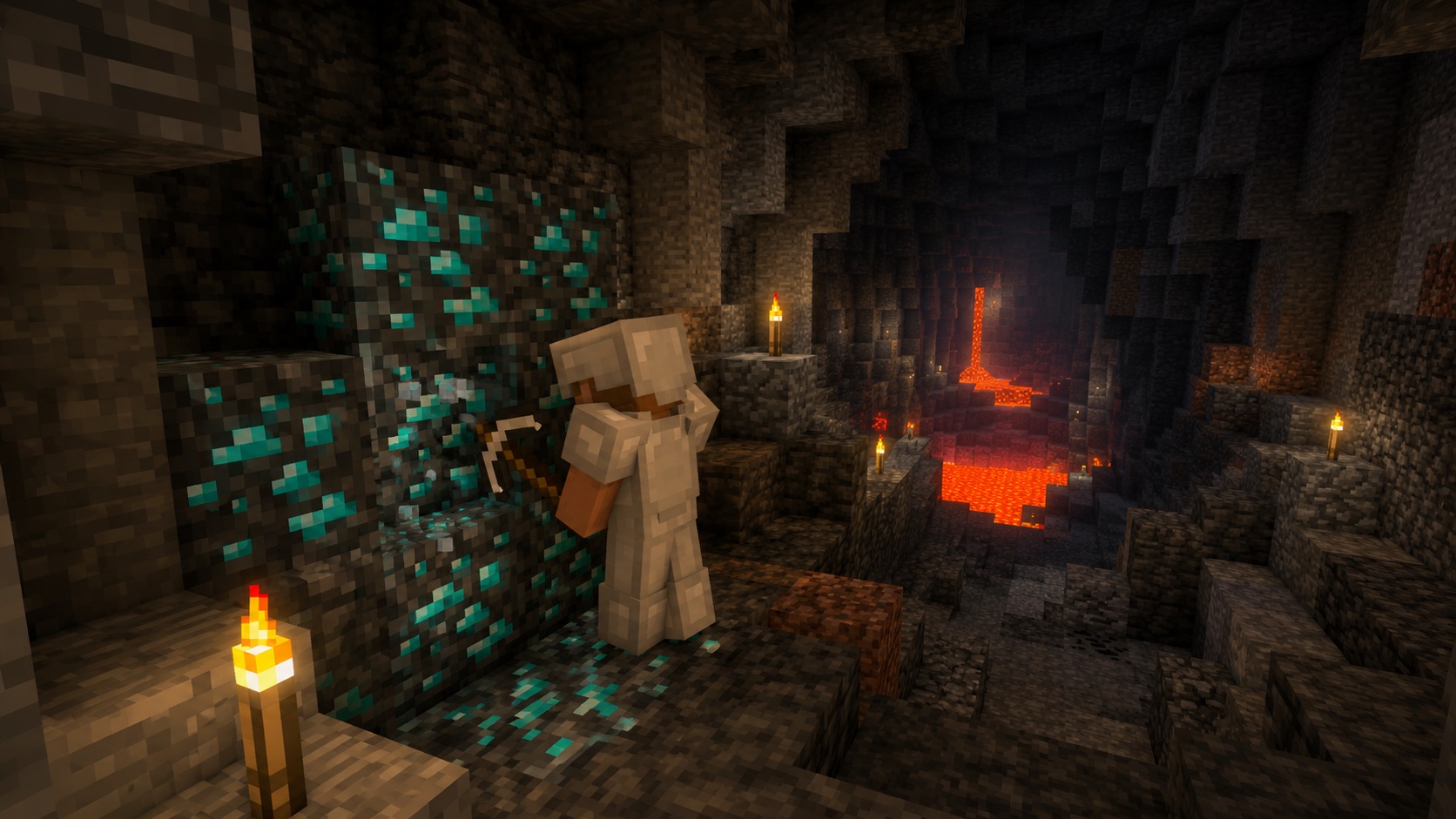
Diamond ore is the block that drops a diamond when broken with the right pickaxe. It looks like stone or deepslate with bright blue-white crystal flecks running through it, and it spawns deep underground in the lower half of the world. Pretty much every progression goal past iron tier runs through this block, which is why players go to so much trouble to find it.
Diamonds make the strongest non-netherite gear in the game, and they’re the only crafting material that lets you upgrade tools and armor to netherite later. Diamonds are also part of the recipe for an enchanting table, a jukebox, and a firework star, so even if you already have a full netherite kit, you still need a steady supply.
Mojang has changed how diamond ore generates a few times. The current version, since the 1.18 Caves and Cliffs update, pushes diamond ore deeper than it used to be and spreads it across more layers. The old advice to mine at Y=12 is out of date. If a guide tells you to strip-mine at Y=11 with full diamond armor, that guide is from 2020.
Where diamond ore generates
Diamond ore spawns in the bottom slice of the Overworld. In 1.18 and later, it can appear anywhere from Y=16 down to Y=-64, but the distribution is heavily weighted toward the bottom. The single most common Y-level is around Y=-58, just above bedrock.
The block matrix changes with depth. Between Y=16 and roughly Y=0, diamond ore spawns inside the regular stone layer and uses the classic “stone with crystals” texture. Below Y=0, the world is made of deepslate, and diamond ore generated in deepslate has the deepslate diamond ore texture: a darker gray block with the same blue crystals. Both blocks function the same way; only the surrounding rock is different.
You can also find diamond ore in mineshafts, exposed ravines, and underwater cave systems, since those features cut through the layers where diamond ore generates. Lush caves and dripstone caves are good hunting grounds because they tend to have a lot of natural openings, which means you can spot ore without digging blind. Ancient cities, which generate in the deep dark biome below Y=0, sit right in the diamond zone and often have diamond ore in their surrounding walls.
Best Y-level to mine at
If you’re going to dig a strip mine and never move, the math says Y=-58 is your best single elevation. That layer gives you the highest probability of diamond ore per block broken.
In practice, most players don’t sit on one Y-level. A strip mine at Y=-54 lets you see two layers up and two layers down without rebuilding the corridor, which is more efficient than dropping to exactly Y=-58. If you mostly explore caves with night vision and good torches, you’ll cover ground faster than a strip miner anyway, and you don’t have to sweat the exact Y-coordinate.
How to mine diamond ore
You need an iron, diamond, or netherite pickaxe to mine diamond ore. A stone pickaxe or wooden pickaxe will swing and crack the block, but when it shatters, you get nothing. This is the most expensive new-player mistake in the game, and it happens to almost everyone the first time.
If you reach a diamond ore block and you only have stone tools, leave the block alone, mark the spot with a torch or a column of dirt, and come back with iron. Don’t try to break it.
Tools and enchantments that change the drop
A clean iron pickaxe drops exactly one diamond per ore block. The interesting case is enchantments.
Fortune increases the number of diamonds dropped from a single block. Fortune I gives a chance at one or two diamonds. Fortune II gives a chance at one, two, or three. Fortune III, the maximum level, can drop up to four diamonds per block. The average over many blocks works out to roughly 2.2 diamonds per ore with Fortune III, so a single enchanted pickaxe more than doubles your yield.
Silk Touch does the opposite. Instead of dropping a diamond, it drops the ore block itself, which you can pick up and place somewhere else. That’s useful if you want to bank ore until you have a Fortune III pickaxe, or if you want to build a decorative wall of diamond ore.
You can’t combine Fortune and Silk Touch on the same pickaxe.
XP from diamond ore
Each diamond ore block drops 3 to 7 experience orbs when mined with a non-Silk-Touch pickaxe. Over a long mining session, this stacks up fast and is one of the better natural XP sources in the early game. Silk Touch suppresses the XP drop because the block isn’t actually broken into a resource; it’s picked up whole.
What diamond ore drops
A standard break with iron, diamond, or netherite drops one diamond. Diamonds are the primary drop, but the ore block itself can come back to you in two other situations.
The first is when the pickaxe is enchanted with Silk Touch, which drops the ore block. The second is when the block is destroyed by an explosion or piston push, but explosions almost never give you anything (the same is true if a creeper takes the wall out next to your mine).
That’s the whole drop table. There’s no random rare drop, no chance of two diamonds without Fortune, and no special variant from deepslate diamond ore. It drops the same regular diamond, just from a different-looking parent block.
Tips and common mistakes
A few patterns separate efficient diamond hunters from people who burn an afternoon and come home with three diamonds.
Bring a water bucket. Lava lakes are extremely common at diamond depths, and diamond ore loves to generate right next to them. A bucket of water dumped on lava turns it into obsidian, which means you stop dying and your diamonds stop falling into the lake.
Don’t dig straight down. The single rule that every Minecraft guide repeats is repeated because new players keep doing it anyway. Below Y=0 the chance of dropping into a lava pocket is real, and lava at that depth means losing whatever you’re carrying.
Light as you go. Hostile mob spawns get worse at low Y-levels, and the deep dark biome (which can generate across your path) spawns wardens if you make noise without sneaking. Torches every six blocks at minimum.
Skip the netherite armor on a quick run. Netherite is great, but if you fall in lava with full netherite, you lose the netherite. A diamond chestplate and a fire resistance potion is a cheaper insurance policy until your base is more secure.
Use a beacon if you have one. The Haste II effect from a full beacon pyramid makes mining diamond ore almost instant, which compounds across thousands of blocks of strip mining. The investment is steep, but for a long-term base it pays for itself.
Java versus Bedrock differences
The generation rules for diamond ore are the same in Java and Bedrock Editions in current versions. Both editions use the Y-level distribution introduced in 1.18.
The differences are small and mostly affect edge cases. XP orb drops can vary by one or two orbs between editions because of how the random number generator is seeded, but the average is identical over a long session. Bedrock’s Fortune calculation uses a slightly different probability table than Java’s, so the exact diamonds-per-ore curve isn’t identical. The practical difference over a hundred blocks is one or two diamonds. Mob spawn rates at mining depth are also tuned a bit differently; Bedrock spawns more hostile mobs in caves on default difficulty than Java does on hard.
None of these change how you should play. The basic strategy of going deep, lighting up, and bringing water works on both editions.
Frequently asked questions
Can you mine diamond ore with a stone pickaxe?
No. Stone and wooden pickaxes will break the block but drop nothing. You need iron, diamond, or netherite.
What’s the best Y-level for diamonds in current versions?
Y=-58. That’s the single layer with the highest diamond ore density. Most players strip-mine at Y=-54 or Y=-58 because anywhere in that range works well.
Does Fortune work on diamonds?
Yes. Fortune III on an iron, diamond, or netherite pickaxe drops up to four diamonds per ore block, averaging just over two per block.
Does deepslate diamond ore give more diamonds?
No. Deepslate diamond ore takes slightly longer to mine because deepslate is harder than stone, but it drops the same single diamond per block as regular diamond ore.
What’s the difference between diamond ore and deepslate diamond ore?
The matrix block. Diamond ore generates in regular stone above Y=0 with a gray-tan background. Deepslate diamond ore generates in the deepslate layer below Y=0 with a darker gray background. Both drop the same diamond.
Can creepers blow up diamond ore?
Yes. Creepers and TNT will destroy diamond ore, and the diamond does not drop when a block is exploded. Keep creepers off your diamond stash.
Is diamond ore renewable?
Not directly. Diamond ore doesn’t regenerate after you mine it. You can still get diamonds from bartering with piglins, from chest loot in structures like shipwrecks and end cities, and from killing zombies wearing diamond armor (very rare). For practical purposes, treat diamond ore as a non-renewable resource.
The takeaway
If you only remember three things about diamond ore: use iron or better to mine it, dig at Y=-58 or near it, and don’t fall in lava. Everything else is optimization. A patient strip mine with torches, a water bucket, and a Fortune III pickaxe will keep your base stocked for as long as you want to play.