What is diorite?
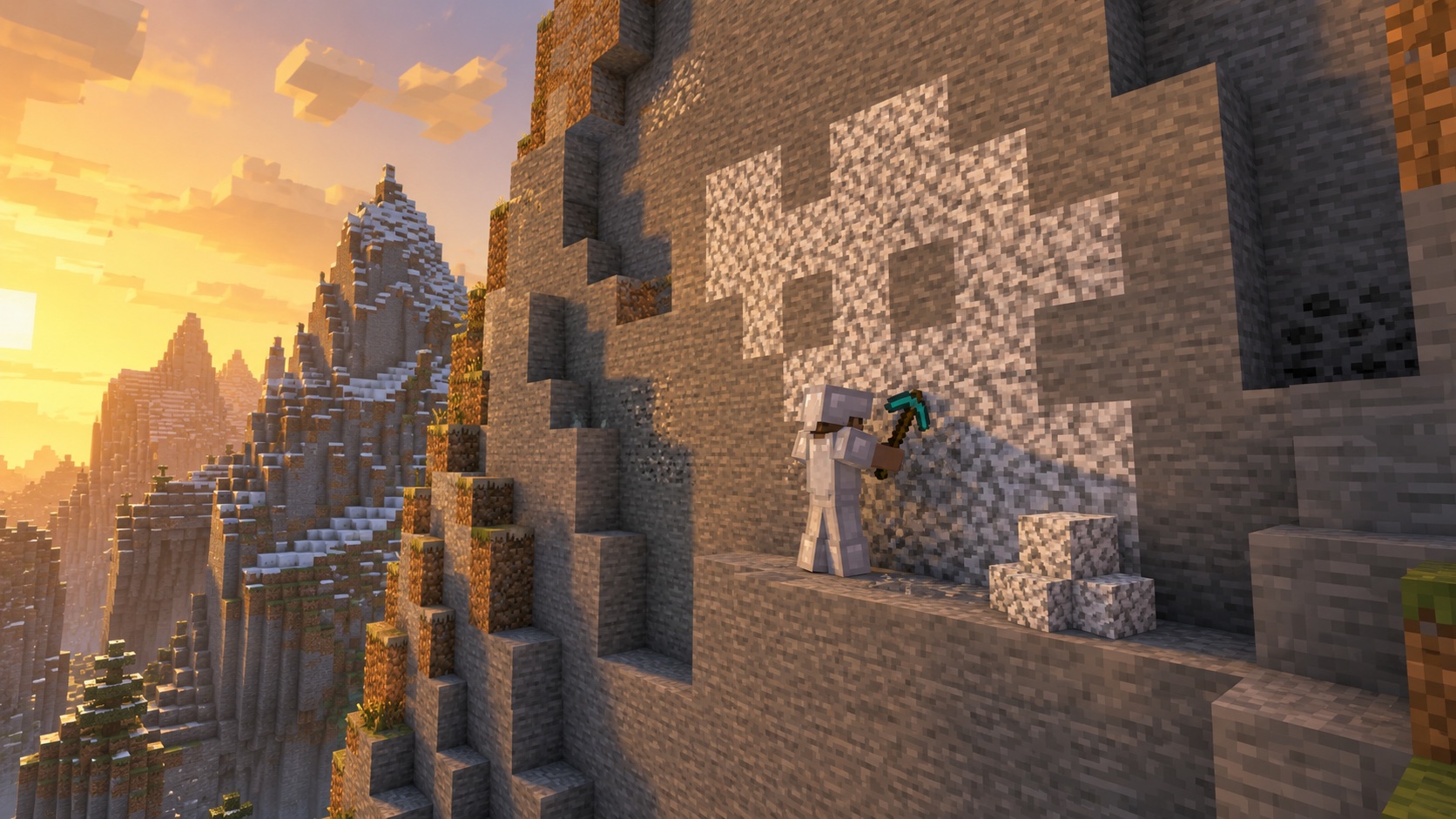
Diorite is a white-and-gray speckled stone block that generates naturally in the Overworld. It looks lighter than regular stone, with a salt-and-pepper texture that reads as crushed rock from a distance. Mojang added it in version 1.8 along with andesite and granite, and the three blocks share the same generation rules and the same role in builds: aesthetic stone variants that aren’t meant for anything mechanical.
You can’t smelt diorite, you can’t use it as fuel, and it isn’t a building material with any special property. It exists to give you another color of stone. That’s it. The interesting questions for most players are where it spawns, how to mine it efficiently, and what to do with the pile that ends up in your inventory after every cave trip.
Where to find diorite
Diorite generates in blobs (large rounded deposits) inside stone, mostly between Y=0 and Y=160 in modern versions of the game. The blobs can be 30 to 50 blocks across, so when you find one, you usually find a lot at once.
It shows up more often in certain biomes:
- Stony peaks, jagged peaks, and other mountain biomes
- Dripstone caves (mixed in with the usual stone)
- Windswept hills and windswept gravelly hills
You’ll also see it in regular caves at almost any depth in the Overworld. If you’ve been mining for diamonds at deepslate levels and notice big patches of speckled white stone, that’s diorite. It generates inside both stone and deepslate layers, though the deepslate version is just regular diorite. Mojang didn’t add a “deepslate diorite” variant the way they did for ores.
How to mine diorite
You need at least a wooden pickaxe to mine diorite. Stone, iron, diamond, and netherite pickaxes all work and mine it faster. Mining with your fist or any other tool destroys the block without giving you a drop, so don’t bother.
Diorite drops itself when mined, regardless of pickaxe tier or enchantments. Silk Touch doesn’t change anything because the raw drop is already the block itself. Fortune doesn’t apply. The block is straightforward: dig it, pick it up.
If you’re filling a chest with diorite for a build, the fastest method is finding one big blob and strip-mining it. Branch mining will hit blobs incidentally, but you’ll spend most of your time on stone and ores. For pure diorite stockpiling, surface-level mountain biomes often have the deposits exposed to the air, which means you can mine them without digging tunnels first.
How to craft diorite
If you don’t want to hunt for it, you can craft diorite at a crafting table. The recipe uses two cobblestone and two nether quartz arranged in a checker pattern (cobblestone on top-left and bottom-right, quartz on top-right and bottom-left, or the mirror). Each craft produces two diorite.
The catch is the nether quartz: you need access to the Nether and a few minutes with a pickaxe on quartz ore. For new survival worlds where the Nether is still off-limits, this recipe isn’t an option, so you’ll be mining diorite the regular way.
A stonecutter does not convert other stone types into diorite. Going from cobblestone to diorite requires the crafting table recipe with quartz. Going from diorite to its variants (slab, stair, wall, polished) works in either a stonecutter or a crafting table.
Diorite variants and recipes
Diorite is the base block for a small family of decorative pieces:
- Polished diorite: 4 diorite in a 2×2 grid yields 4 polished diorite. Smoother texture, brighter color.
- Diorite slab: 3 diorite in a horizontal row yields 6 slabs. Half-height blocks for stairs, ledges, and floor detail.
- Diorite stairs: 6 diorite in a stair shape yields 4 stairs. Used for roof angles and steps.
- Diorite wall: 6 diorite in two horizontal rows of 3 yields 6 walls. Connecting blocks for fences, low garden walls, and gates.
- Polished diorite slab and stairs: same recipes as the above, but with polished diorite as the input.
A stonecutter can produce any of these variants directly from raw diorite. One diorite gives you one variant block, with slabs being the exception: one diorite gives two slabs. For large builds the stonecutter is the cleaner choice because it avoids the crafting-table overhead.
Building with diorite
Diorite has a reputation for being ugly. That reputation comes from its raw form, where the speckle reads as visual noise in tight spaces. Three places where it actually works well:
Polished diorite as a clean white block. Once you polish it, the texture calms down and you get one of the brightest white-ish blocks in the game. It pairs well with quartz, snow blocks, and white concrete in modern builds and sculpted statues. Pillars made from polished diorite and quartz read as marble from across a courtyard.
Mixed with stone for natural cliff faces. If you’re terraforming a mountain or extending a natural cave, sprinkling diorite into a stone wall mimics what generates naturally and breaks up the gray. Many builders mix andesite, granite, and diorite into the same wall to make terrain look hand-shaped rather than placed.
As a base for snowy or icy themes. Diorite reads as light enough to fit a winter palette without resorting to pure white blocks, which can look flat under bright light. Snow on top, diorite underneath, blue stained glass for ice features.
For walls and floors in indoor builds, the raw diorite texture often looks better than people give it credit for. The complaint usually comes from seeing it in tiny patches against a stone backdrop where the contrast is harsh. Build with it intentionally and the speckle becomes a feature.
Java vs. Bedrock differences
Diorite behaves the same in Java Edition and Bedrock Edition for all practical purposes. The generation, the recipes, the tool requirements, the variants, and the stonecutter behavior all match. The only place you might see a small difference is in older versions of either edition before walls were added to diorite. Walls came to all stone types in 1.16 on Java and around the same time on Bedrock. On any modern version, the two editions are equivalent.
Tips and common mistakes
A few things players run into:
- Wrong tool drops nothing. Mining diorite with a sword or shovel destroys it without a drop. If you’re running through a cave and want to clear diorite for line-of-sight, a wooden pickaxe is enough and weighs the same in your inventory.
- Stonecutter beats crafting table for variants. If you have a stonecutter (and you should, they’re cheap), use it. Less wrist strain, fewer recipe lookups, no wasted materials.
- Diorite blobs can hide ores. Veins of coal, iron, and copper sometimes sit at the edge of a diorite blob. If you’re stripping a blob, glance at the surrounding stone before you backfill.
- It’s not a chiseled or smooth variant. Diorite has polished, slab, stair, and wall variants, but it has no “chiseled diorite” or “smooth diorite” block the way sandstone does. Don’t waste time looking for a recipe that doesn’t exist.
- Storage fills fast. Diorite is a high-volume drop from cave exploration. A dedicated double chest for it pays for itself.
Frequently asked questions
What is diorite used for in Minecraft?
Diorite is a building block. It has no crafting use as a material in tools, redstone, or food. You use it for decoration: walls, pillars, statues, floors, terraforming, and any build that wants a white or speckled stone color.
Can you smelt diorite into something else?
No. There is no smelting recipe for diorite. Putting it in a furnace does nothing.
What’s the fastest way to get a lot of diorite?
Find a large diorite blob in a mountain biome or a near-surface cave, then strip-mine the whole blob with an Efficiency pickaxe. A single blob often gives several stacks. Crafting it from cobblestone and nether quartz works but is slower for bulk amounts because each craft only yields two blocks.
Does Silk Touch or Fortune affect diorite?
No to both. Diorite drops itself by default, so Silk Touch has nothing to preserve. Fortune doesn’t multiply the drop because diorite isn’t an ore.
Can you find diorite in the Nether or the End?
No. Diorite generates only in the Overworld. The Nether has its own stone types (netherrack, basalt, blackstone), and the End has end stone. None of those substitute for diorite.
Why do builders use polished diorite for marble-style builds?
Polished diorite is one of the brightest near-white blocks in vanilla Minecraft. Combined with quartz pillars or quartz blocks, the color and texture read as marble or stucco from a distance. It’s a cheap substitute for quartz when you don’t want to make repeated Nether trips.
Is there a chiseled diorite?
No. Chiseled variants exist for sandstone, quartz, deepslate, stone bricks, nether bricks, and a few others, but diorite is not in that list. The only finished variants for diorite are polished diorite, slabs, stairs, and walls.
The bottom line on diorite
Diorite is one of the most overlooked decorative blocks in the game. The raw form gets dunked on for cluttering caves, but the polished version is one of the cleanest white-ish stones available, and the variants give you everything you need for full builds. If you’ve been clearing it out of caves and throwing it away, save the next few stacks for an actual build before you write it off.