What budding amethyst is
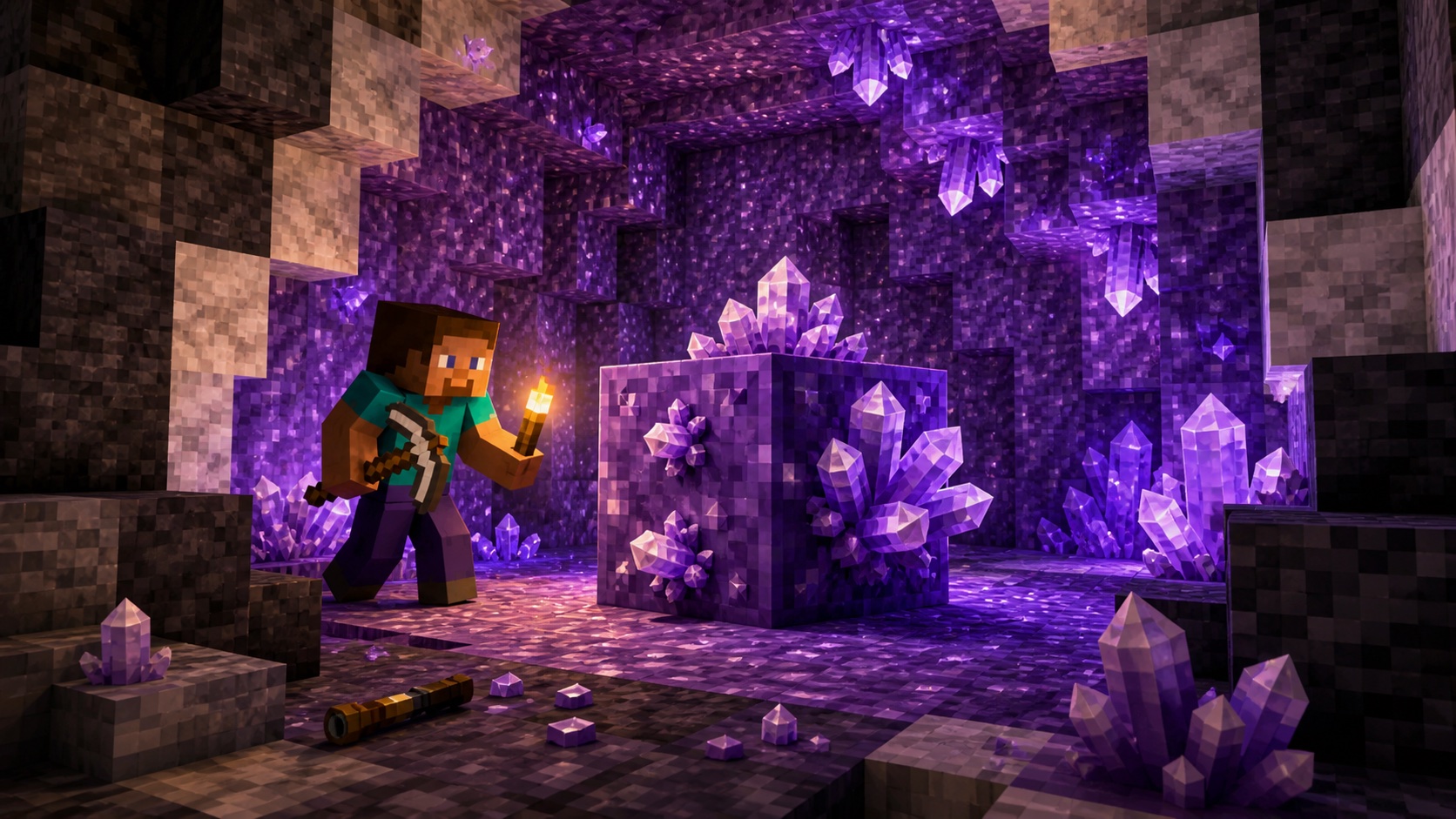
Budding amethyst is the only block in Minecraft that can grow amethyst clusters. It looks like a deep-purple block with a glowing pattern of crystals embedded in its faces, and you’ll only find it inside an amethyst geode, the round hollow structure that generates underground in the Overworld.
Most players bump into budding amethyst while caving, when they crack through a calcite outcrop and find a hollow chamber lined with purple crystals. The dark crystal blocks studded around those chamber walls are budding amethyst. Those are the ones doing the work.
If you’re hoping to mine it and bring it home, stop. You can’t. Budding amethyst can’t be collected in survival, even with Silk Touch. The rest of this article explains what the block actually does, why you can’t take it with you, and how to use the geode the way the game expects you to.
Where to find budding amethyst
Budding amethyst only generates inside amethyst geodes. Geodes are large round structures that spawn anywhere from about y=30 down to y=-58 in the Overworld, in any biome. Most players run into them while branch mining at diamond level or while exploring caves.
The outside of a geode is a shell of smooth basalt. Inside that is a layer of calcite. The hollow center is lined with amethyst block and budding amethyst, with amethyst clusters sticking out of the walls at various growth stages.
How to spot one in the wild:
- Calcite is the giveaway. It’s a pale, almost-white block that shows up in calcite outcrops near caves and ravines.
- If you see calcite where it doesn’t belong, like a chunk of it tucked into a cave wall or sticking up from the floor, there’s almost always a geode behind it.
- Geodes can also break the surface. On islands, beach faces, and exposed cliffs, you’ll occasionally see calcite or basalt poking out with a geode hollow inside.
You can also let the game tell you. Amethyst clusters make a distinctive chime sound when you bump into them. If you hear that sound and don’t see crystals, dig toward it.
Why you can’t mine budding amethyst
This is the question every player asks once they realize what the block does. Why won’t Silk Touch work on it?
The answer: Mojang made budding amethyst non-collectable on purpose. The block was added in the 1.17 Caves and Cliffs update along with amethyst geodes, and the design intent is that geodes are renewable resource sites you visit, not portable farms you carry home. If players could harvest budding amethyst with Silk Touch, every geode in the game would get stripped to bedrock and the structure would lose its identity.
So the rule, simply: in survival, breaking a budding amethyst block destroys it. The block drops nothing. It doesn’t matter what tool you use. It doesn’t matter what enchantment is on it. Silk Touch, Fortune III, Efficiency V, none of them change the outcome.
The block is available in creative mode, where you can grab it from the inventory and place it wherever you like. Some players use it as a decorative block, since it has a distinct dark-purple look that fits stone palettes well.
How budding amethyst grows clusters
This is the part that matters for survival players. A budding amethyst block grows amethyst clusters on any of its six faces. The growth happens in stages.
The four growth stages, in order:
- Small amethyst bud
- Medium amethyst bud
- Large amethyst bud
- Amethyst cluster (fully grown)
Growth is driven by random ticks. Each game tick, blocks within range of the player have a chance of getting a random tick. When budding amethyst gets one, there’s a small chance it picks an open face and either spawns a new small bud or advances an existing bud one stage. Once a face has a fully grown cluster, that face stops cycling until you harvest the cluster.
For growth to happen on a given face:
- The block adjacent to that face has to be air or water. A bud or cluster can’t grow into a solid block.
- The chunk has to be loaded and within random tick range, which is roughly the chunks closest to a player.
- The bud or cluster on that face advances one stage at a time. It does not skip stages.
That last point matters. If you set up an amethyst harvest area and only break fully grown clusters, the budding amethyst will start a new bud on that face and cycle it back through small, medium, large, and finally cluster again. This loop is what makes geodes a renewable source of amethyst shards.
Building an amethyst farm
Because budding amethyst can’t be mined and moved, “building a farm” really means turning the existing geode into a working harvest area. The good news: it’s straightforward.
Basic steps:
- Light up the geode interior with torches, glowstone, or shroomlights. Amethyst clusters can spawn on any side, and you don’t want hostile mobs spawning while you wait for crystals to grow.
- Make sure the block adjacent to each budding amethyst face is air or water, not a solid block. Solid blocks on the active face stop growth on that face.
- Stay nearby, AFK at the geode, or set up a base inside it so the chunks stay loaded and random ticks fire on the budding amethyst blocks.
- Harvest fully grown clusters with any pickaxe to drop 4 amethyst shards each. If you want to collect the cluster as a placeable block, use a pickaxe with Silk Touch.
Players have built more advanced setups using observers and pistons that automatically harvest each cluster the moment it finishes growing, but the most reliable version is still manual. The block doesn’t grow fast enough to justify a complex contraption for most players.
One trap to avoid: breaking a partial bud (small, medium, or large) wastes the growth. The bud drops nothing and the budding amethyst block has to start that face over from scratch. Only break the fully grown clusters.
Tips and common mistakes
- Don’t try to mine budding amethyst. You will lose the block and gain nothing.
- Don’t break partially grown buds. You’ll reset the face’s growth cycle for nothing.
- Carry an iron or diamond pickaxe with Silk Touch if you want to collect amethyst clusters as decoration. Without Silk Touch, the cluster gives 4 shards but the block itself is gone.
- Bring water buckets. Geodes often connect to caves with mob spawns and lava pockets, and a water source is the simplest panic button.
- If a geode pokes through to the surface or into a cave, that’s the easiest setup. You don’t have to dig in from the outside basalt shell.
- Pistons can’t move budding amethyst. The block has the same immovable status as obsidian for piston purposes. You can’t push it home.
- Calcite, basalt, and the regular amethyst block (not budding) are all collectable. If you want building material from the geode, those three are fair game.
Java vs Bedrock differences
The behavior of budding amethyst is essentially the same on both editions. The block generates inside amethyst geodes, can’t be mined or pushed, and grows amethyst clusters through the same four-stage cycle.
Tick-rate behavior can differ between editions in subtle ways because of how each platform schedules random ticks, but for practical purposes both Java and Bedrock players use the same farming approach: light the area, keep the chunk loaded, harvest fully grown clusters.
Frequently asked questions
Can you mine budding amethyst with Silk Touch?
No. Silk Touch has no effect on budding amethyst. The block always drops nothing in survival, regardless of pickaxe tier or enchantment. This is intentional behavior on Mojang’s part.
Where do you find budding amethyst?
Budding amethyst only generates inside amethyst geodes in the Overworld, between roughly y=30 and y=-58. The fastest way to find a geode is to look for calcite. Calcite outcrops are usually a sign that a geode is nearby.
How fast do amethyst clusters grow?
Growth happens gradually as the budding amethyst block receives random ticks. In practice, an active geode produces a steady supply of shards as long as you’re playing nearby or have the area loaded.
Can pistons move budding amethyst?
No. Budding amethyst is on the list of blocks pistons can’t push or pull, alongside obsidian, bedrock, and ender chests. You cannot relocate it.
Does budding amethyst spawn anywhere besides geodes?
No. Budding amethyst only spawns as part of the amethyst geode structure. It does not appear in caves, dripstone caves, or any other generated structure.
Can you craft budding amethyst?
No. There is no crafting recipe for budding amethyst, and there is no way to obtain it in survival. The only way to place it is in creative mode, where it’s available in the inventory.
Why won’t my budding amethyst grow clusters?
Two common causes: the chunk isn’t loaded often enough, so the block isn’t getting random ticks; or the active faces are blocked by solid blocks, so there’s nowhere for the bud to spawn. Stay near the geode and make sure each face has air or water in front of it.
The short version
Budding amethyst is the engine inside an amethyst geode. You can’t take it with you, but you don’t need to. Light the geode, keep the chunks loaded, and harvest the clusters that grow. That’s the entire workflow.