What are cracked polished blackstone bricks?
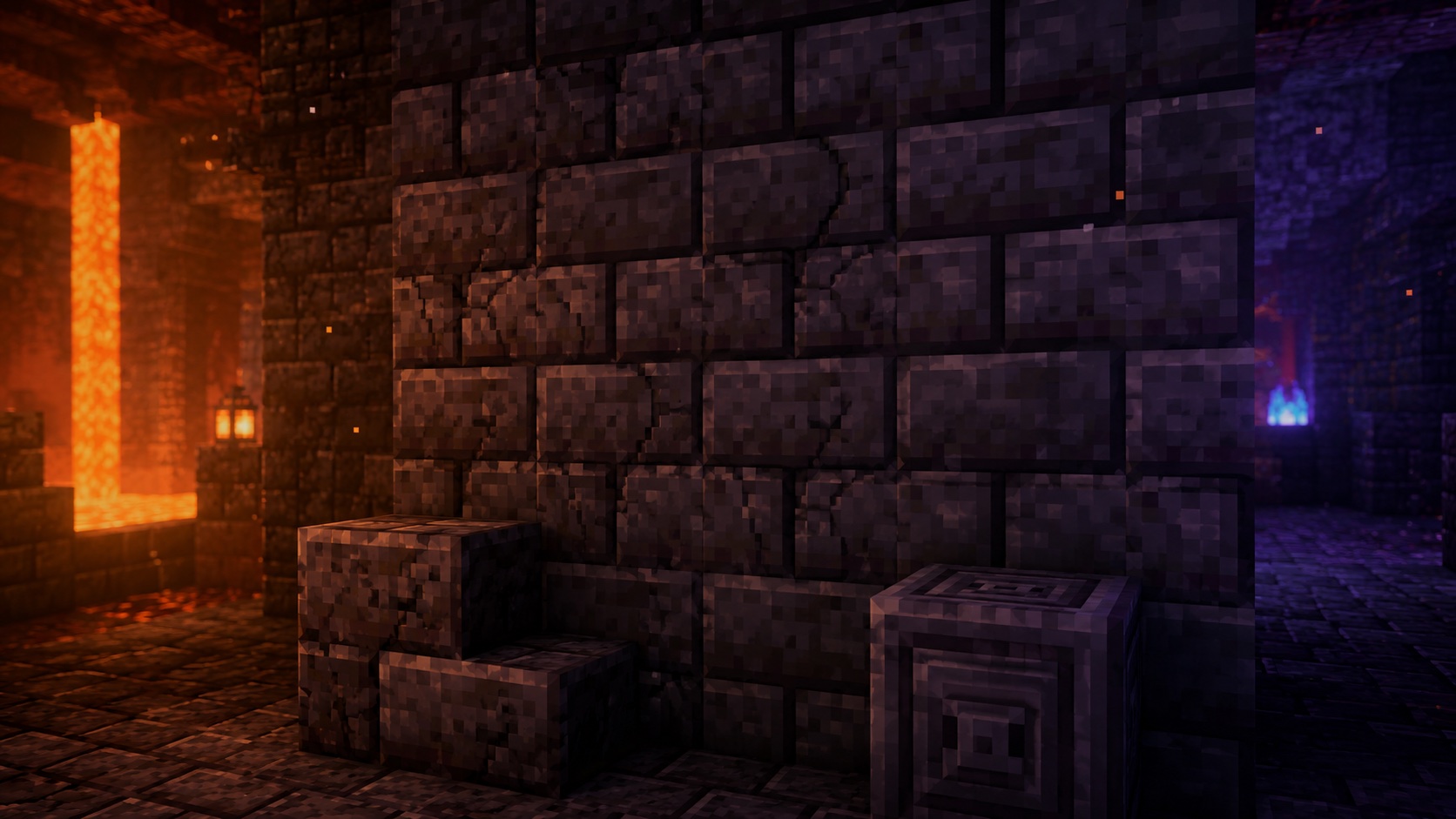
Cracked polished blackstone bricks are a decorative variant of polished blackstone bricks. They share the dark gray and black color of the rest of the blackstone family, but their texture has visible crack lines running across each face. The result reads as a wall that’s been around for a while.
The block was added in Minecraft 1.16, the Nether Update, alongside blackstone, polished blackstone, gilded blackstone, and chiseled polished blackstone. It only enters the world in two ways: as a smelting product in a furnace, or as natural generation inside bastion remnants.
This is a pure building block. It has no redstone use, no special interaction with mobs or items, and no role in any recipe other than its own creation. Its job is to look beat-up next to its cleaner siblings.
How to make cracked polished blackstone bricks
The only recipe is smelting. Place a polished blackstone brick block in the input slot of a furnace or blast furnace, add fuel, and wait. Each smelt converts one polished blackstone brick into one cracked polished blackstone brick. The 1:1 ratio applies whether you’re smelting one or sixty-four.
The full chain looks like this:
- Mine blackstone in the Nether with any pickaxe. It generates plentifully in basalt deltas and around bastion remnants.
- Craft polished blackstone by placing four blackstone in a 2×2 grid. You get four polished blackstone per craft.
- Craft polished blackstone bricks by placing four polished blackstone in a 2×2 grid. You get four polished blackstone bricks per craft.
- Smelt the polished blackstone bricks in a furnace or blast furnace. One smelt, one cracked.
A regular furnace takes about 10 seconds per item. A blast furnace runs at double speed, so the same stack finishes in roughly half the time. Both burn fuel at the same rate per item, which means a blast furnace is the better tool when you’re cracking large quantities and want to be done before sunrise.
Stonecutters do not produce cracked polished blackstone bricks. This catches a lot of players because the rest of the polished blackstone family (stairs, slabs, walls) can be made on a stonecutter. The cracked variant is the exception. It only comes from heat.
If you want to crack a stack quickly, set a blast furnace next to a chest of coal blocks. One coal block burns through eight items, so a stack of polished blackstone bricks (64) needs eight coal blocks worth of fuel to finish. Walk away, come back to a stack of cracked.
Where to find them in the wild
Cracked polished blackstone bricks generate naturally in bastion remnants, the large fortress structures that spawn in Nether biomes other than the basalt deltas. They appear scattered into floors, walls, columns, and stairs of bastions to make the structures look old and battle-worn.
The four bastion types (housing units, treasure room, hoglin stable, and bridge) all use cracked polished blackstone bricks somewhere in their build, but the housing units and treasure room have the densest concentration. Floors are where you’ll see clusters of three or four cracked blocks together.
If you want to harvest them straight from a bastion, focus on the upper floors and bridges. The blocks are surface-level and easy to mine on the way through. Bring a stone pickaxe at minimum and gold armor to keep most piglins from aggroing.
Bastions don’t regenerate, so once you’ve stripped the cracked blocks out of one, that bastion is done. If you want a sustainable supply, smelting your own is the cleaner route than looting more bastions.
Mining and behavior
Cracked polished blackstone bricks need a pickaxe to drop. A wooden pickaxe is the minimum. If you punch the block with a fist or any non-pickaxe tool, it breaks but drops nothing.
The hardness is 1.5 and the blast resistance is 6, identical to regular polished blackstone bricks and roughly equivalent to stone. It’s tougher than cobblestone in mining time but the same in explosion resistance. Creepers can destroy it, ghast fireballs at point-blank range can destroy it, and TNT will go through several layers.
Other behavior:
- Pistons can push and pull the block freely. It has no special block entity that would prevent movement.
- It blocks light fully and supports torches, banners, signs, and other wall-mounted items.
- Mobs spawn on top of it the same way they spawn on stone or cobblestone.
- Silk Touch and Fortune don’t affect the drop. The block always drops itself, one for one.
- Lava and fire don’t damage it. Setting it next to a campfire is fine.
- It’s a full opaque block, so it can be the base for water source blocks, redstone components, and other physics.
The mining time with a wooden pickaxe is around 1.15 seconds. Iron drops it to about 0.4 seconds, and netherite is roughly 0.3. Efficiency V on a netherite pickaxe with Haste II will instamine it.
How to use them in builds
The point of this block is to look aged. Use it anywhere a clean polished blackstone brick build would feel too pristine. Five patterns players lean on:
Aged castles and fortresses
Mix cracked polished blackstone bricks into a regular polished blackstone brick wall at roughly a 1:5 ratio. The eye reads the wall as one that has seen siege without making it look broken or unfinished. Heavier ratios (1:3) work for actively damaged sections.
Ruined paths and roads
For a road that should look abandoned, alternate cracked polished blackstone bricks with mossy cobblestone, regular polished blackstone bricks, and the occasional patch of dirt or grass path. The dark color reads well against forest, taiga, and Nether-portal-room palettes.
Nether-themed bases
Cracked polished blackstone bricks sit naturally beside basalt, blackstone, gilded blackstone, and crimson stems. A base built in the Nether with this combination blends into the biome instead of looking imported.
Deep underground builds
In deep caves and Ancient City-adjacent builds, the cracked texture pairs well with deepslate bricks, tuff, and cobbled deepslate. The textures don’t clash and the dark palette stays consistent.
Battle-damaged statues and ruins
For one-off ruined statues, broken pillars, or the wreckage of an old throne room, cracked polished blackstone bricks combined with cobwebs and a few air gaps sell the look. The crack pattern carries the weathering on its own.
Common mistakes to avoid
A few things that trip up new builders:
- Trying to use a stonecutter to make them. The cracked variant only comes out of a furnace or blast furnace.
- Mining bastion blocks with the wrong tool. Without a pickaxe, the cracked bricks break and drop nothing. That stings after fighting through piglins to reach them.
- Expecting stair, slab, or wall variants. Cracked polished blackstone bricks have no shape variants. If you need stairs, use the regular polished blackstone brick stairs.
- Confusing them with cracked stone bricks, cracked deepslate bricks, or cracked nether bricks. Different colors, different recipes, different worlds.
- Smelting them again. Cracked polished blackstone bricks cannot be smelted into anything. Once cracked, they stay cracked.
Java vs. Bedrock differences
The block is identical across editions. Same smelting recipe, same hardness and blast resistance, same loot, same generation in bastion remnants, same lack of stonecutter support. If your build uses cracked polished blackstone bricks on Java, the same plan ports cleanly to Bedrock.
Frequently asked questions
Can you craft cracked polished blackstone bricks?
No. There is no crafting recipe. The only way to make them is smelting polished blackstone bricks in a furnace or blast furnace. Stonecutters and crafting tables won’t produce them.
Do cracked polished blackstone bricks have stair, slab, or wall variants?
No. Polished blackstone bricks have stair, slab, and wall variants, but the cracked version does not. If you need shapes, build with the regular polished blackstone brick family and mix in cracked full blocks for the weathered look.
What pickaxe do you need to mine them?
Any pickaxe is enough. Wooden, stone, iron, gold, diamond, or netherite all drop the block. Mining without a pickaxe drops nothing.
Can a stonecutter make cracked polished blackstone bricks?
No. The stonecutter handles stairs, slabs, and walls in the polished blackstone family, but the cracked variant is furnace-only.
Where do they spawn naturally?
Inside bastion remnants in the Nether, mostly in floors and walls of housing units and treasure rooms. They don’t appear in the Overworld or the End.
Are cracked polished blackstone bricks fireproof?
Lava and fire don’t destroy them, the same as other stone-family blocks. They aren’t truly fireproof in the netherrack sense (they won’t burn forever as a light source), but a campfire or lava block next to them is fine.
Can you make stairs out of cracked polished blackstone bricks?
No. The cracked variant has no shape variants. The closest match is regular polished blackstone brick stairs, which use the un-cracked texture but the same color family.
If you’re cracking a stack of polished blackstone bricks for a build, set up a blast furnace next to a chest of coal blocks and let it run. A stack finishes in around eight minutes, and the texture is the only path to a weathered look in this block family short of raiding more bastions.