What cracked nether bricks are
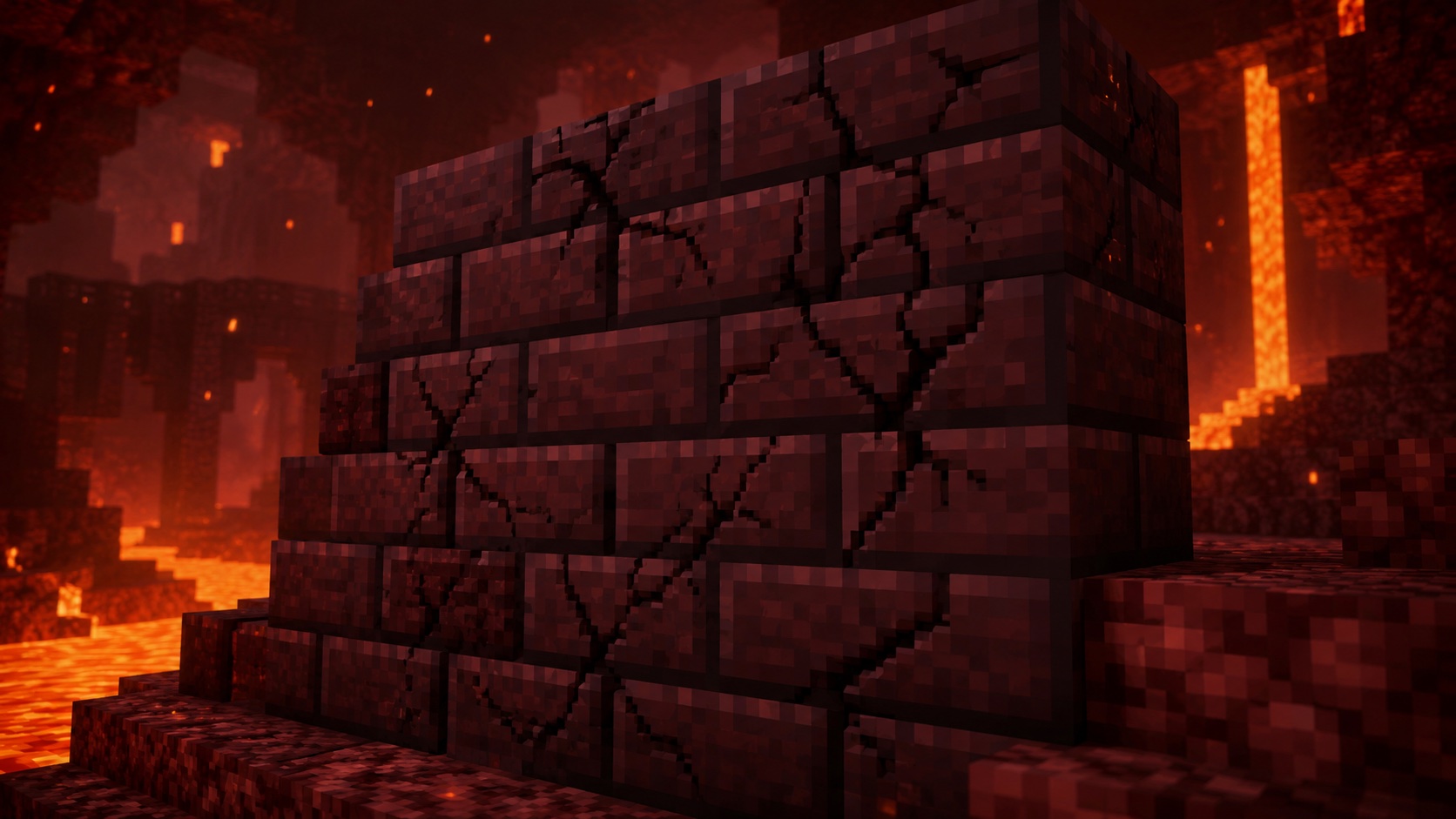
Cracked nether bricks are a decorative variant of regular nether bricks. They have the same dark red color, with deep cracks running through the surface that make builds look weathered and old.
The block was added in Java Edition 1.16, the Nether Update, alongside other Nether decorative blocks like chiseled nether bricks and the polished blackstone family. It exists in both Java and Bedrock, and it behaves the same way in each.
How to get cracked nether bricks
There are two ways to add cracked nether bricks to your inventory: smelt them yourself, or pick them up from a generated structure.
Smelt them from regular nether bricks
Put one regular nether bricks block in the top slot of a furnace, add fuel, and the furnace gives you one cracked nether bricks back. The smelt cycle is the standard 10 seconds per item, and it grants about 0.1 experience per smelt.
This is the only crafting recipe. You cannot make cracked nether bricks at a crafting table or a stonecutter, even though the stonecutter does work on regular nether bricks for slabs and stairs.
Fuel cost is the limiting factor for big projects. If you smelt in bulk, a coal block or a bucket of lava per furnace load works well. Coal blocks burn 80 items each, and a lava bucket burns 100.
Smelting is the most reliable supply method. Once you have nether bricks (the block) at home, you can produce cracked variants on demand. The full chain to start from scratch is: mine netherrack, smelt it into nether brick items, craft those into nether brick blocks, then smelt the blocks again. That’s two smelts and a craft, so the fuel adds up. Set up a netherrack farm or stockpile if you plan to do this regularly.
Find them in bastion remnants
Cracked nether bricks generate naturally in bastion remnants, the large fortified structures that spawn in the Nether. They show up mixed in with regular nether bricks and blackstone, especially in the older, more damaged sections of the bastion.
You can mine them on the spot and bring them home. Watch for piglins and the lava pools around most bastions. Piglins are neutral if you’re wearing at least one piece of gold armor, but magma cubes attack on sight.
Nether fortresses have regular nether bricks but not the cracked variant, so don’t expect to harvest cracked bricks there.
Mining cracked nether bricks
You need a pickaxe to mine cracked nether bricks. Wooden tier or better will drop the block. Mining without a pickaxe destroys the block and gives you nothing, the same as every other nether brick variant.
A higher-tier pickaxe mines faster. Diamond and netherite are noticeably quicker than wood or stone, and Efficiency on top of that helps if you’re stripping a whole section of a bastion.
Silk Touch isn’t required. The block always drops itself when mined with any pickaxe.
If you’re mining inside a bastion, place a torch or two before you start swinging. The light helps with mob spawns in nearby corridors, and it makes it easier to spot the cracked blocks against the surrounding nether bricks and blackstone.
Properties and behavior
Cracked nether bricks share most of their stats with regular nether bricks. They are a solid block, and pistons can push and pull them freely.
The block doesn’t catch fire, and lava is safe next to it. That makes it a reasonable choice for builds that sit close to lava in the Nether.
Mobs can spawn on cracked nether bricks at low light levels, the same as on most solid blocks. To stop spawns on a roof or floor, light the area or replace part of the surface with slabs.
Placed under a note block, cracked nether bricks produce the basedrum sound, like other stone-class blocks.
Building with cracked nether bricks
The cracks give the block a ruined, ancient texture. Builders mostly use it for two looks: aged Nether builds (ruins or abandoned outposts) and texture variation in walls of regular nether bricks.
The 50/50 mix is the most common pattern. A wall built entirely from cracked nether bricks reads as too busy. A wall built entirely from regular nether bricks reads as too clean. A random mix of the two with maybe some chiseled nether bricks for accent reads as a real building someone lived in.
Cracked nether bricks pair well with blackstone, polished blackstone, soul soil, soul lanterns, and gilded blackstone. The dark red and dark gray of these blocks make a moody, hellish color palette that works for Nether bases and for overworld dungeon builds.
A few specific build ideas: surrounding an obsidian portal frame with cracked blocks gives the look of a long-abandoned portal; walling in a bastion-style ruin with collapsed roof segments and gold-block accents reads as a defeated rampart; and using the block as a boundary wall in dark overworld castles or witch lairs adds age without any extra modeling work.
For interior detailing, a single cracked block dropped into a polished basalt floor or a blackstone column can break up an otherwise uniform texture without rewriting the whole palette. Use it in moderation; the cracks are loud, and a little goes a long way.
Other blocks in the nether brick family
Cracked nether bricks sit in a small family of nether brick variants. Plain nether bricks are the base block, crafted from four nether brick items. Cracked nether bricks come from smelting the plain block. Chiseled nether bricks come from stacking two nether brick slabs in a crafting table. Red nether bricks are a redder variant, crafted from two nether wart and two nether brick items.
Mixing these together gives you a richer wall than any single one alone. A 60/30/10 split of regular, cracked, and chiseled is a common builder’s recipe for a medium-detail Nether wall.
Tips and common mistakes
A few things worth knowing before you commit to a big project:
- Smelting nether bricks costs you regular nether bricks. Plan for that. If you want a 50/50 wall, you need to smelt half your stockpile, which doubles the fuel and time cost.
- The block has no slab, stair, or wall variant in vanilla Minecraft. If you need slabs or stairs in that texture, you have to use the regular nether brick versions and accept that they don’t have cracks.
- You cannot use a stonecutter to convert regular nether bricks into cracked. The stonecutter handles slabs, stairs, and walls for regular nether bricks, but the cracked transition only happens through smelting.
- Bastion looting is faster than smelting if a bastion is nearby and you have safe access. Smelting at base with a few furnaces and a stack of fuel is more reliable.
- The smelting XP is small (about 0.1 per item), but it stacks up. Empty the furnace into your inventory after a full batch instead of pulling items one at a time, so you collect the XP all at once.
Java vs Bedrock differences
The block looks the same and behaves the same in both editions. The smelting recipe and the bastion generation are identical, and so are the mining requirements. There are no edition-specific quirks worth listing for this one. The block ID is minecraft:cracked_nether_bricks in both, so the same /give command works on either platform.
Frequently asked questions
Can you craft cracked nether bricks at a crafting table?
No. The only way to make them is to smelt regular nether bricks blocks in a furnace.
Do cracked nether bricks have slabs or stairs?
Not in vanilla Minecraft. There are slabs, stairs, and walls for regular nether bricks, but no cracked versions of those.
Can you turn cracked nether bricks back into regular nether bricks?
No. The change is one-way. Once smelted, they stay cracked.
Where do cracked nether bricks spawn naturally?
Bastion remnants. They show up alongside regular nether bricks and blackstone, especially in older, more damaged sections. Nether fortresses do not have them.
Can mobs spawn on cracked nether bricks?
Yes, in the dark. They follow the same spawn rules as other solid Nether blocks. To prevent mob spawns, light the area or replace some of the surface with slabs.
Do cracked nether bricks burn?
No. The block doesn’t catch fire, and lava is safe next to it.
What pickaxe do you need to mine cracked nether bricks?
A wooden pickaxe is the minimum. Stone, iron, diamond, or netherite work too, and they mine faster.
Are cracked nether bricks renewable?
Yes. Netherrack is plentiful in the Nether, so the supply chain is renewable: mine netherrack, smelt it into nether brick items, craft those into nether brick blocks, smelt the blocks for cracked nether bricks. The only real consumable is fuel.
One last thing
If you’re collecting Nether decorative blocks for a base, smelt one full stack of regular nether bricks at the start of a build session. That gives you 64 cracked variants, which is enough for a 50/50 mix on a fairly large wall and still leaves room to bring home some chiseled nether bricks and gilded blackstone on the same trip.