What is deepslate gold ore?
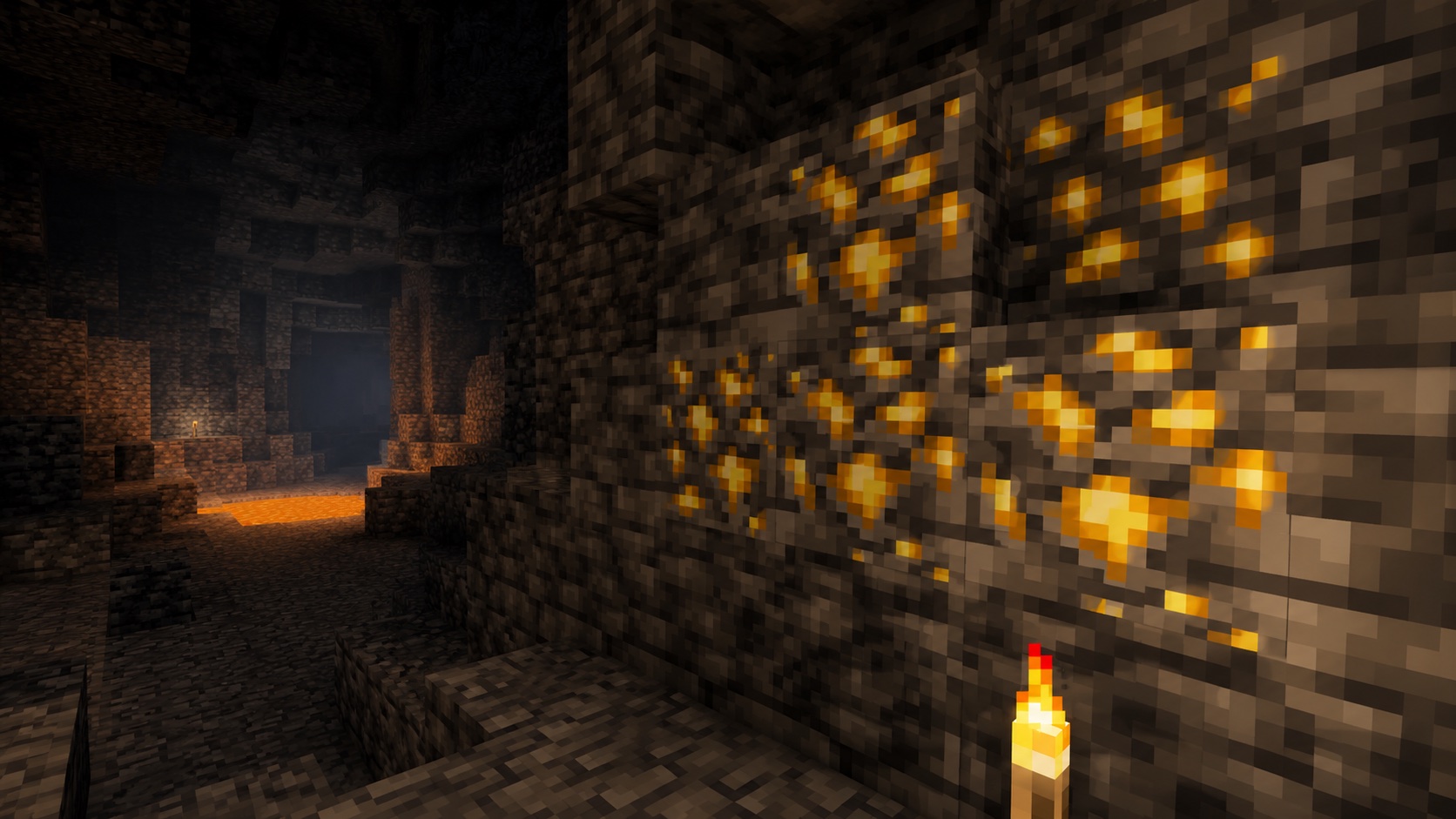
Deepslate gold ore is the deepslate version of regular gold ore. Same drops, same uses, but it generates inside the deepslate layer of the Overworld instead of in regular stone. The block has the dark gray, slightly streaky deepslate texture with the gold-fleck pattern you see on the standard ore.
It was added in the Caves and Cliffs update (1.17), when Mojang split most ore blocks into stone and deepslate variants so the deeper layers of the world had their own look. If you see a gold ore block at low Y levels and the surrounding rock is dark, it’s the deepslate variant.
The block itself doesn’t exist as a separate item unless you mine it with Silk Touch. Without Silk Touch, it drops raw gold the same way regular gold ore does.
Where deepslate gold ore generates
Deepslate gold ore spawns naturally in the Overworld inside the deepslate layer. Generation rules in current versions of the game (1.21 and later):
- Y range: roughly Y=-64 to Y=32, with the highest concentration between Y=-16 and Y=-48.
- Replaces deepslate, tuff, and other deepslate-layer blocks during world generation.
- Veins are small. Most contain 1 to 4 blocks. The biggest can reach about 9 blocks in a tight cluster.
- Generates more often in badlands biomes. Above-ground badlands gold has its own boosted distribution from Y=32 up to Y=256, but in the deepslate layer the rules match the rest of the Overworld.
If you’re mining for gold below Y=0, almost every gold ore you hit will be the deepslate version. The regular stone variant is rare that deep.
How to spot it
Deepslate gold ore looks like a deepslate block with diagonal gold flecks running across the face. The flecks are the same yellow color as the stone version, but they sit on darker rock, so the contrast is sharper. In low light it can blend in with raw deepslate at a glance. Hold a torch up to a wall you’re about to break through and you’ll spot the flecks faster.
How to mine deepslate gold ore
You need at least an iron pickaxe to mine deepslate gold ore. A wood or stone pickaxe will break the block and give you nothing. With an iron, diamond, or netherite pickaxe, the block drops raw gold by default.
Deepslate variants take longer to mine than their stone counterparts. Hardness values:
- Regular gold ore: 3
- Deepslate gold ore: 4.5
That extra 50 percent hardness adds up across a whole vein. Efficiency on your pickaxe is the cheapest fix. Efficiency IV on an iron pickaxe makes deepslate ores feel about the same speed as plain gold ore on an unenchanted iron tool. Diamond and netherite picks with Efficiency V make the deepslate penalty almost invisible.
Best enchantments for mining
Fortune is the main enchantment to chase. Fortune III is the most useful, since gold ore drops raw gold and benefits fully from Fortune:
- No Fortune: 1 raw gold per block
- Fortune I: 1 or 2 raw gold
- Fortune II: 1, 2, or 3 raw gold
- Fortune III: 1 to 4 raw gold (rough average around 2.2)
Silk Touch is the other option. With Silk Touch you get the deepslate gold ore block itself, useful if you want to store ore for later, build with the gold-fleck texture, or move a vein to a more convenient spot. Unbreaking and Mending round out the loadout. Mending in particular is worth it because gold farms or piglin trading lets you stockpile XP to repair a top-tier pickaxe almost indefinitely.
Should you smelt the block or break the vein?
If you have Silk Touch and Fortune III on separate pickaxes, the math is simple. Fortune III drops more raw gold on average than smelting a Silk Touch block (which always gives exactly 1 gold ingot). Carry Fortune III for mining, and use Silk Touch only when you specifically want the block as a building material.
What deepslate gold ore drops
Default drops without Silk Touch:
- 1 raw gold per block
- 0 to 7 XP per block
Raw gold is a separate item from gold ingot. To get an ingot, drop the raw gold into a furnace or blast furnace. Smelting one raw gold gives one gold ingot. A blast furnace smelts twice as fast as a regular furnace.
Nine raw gold can also be compressed into a single block of raw gold, which is mostly a storage shortcut. The block reverts back to nine raw gold on the crafting grid when you need it. Note that you cannot smelt a raw gold block directly into nine ingots; you have to break it back down first.
Using gold from deepslate ore
Once you have ingots, the use cases for gold cover a lot of ground:
- Powered rails: 6 gold ingots, 1 stick, and 1 redstone dust make 6 powered rails. The backbone of any serious minecart line.
- Golden apples: 8 gold ingots around 1 apple. Best general-purpose food for tough fights.
- Enchanted golden apples: only obtainable from loot chests now (mineshafts, dungeons, strongholds, desert temples, bastions). Cannot be crafted.
- Clocks: 4 gold ingots and 1 redstone dust. Tells the time of day even when you can’t see the sky.
- Golden carrots: 8 gold nuggets and 1 carrot. Highest hunger saturation in the game, and the main currency for top-tier farmer trades.
- Gold armor and tools: weak durability but very high enchantability. Useful for cheap enchanting-table farming, then sacrificing the gold tool for the books or keeping it alive with Mending.
- Piglin bartering: gold ingots tossed at piglins in the Nether trigger a barter for random items including ender pearls, obsidian, crying obsidian, soul speed books, and string.
- Light blocks: glowstone uses gold nuggets indirectly through trading, and the gilded blackstone block (found in bastions) drops gold nuggets when mined.
Piglins also become passive when you wear at least one piece of gold armor. Useful in bastions and crimson forests, but they still attack if you open a chest or break a gold block in their line of sight.
Tips for finding it faster
If you want to stockpile gold from deepslate, three strategies work well:
- Strip mine at Y=-16 or Y=-48. Both bands have decent gold generation. Y=-16 is easier to reach and lava is less common.
- Branch mine off natural caves. Lush caves and dripstone caves cut through the deepslate layer and expose ore blocks on the walls. Walk the cave, mine what you see, and tunnel into anything that looks promising.
- Use a badlands seed. Badlands biomes have boosted gold generation above ground. If a badlands biome sits over a deep enough column of terrain, deepslate gold ore appears below it too at normal deepslate rates, while the surface bonus stacks on top.
Carry water buckets when you mine deep. Lava pools are everywhere at low Y, and one careless step into a lava puddle while holding 30 raw gold will ruin the trip. Iron-tier defense beats fancy enchantments at the bottom of the world. Pack Fire Resistance potions if you’re going below Y=-50; the deeper you go, the more open lava you see.
Common mistakes
- Mining with a stone pickaxe. The block breaks and gives nothing. Always bring iron or better.
- Trying to smelt a raw gold block. A raw gold block does not smelt into nine ingots. You have to break the block back down into nine raw gold items first, then smelt them.
- Forgetting Fortune. A Fortune III pickaxe roughly doubles raw gold yield over an unenchanted pickaxe. Worth crafting a dedicated mining pick before you start a long strip-mining session.
- Aggroing piglins by mining gold blocks. Piglins ignore you in gold armor but still aggro when they see you breaking gold blocks or opening chests. Raw gold drops on the ground don’t trigger aggro on their own.
- Mining too high. Plain gold ore generation drops off above Y=32, and deepslate gold ore is rare above Y=0. If you’re at Y=20 looking for deepslate gold, you’re in the wrong band; go deeper.
Java vs. Bedrock differences
For deepslate gold ore, Java and Bedrock behave the same in current versions:
- Same Y range and ore distribution.
- Same mining tool requirement (iron or better).
- Same Fortune drop curve.
- Same Silk Touch behavior.
- Same XP drop range.
One minor footnote is that some older Bedrock versions during the 1.17 rollout had slightly different hardness values on deepslate variants. In current versions of both editions, hardness is identical and so are the drops.
Frequently asked questions
What Y level is best for deepslate gold ore?
Between Y=-16 and Y=-48 is the sweet spot. Y=-16 is the most popular choice because it sits well above the bedrock layer and has lower lava exposure than the deeper bands.
Can you mine deepslate gold ore with a stone pickaxe?
No. You need an iron pickaxe or better. A stone pickaxe will destroy the block and drop nothing.
Does Fortune work on deepslate gold ore?
Yes. Fortune III is the recommended enchantment. It gives 1 to 4 raw gold per block, with an average around 2.2.
Is deepslate gold ore worth more than regular gold ore?
No. The drop is identical (raw gold, which smelts into a gold ingot). The only practical difference is that deepslate gold ore takes longer to mine because deepslate is harder than stone.
Can you find deepslate gold ore in the Nether?
No. Deepslate only generates in the Overworld. The Nether has nether gold ore, which is a different block with different drops (gold nuggets, not raw gold).
Does Silk Touch work on it?
Yes. A Silk Touch pickaxe drops the deepslate gold ore block as an item, which you can place again or store. Without Silk Touch, you only get raw gold.
How rare is deepslate gold ore compared to regular gold ore?
About 50 percent more common than regular gold ore at the same Y level if you stay below Y=0. Generation peaks around Y=-16 and tapers off both above and below that band.
The takeaway
Deepslate gold ore behaves the same as the stone version, but you find it deeper and it takes longer to break. Bring an iron pickaxe minimum, put Fortune III and Efficiency on a dedicated mining pick, and set up at Y=-16 if you want to farm it. Keep a water bucket on the hotbar. The drops are the same as regular gold ore, but the volume per trip is higher because gold concentrates in the deepslate layer.