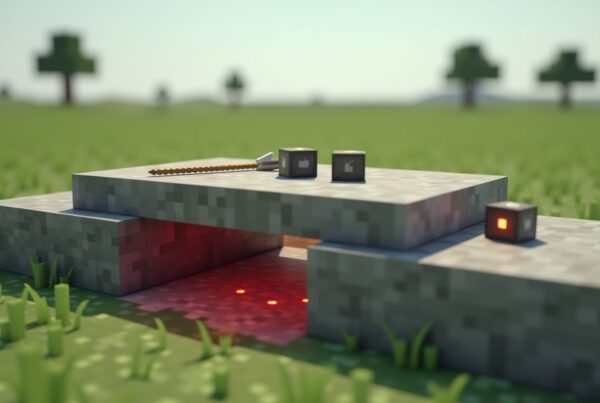
What the light weighted pressure plate is
The light weighted pressure plate is a gold redstone component that outputs a variable signal based on how many entities are standing on it. Unlike a standard wooden or stone pressure plate, which gives a flat on or off, this one scales from 1 to 15 depending on the count.
It looks like a thin slab of polished gold sitting flush with whatever block it sits on. The output is faster and more sensitive than its iron cousin, the heavy weighted pressure plate, which is why redstone builders reach for it when they need to count items or detect small mob populations.
If you have ever wanted a hopper to stop dropping items at a specific total, or wanted a chicken egg farm to ping a counter every time a chick spawns, this is the block that does the math for you.
How to craft a light weighted pressure plate
The recipe is simple: two gold ingots placed side by side in a crafting grid. The two ingots can sit in any horizontal pair on any row, and they produce one light weighted pressure plate per craft. There is no smithing table, no upgrade path, and no alternative recipe.
A crafting table is the safer choice across versions, since some 2×2 inventory grids do not accept the horizontal pair layout cleanly. Once you have the ingots, the craft itself takes a second.
Gold ingots come from smelting raw gold or gold ore, killing zombified piglins for occasional drops, or trading with apprentice-level toolsmiths and weaponsmiths. A bartering farm or Nether-roof gold farm using zombified piglins is the standard way to get the volume of ingots a serious redstone build needs.
How the signal works
This is the part that matters. The light weighted pressure plate outputs a redstone signal equal to the number of entities on it, capped at 15.
- 1 entity on the plate: signal strength 1
- 2 entities: signal strength 2
- …
- 15 or more entities: signal strength 15 (the cap)
An “entity” here means almost anything that can sit on a block: a player, a mob, an item stack, an experience orb, an arrow, even a thrown trident. Each item stack counts as a single entity regardless of stack size, so a stack of 64 cobblestone counts the same as one dropped diamond.
The signal stays at that strength as long as the entities stay on the plate. As soon as they leave, get destroyed, get picked up, or despawn, the signal drops accordingly. There is a small detection delay of one redstone tick when entities arrive or leave, which matters for clock circuits but not for most counter builds.
What activates the light weighted pressure plate
The plate reacts to almost anything that physically rests on it:
- Players walking, jumping, or sneaking on top
- Hostile and passive mobs
- Dropped item stacks
- Experience orbs
- Arrows, tridents, and other projectiles that land on it
- Boats and minecarts that come to rest on top of it
- Armor stands
What does not activate it:
- Entities flying above the plate without touching it
- Block updates from neighboring components
- Riding passengers (if you sit inside a minecart on the plate, only the minecart entity is counted)
Sneaking does not let you pass over the plate undetected. Pressure plates ignore the sneak-bypass that some other detection blocks respect.
Light, heavy, and regular pressure plates
Minecraft has four pressure plate types, and only the gold and iron ones output a variable signal.
| Plate | Material | Output type | Sensitivity |
|---|---|---|---|
| Wooden pressure plate | Wood planks | Binary on or off | Any entity, including items and arrows |
| Stone pressure plate | Stone | Binary on or off | Mobs and players only |
| Light weighted pressure plate | Gold ingots | Variable, 1 per entity | 1 entity = strength 1, 15+ = strength 15 |
| Heavy weighted pressure plate | Iron ingots | Variable, 1 per 10 entities | 10 entities = strength 1, 150+ = strength 15 |
Pick the gold plate when you want fine-grained counting at low entity volume. Pick the iron plate when you want to detect large item floods (think automatic sorters dropping dozens of stacks at once) without maxing out the signal immediately. For a basic “someone stepped here” trigger, the wooden or stone plates are usually the right call since they are cheaper and stay binary.
Common uses
Item counters
Drop items on the plate one at a time and the signal climbs by one per item. Feed that signal into a comparator and you have a real-time entity counter. The standard pattern uses a hopper feeding a dropper that ejects items onto the plate, but any setup that lands items on top of the plate works.
Mob farm output sensors
Place a plate at the bottom of a mob drop chute and you can detect roughly how many mobs are landing per second. If the signal climbs to 15 quickly, your farm is producing well. If it sits at 1 or 2, something is wrong with spawning or with the kill mechanism.
Item filters and routing logic
Pair the plate with a comparator set to subtract mode to gate output on specific item counts. For example, a build that should fire only when at least 4 items are on the plate can compare the plate’s signal against a constant signal of 3, with the output line activating when the plate’s signal exceeds it.
Arrow-triggered traps
Since arrows count as entities, a dispenser pointed at a plate can act as a remote trigger. The arrow lands, the plate reads strength 1, and the signal fires for a few seconds before the arrow despawns or gets destroyed. This is useful for tripwire-free hidden doors and one-shot trap mechanisms.
Egg dispenser feedback
Chicken egg farms use a dispenser that hatches eggs into chicks. Drop the eggs onto a plate first and you get instant feedback on how many eggs were dispensed in the last cycle, which helps balance the farm’s output rate.
Tips and common mistakes
The signal counts entities, not item quantity. A single dropped stack of 64 anything reads as strength 1. If you need to count items by quantity, you need to either drop them one at a time (a hopper-dropper pulse circuit) or feed them through a hopper into a comparator, which reads container fullness instead.
The plate has to sit on top of a full block. It will not place on slabs in some orientations, on fences, or on top of stairs that are not facing the right way. Use a solid block under it.
Item entities have a 5-minute lifespan before they despawn. If your build relies on items resting on a plate for longer than five minutes, the items will vanish and the signal will drop. Build a feeder that refreshes the entities (a hopper minecart loop, or a dropper that fires on a slow clock) if you need persistent signal.
The plate cannot be wire-locked. Unlike a redstone repeater, you cannot freeze its state with another component. Whatever entities are present, the plate reports honestly.
Java and Bedrock differences
The crafting recipe, signal scaling, and entity detection rules are identical across Java and Bedrock editions. The one wrinkle worth knowing: in some older Bedrock versions, the plate’s detection delay could lag by an extra tick when many entities arrived in the same frame, which would throw off precise counting circuits. Modern Bedrock (1.21 and later) has narrowed this gap. If you build a tick-perfect counter on Java and then port it to Bedrock, test the timing before relying on it.
Frequently asked questions
What is the light weighted pressure plate made of?
Two gold ingots, placed horizontally in a crafting table. The recipe produces one plate per craft.
Does it count item stack size or item count?
Item count. A single dropped stack of 64 reads as one entity. To count by quantity, use a hopper and a comparator instead.
How many entities does it take to max the signal?
Fifteen. At 15 or more entities on the plate, the output sits at signal strength 15. Below that, the signal equals the entity count.
Will sneaking let me bypass it?
No. Pressure plates do not respect sneak. If you stand on one, even while sneaking, the plate reads you as one entity.
Can I place it on glass or slabs?
It places on the top face of full, solid blocks. Glass works in current versions. Slabs work only if the slab is in the top-half position (acting as a full surface). Stairs and partial blocks generally do not accept it.
What is the difference between the light and heavy weighted pressure plates?
The gold plate adds one signal per entity, capping at 15. The iron plate adds one signal per ten entities, capping at 15 (so it takes 150 entities to max it). Gold is for fine-grained low-volume counting; iron is for bulk detection.
Can I detect XP orbs with it?
Yes. Experience orbs are entities, and the plate counts them like any other. This is useful for XP farms that route orbs into a counter feeding back to the player.
Where the light weighted pressure plate fits in a redstone build
This is one of the cheaper signal-strength outputs in the game, and it costs only two gold ingots once you have a farm running. If you are scaling up a larger redstone build and want a way to gate logic on entity count without piping items through a hopper, the gold plate is the right tool. Keep a couple in your inventory whenever you start a new farm, since you will find a use for one sooner or later.