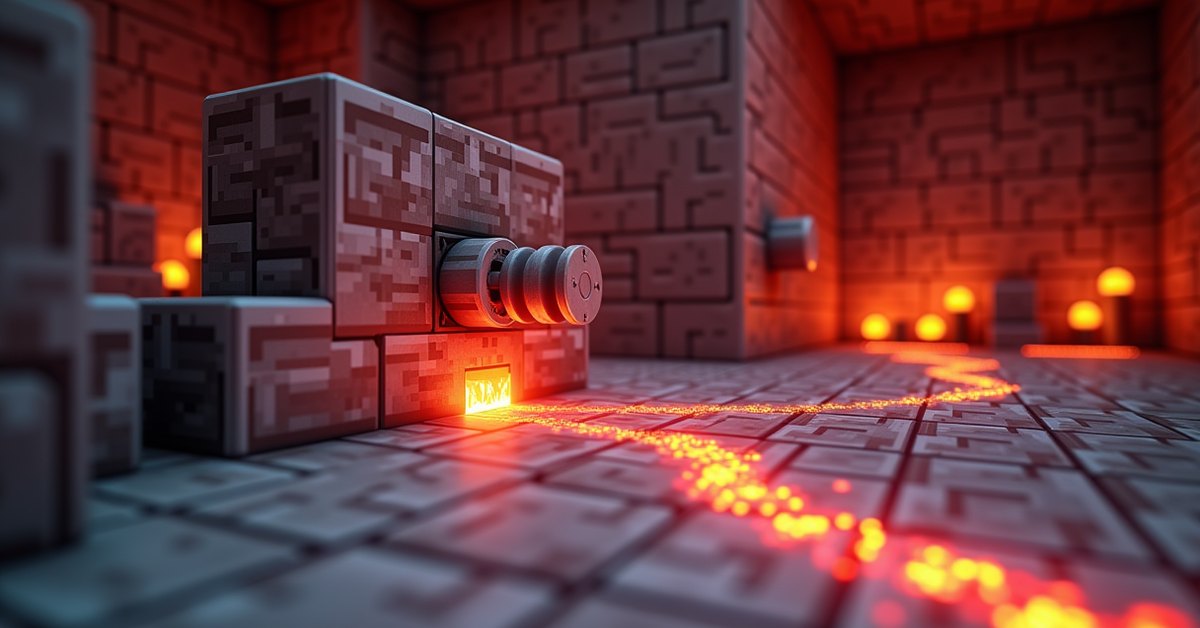
What is a piston in Minecraft?
A piston is a redstone-powered block that pushes other blocks. When it gets a redstone signal, an arm shoves out and moves whatever sits in front of it by one space. Cut the signal and the arm pulls back.
There are two versions. A regular piston pushes blocks away and leaves them where they land. A sticky piston does the same push, then drags the block back when it retracts. That one difference is the reason sticky pistons cost an extra slimeball and show up in almost every moving build.
Pistons are the backbone of redstone engineering. Hidden doors, automatic farms, drawbridges, and flying machines all run on them. If you want something in your world to physically move, a piston is doing the work.
How to craft a piston
You make a piston at a crafting table from four common materials. Everything you need is easy to gather once you have a small amount of iron, so pistons are cheap by early-game standards.
Piston recipe
Fill the 3×3 crafting grid like this:
- Top row: three wooden planks (any wood type works, and you can mix types)
- Middle row: cobblestone, iron ingot, cobblestone
- Bottom row: cobblestone, redstone dust, cobblestone
That comes to three wooden planks, four cobblestone, one iron ingot, and one redstone dust for a single piston. When you place the piston, its face points toward you, so the direction you are looking decides which way the arm will fire. Place the block first and check the face before you wire any redstone to it.
How to make a sticky piston
A sticky piston needs one regular piston and one slimeball. Put the piston in the crafting grid with the slimeball directly above it, and you get one sticky piston back. Slimeballs drop from slimes, which spawn in swamps at night and in slime chunks deep underground, so the sticky version takes a little more effort to produce in bulk. You can also find sticky pistons already built into the redstone trap inside jungle temples if you would rather salvage than craft.
How pistons work
A piston does nothing until it gets power. Any redstone source will trigger it: a lever, a button, a pressure plate, a redstone torch, an observer, or a line of redstone dust running into the block.
When powered, the arm extends and pushes the block directly in front of it forward by one space. The piston head fills the gap while the arm is out, so the space in front of a piston is never truly empty when it is firing. Drop the signal and a regular piston pulls its head back, leaving the pushed block one space ahead of where it started.
A single piston can push a row of up to 12 blocks at once. Ask it to move a 13th and the piston refuses to fire at all. The same thing happens if any block in that line cannot be moved: one immovable block stops the whole push.
Quasi-connectivity in Java Edition
In Java Edition, a piston can fire even when nothing powers it directly. If the block one space above the piston body is powered, the piston behaves as if it were powered too. Redstone players call this quasi-connectivity, or QC. It is a long-standing quirk rather than an intended feature, and many compact redstone designs lean on it. Bedrock Edition has no quasi-connectivity, which is why some Java contraptions stop working when you rebuild them on Bedrock.
What pistons can and can’t push
Most ordinary blocks move without trouble: stone, dirt, wool, planks, glass, ore blocks, and the like. A handful of blocks behave differently, and knowing which is which saves a lot of confused building.
Some blocks are completely immovable. A piston will not push obsidian, crying obsidian, bedrock, reinforced deepslate, or an end portal frame, and it will not extend if one of those sits in its path. An already-extended piston head cannot be pushed either.
Other blocks break instead of moving. Push a torch, a flower, a rail, or loose redstone dust and it pops off as a dropped item rather than sliding along. That is normal behavior for blocks that cannot exist floating in mid-air.
Blocks with a block entity are the common gotcha. In Java Edition, pistons cannot move chests, furnaces, hoppers, droppers, dispensers, or other blocks that store data. Bedrock Edition is more permissive and lets pistons move several of these, so a build that shuffles chests around can work on Bedrock and fail on Java.
Sticky pistons and slime blocks
Sticky pistons get far more useful when you pair them with slime blocks or honey blocks. A slime block sticks to almost every block it touches. When a piston pushes a slime block, everything attached to that slime block moves with it, which lets one piston shift a whole cluster of blocks at once.
Honey blocks work the same way with one important exception: slime blocks and honey blocks do not stick to each other. That single rule is what makes flying machines possible. By alternating slime and honey, redstone builders create contraptions that push themselves across the world.
One limit is worth remembering. A sticky piston only pulls the single block attached to its head. It cannot drag a second block sitting behind the first. When you need to move a wider structure, slime and honey blocks are how you get around that limit.
What pistons are used for
Pistons turn up everywhere once you start building with redstone. Common projects include:
- Hidden doors and walls that slide open when you flip a lever
- Automatic farms for sugar cane, pumpkins, melons, and other crops
- Drawbridges over lava, water, or open gaps
- Flying machines and self-extending bridges built from slime and honey blocks
- Block-swapping displays, redstone clocks, and compact storage sorters
- Traps that drop the floor out from under a mob or an unlucky player
Sticky pistons handle anything that needs to move and then come back. Regular pistons are the better choice when you only want a one-way shove, like nudging a block into a slot and leaving it there.
Tips and common mistakes
A few things tend to trip up newer redstone players:
- Respect the 12-block limit. A long piston push fails quietly at block 13, with no error to tell you why.
- Do not try to push a chest in Java Edition. The chest will not move and the piston will not fire.
- Pistons push entities as well as blocks. They will shove players, mobs, and dropped items, which is great for traps and risky near ledges.
- A very short redstone pulse can make a sticky piston push a block forward without grabbing it on the way back. This block-dropping behavior is technically a bug, but builders use it on purpose in flying machines.
- Place the piston before wiring the redstone so you can confirm the face points the way you expect.
Java vs. Bedrock differences
Pistons are not identical across the two editions. Quasi-connectivity exists only in Java, so QC-based designs need rework on Bedrock. Bedrock also lets pistons move some block entities that Java refuses to budge. Pulse timing and block-update order differ slightly as well, which is why fast redstone machines often need retuning when you carry them between editions. For everyday builds the gap rarely matters, but it shows up quickly once you reach advanced redstone.
Frequently asked questions
What is the difference between a piston and a sticky piston?
A regular piston pushes a block and leaves it in place. A sticky piston pushes the block, then pulls it back when the redstone signal stops. The sticky version costs one extra slimeball.
How many blocks can a piston push?
Up to 12 blocks in a single row. If the push would involve 13 or more, the piston does not extend at all.
Can a piston push obsidian?
No. Obsidian, bedrock, reinforced deepslate, and end portal frames are immovable. A piston will not push them and will not fire if one is in its path.
Can pistons push players and mobs?
Yes. Pistons push players, mobs, and dropped items along with blocks. That makes them handy for traps and worth respecting near drops and lava.
Can a sticky piston pull two blocks?
No. A sticky piston only pulls the one block attached to its head. To move more than one block at a time, push a slime block or honey block with other blocks stuck to it.
Do pistons need redstone dust to work?
They need a redstone signal, but not redstone dust specifically. A lever, button, pressure plate, redstone torch, or observer placed against the piston will all power it.
Why won’t my piston push a chest?
In Java Edition, pistons cannot move blocks that store data, including chests, furnaces, and hoppers. Bedrock Edition allows some of these, so the same build can behave differently depending on your version.
Getting started with pistons
Pistons are the first real step from decorating with redstone to building with it. Start with a simple two-piston hidden door, get comfortable with how power reaches the block, and the bigger contraptions stop looking like magic. Once slime blocks enter the picture, the main limit is how much redstone you feel like wiring.