What a dispenser is and what it does
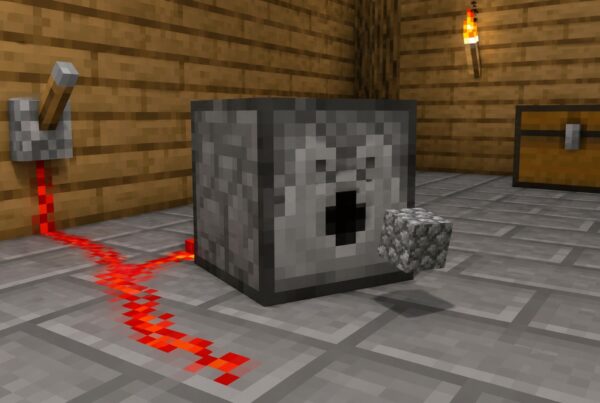
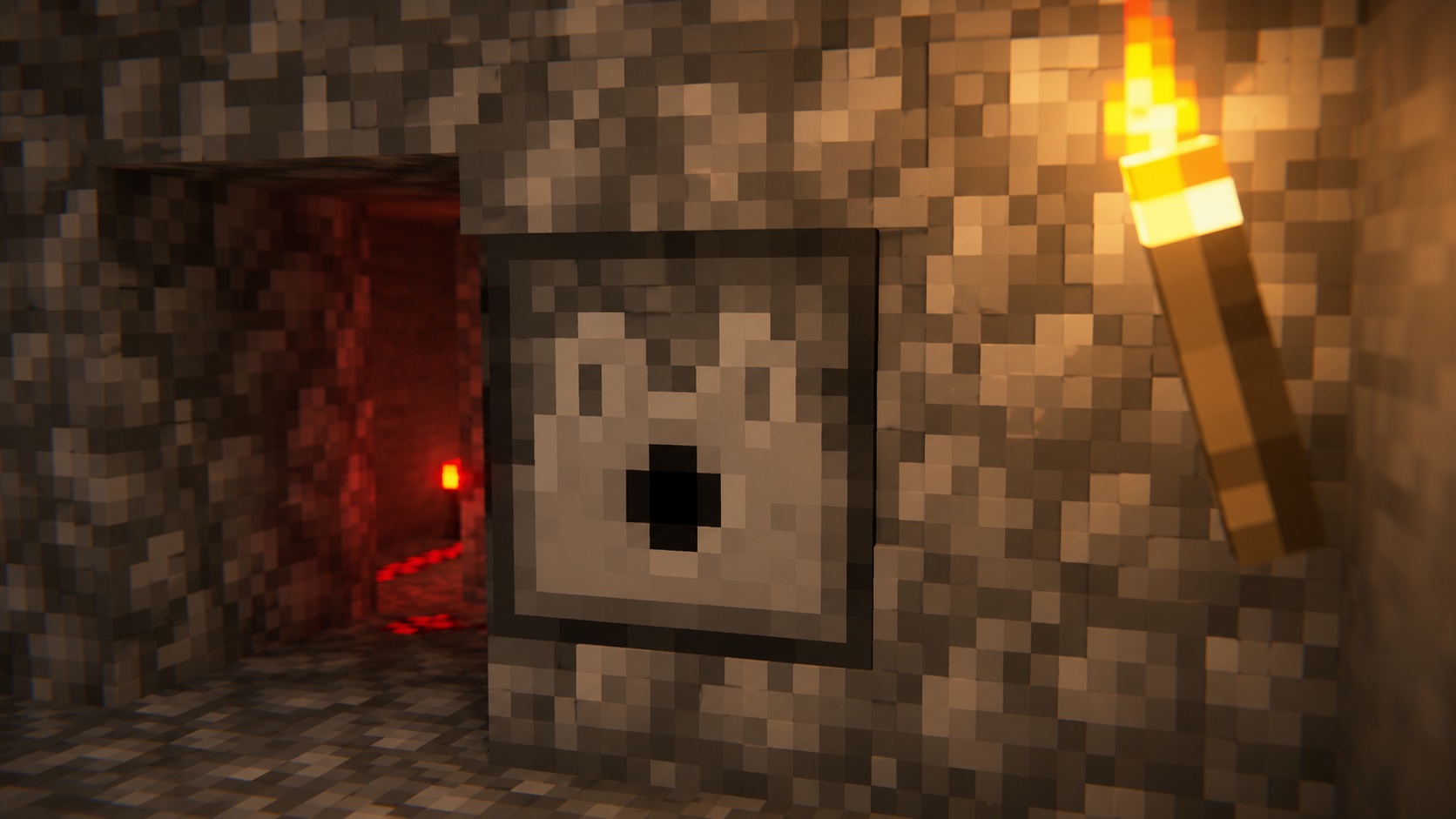
A dispenser is a redstone-powered block that fires items out of its inventory when it gets a redstone pulse. It looks like a stone block with a grim face on one side. That face is the output direction. Whatever sits inside the dispenser’s nine inventory slots gets shot, thrown, placed, applied, or otherwise activated through that face when you trigger it.
If you’ve ever built an automatic arrow trap, an auto-egg farm, a hidden door that arms itself, or a contraption that throws splash potions at mobs, you’ve used a dispenser. It’s the block that turns a button or pressure plate into a small machine.
How to craft a dispenser
You need three ingredients: 7 cobblestone, 1 bow, and 1 redstone dust. Open a crafting table and arrange them in this pattern:
- Top row: cobblestone, cobblestone, cobblestone
- Middle row: cobblestone, bow, cobblestone
- Bottom row: cobblestone, redstone dust, cobblestone
That gives one dispenser per craft. The bow can be at any durability, since the recipe ignores the item’s damage value. Even a nearly broken bow works fine.
Cobblestone is the easy ingredient. Redstone dust comes from mining redstone ore with an iron pickaxe or better; the deeper layers of the world have a lot of it. The bow can be crafted from three sticks and three strings.
How a dispenser works
Place the dispenser with its face pointing where you want the output to go. The face points toward you when you place it, so if you want arrows to fly north, stand south of the spot and place the block looking north.
Send a redstone signal to the block. That can come from a button, a lever, a pressure plate, an observer, a redstone clock, or any other source. When the dispenser receives the signal, it picks one slot at random from its inventory and uses that item. Empty slots are skipped during selection, so the dispenser doesn’t waste pulses on nothing.
The dispenser fires on the rising edge of a signal. Hold a lever on and it dispenses once. To fire it again, the signal has to drop and rise again. A clock circuit or a button press is the common way to retrigger it.
What a dispenser can do
The dispenser’s behavior depends entirely on what it picks from its inventory. Most items it activates fall into a handful of groups.
Projectiles
Arrows fire out like a bow at a fixed speed, with no charge time and no enchantment effects. Eggs and snowballs are thrown the same way a player throws them; snowballs damage blazes and the ender dragon, and eggs sometimes hatch into a chick on impact. Splash and lingering potions get tossed and break on impact, applying the effect in front of the dispenser. Fire charges shoot in a straight line the same way a blaze fireball does.
Buckets and fluids
A water bucket places a water source block in the spot in front of the dispenser. A lava bucket places a lava source, so point that one carefully. An empty bucket picks up a source block of water or lava that’s right in front, converting itself into a full bucket inside the inventory. A milk bucket in a dispenser is just dropped as an item; cows are not milked by dispensers.
Tools that act on the world
Shears shear a sheep standing directly in front, dropping wool. They also harvest a beehive without making the bees hostile, which is the easiest way to automate honey without getting stung. Flint and steel ignites the block in front; on top of dirt or grass it lights a fire, and pointed at a TNT block it primes it directly.
Wearables
Armor pieces equip themselves on a player or armor stand in the spot in front of the dispenser. This is how auto-equip rooms in adventure maps work: you walk into a one-block hallway with four dispensers around you, press a button, and come out fully armored. Wearable heads, pumpkins, and mob skulls equip the same way.
Useful odds and ends
Bone meal applies to a plant or grass block in front, growing crops or producing flowers and tall grass. TNT is placed as primed TNT and starts its fuse immediately. Spawn eggs spawn the mob in the slot in front. Boats and minecarts get placed on water or rails directly in front, the same way a player would place them. Dyes will dye a sheep in front the matching color.
Common builds that use a dispenser
The dispenser shows up in almost every redstone build sooner or later. A few of the most common patterns:
An arrow trap is the original use. Fill the dispenser with arrows, wire it to a pressure plate or a tripwire, and it fires when something steps in front. Stacked dispensers on a clock can stun-lock most mobs in a one-wide chokepoint.
An auto-bone-meal farm uses a dispenser loaded with bone meal pointing at a crop. A simple clock pulses the dispenser, the crop grows, an observer or piston harvests it, and water flows the drop into a hopper. Variations exist for melon and pumpkin farms.
A sheep wool farm uses a dispenser loaded with shears pointing at a sheep on a grass block. A pulse from a clock shears the wool, the sheep regrows it, and a hopper underneath collects the wool. The shears lose durability over time, so you’ll restock them.
A hidden door can use a dispenser to spit out wall blocks and let players through, then re-place them on the next pulse. Most modern hidden doors use pistons, but dispenser doors still show up in older builds.
A fireworks launcher uses a dispenser loaded with firework rockets, usually pointing straight up. The rocket fires out and explodes at its normal altitude.
Dispenser vs dropper
A dropper looks like a dispenser but acts differently. Both have nine inventory slots, both fire on a redstone pulse, both pick a random slot. The difference: a dropper drops items as items, full stop. It does not activate them. An arrow from a dropper falls on the ground as an arrow you can pick up. From a dispenser, that same arrow flies.
If you want to launch, throw, place, or equip something, use a dispenser. If you only need to move an item from point A to point B in a vertical or horizontal stack, use a dropper. Droppers chained together are how item elevators are built.
Tips and common mistakes
The face is the output direction, not the back. People place it backwards all the time. If your arrows are going the wrong way, break it and place it again facing the right way.
The dispenser does not refill itself. Once the slots are empty, it stops doing anything. Run a hopper into the back to feed it from a chest or another hopper line.
Pulse length matters. A button gives a clean short pulse, which the dispenser likes. A lever held on only fires the dispenser once and then sits there doing nothing. If you want repeated firing, use a clock or repeated button presses.
Random slot selection is the source of a lot of confusion. If you put one arrow and one snowball in a dispenser, you might get either when it fires. Stock dispensers with one item type if you need predictable behavior, and chain dispensers if you need a sequence.
Distance matters less than you’d think. Dispensed projectiles have the same speed and range as the player version, and dispensed liquids only act on the block immediately in front. If you need water two blocks away, the dispenser has to be one block back, not two.
Java and Bedrock differences
The dispenser works mostly the same on both editions. A few small differences worth knowing: minecart-with-TNT placement from a dispenser onto rails has slightly different activation timing on Bedrock, and the exact list of items a dispenser can equip on armor stands has shifted a little across versions. If you’re building a contraption that depends on a specific item, test it in your current version before you scale it up.
Frequently asked questions
How do you craft a dispenser without a bow?
You can’t. The bow is a required ingredient. If you don’t have one, get string from spiders or cobwebs and sticks from wood, then craft a bow first. Three sticks and three strings give one bow.
Does a dispenser use durability on shears and flint and steel?
Yes. Items that take durability when a player uses them also take durability when a dispenser uses them. A stack of shears in a dispenser will last a while, but you’ll need to refill them eventually. Arrows are consumed, not damaged.
Can a dispenser fire multiple items at once?
No. One redstone pulse, one item. If you want two items per pulse, stack two dispensers and wire them to the same signal.
Does a comparator read a dispenser?
Yes. A comparator reads the dispenser’s inventory fullness the same way it reads a chest. That’s useful for triggering a clock when a dispenser is full or empty.
Can a dispenser break blocks?
No. Even with a pickaxe in the slot, a dispenser drops the pickaxe as an item instead of mining the block in front. For automatic block breaking, you need a piston pushing the block into honey or slime, a TNT setup, or another contraption that uses different game mechanics.
Will a dispenser shoot through walls?
No. If a solid block sits right in front of the face, projectiles fire and immediately collide with that block. For arrows, that means the arrow lands at the dispenser’s mouth and you can pick it back up.
Does a dispenser power itself when full or empty?
Not on its own. It’s an inventory block, so a comparator beside or behind it outputs a signal proportional to how full it is. The dispenser itself doesn’t emit redstone power. Use a comparator if you want a circuit to react to inventory state.
One small build tip
If you’re new to dispensers, build a single dispenser, a single button, and load it with snowballs before you try anything fancy. Press the button, watch the snowball fly, and you’ll have a clear picture of what the block does. Every other dispenser contraption is a variation on that loop.