What is a dropper?
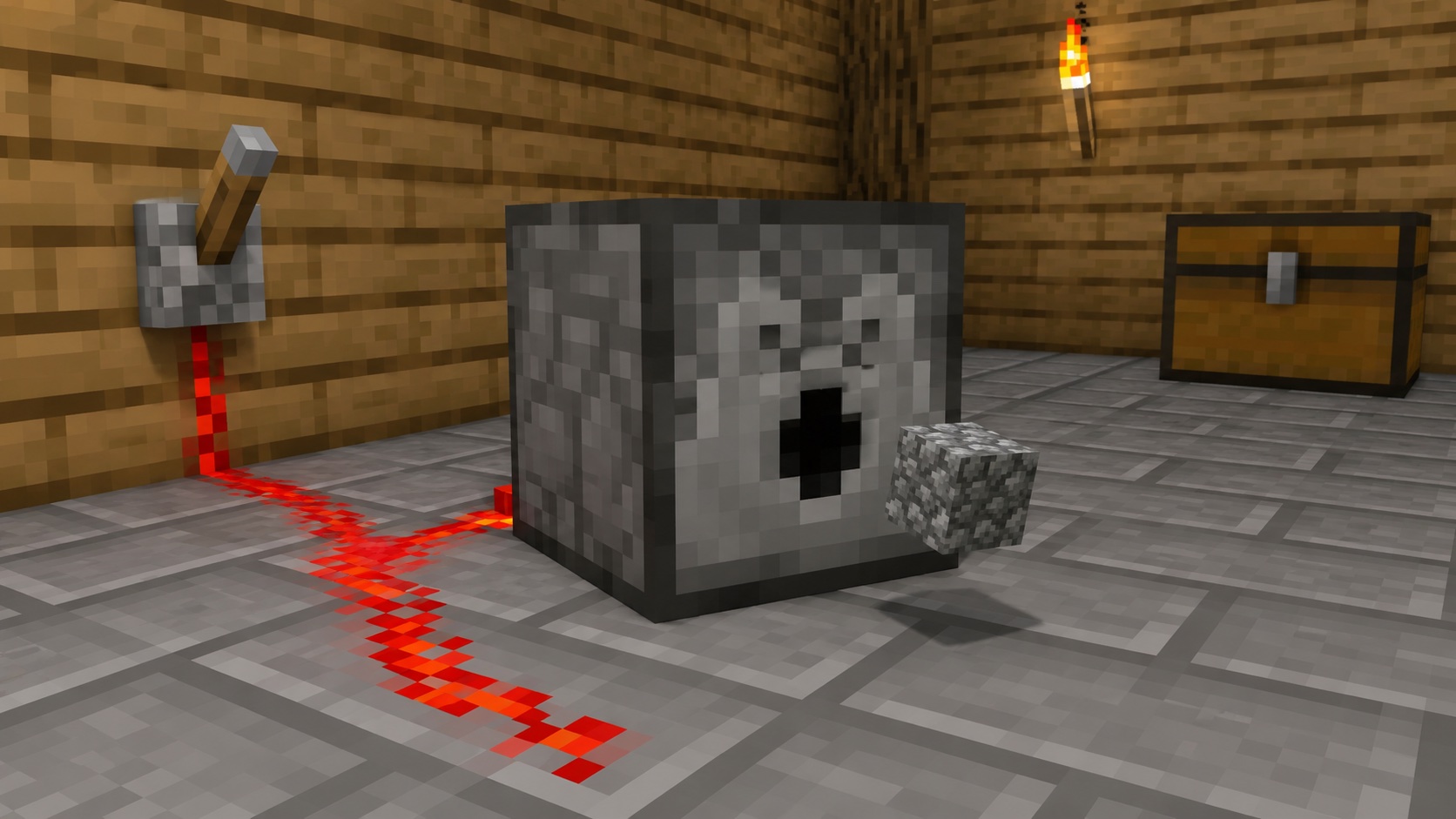
A dropper is a redstone-powered block that ejects items from its inventory when it receives a signal. Place it, fill it, hit it with redstone power, and it spits out one item per pulse.
That’s the short version. The dropper is a quiet workhorse in redstone builds: less famous than the dispenser, but the block you reach for when you want to move items from one container to another or drop them on the ground.
How to craft a dropper
You craft a dropper at a crafting table with seven cobblestone and one redstone dust. The recipe is a hollow box of cobblestone with redstone in the bottom-center slot.
Recipe layout:
- Top row: cobblestone, cobblestone, cobblestone
- Middle row: cobblestone, empty slot, cobblestone
- Bottom row: cobblestone, redstone dust, cobblestone
That’s the same shape as a dispenser recipe, but without the bow in the middle. Easy to remember: dispenser has the bow, dropper doesn’t.
You can also pick a placed dropper up by breaking it with any pickaxe. Mining it with anything else drops nothing.
What a dropper actually does
Right-click a placed dropper to open its 3×3 inventory. You can put any items inside, up to nine stacks.
When the dropper gets a redstone signal, one of two things happens:
- If the side it’s facing has a container (chest, hopper, another dropper, barrel, shulker box, brewing stand, furnace, crafter), the dropper pushes one item from a random non-empty slot into that container.
- If the side it’s facing has no container, the dropper ejects one item from a random non-empty slot as a dropped entity.
The chosen slot is random each pulse, which matters when you’re using a dropper as part of a clock or sorting build. If you want items to come out in a specific order, fill only one slot at a time.
One pulse equals one item. A long held signal only fires the dropper once. To fire it again you need a fresh rising edge: signal off, then on.
Dropper vs. dispenser: the difference that trips people up
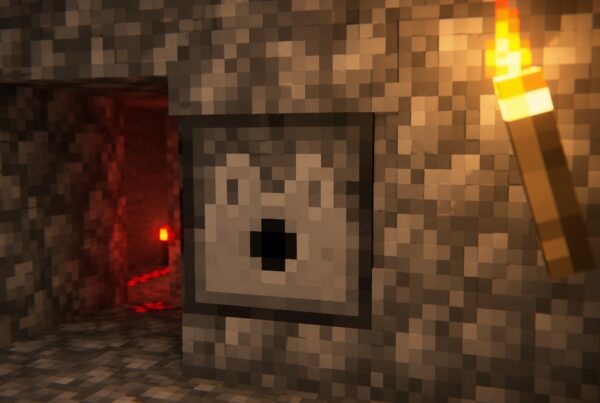
The two blocks look almost identical from the front (the dropper’s face is plain, the dispenser’s has a small grille), and they both have a 3×3 inventory. The behavior is what splits them.
A dispenser activates items. It shoots arrows, throws splash potions, ignites TNT with flint and steel, places boats and minecarts, and pours liquid from buckets. A dispenser only drops items it can’t activate, like cobblestone or wool.
A dropper just drops. It doesn’t shoot, light, or place anything. Whatever’s inside comes out as a falling item or gets pushed into the next container.
Rule of thumb: if you want stuff to land in a chest or on the ground, use a dropper. If you want stuff to do something (shoot, place, activate), use a dispenser.
Common ways to use a dropper
Item elevator
Stack droppers vertically, each facing up, with a hopper feeding the bottom one and a chest on top. A redstone clock pulses the column, and items ride up the stack one block at a time. It’s the classic compact way to move items from a mine, a farm, or a sorter to a higher floor.
Random drop machine
Because the dropper picks a random non-empty slot, you can use it as a built-in randomizer. Fill it with different items, hook it to a button, and you’ve got a loot pinata for an adventure map. Players hit the button and get one of nine possible items.
Filling a chest from a hopper line
A hopper feeds items in, and the dropper pushes them out into a destination chest on the other side. Useful when you want a buffer between the input and the storage, or when you need to gate the flow with a redstone signal.
Trash incinerator
Point a dropper at a cactus, at a lava block with a fire-resistant surround, or into a long fall. The dropped items get destroyed by the cactus, burned in the lava, or sit harmlessly until despawn. Players have built no-drop trash cans this way for years.
Hidden ammunition or treasure
In adventure maps and custom builds, a dropper hidden behind a wall or in a ceiling can deliver an unexpected item drop when the player crosses a tripwire or pressure plate. Quieter than a dispenser firing arrows, and the random-slot mechanic gives you cheap variety.
Mechanics that matter
Facing direction
A dropper faces whichever direction you were looking when you placed it, including up and down. Place it while looking at the floor and it points up; place it while looking at the ceiling and it points down. The output side is always the one with the dark hole in the texture.
Powering it
Any redstone signal source works: a button, a lever, a pressure plate, a redstone block, a comparator, or a wire from a redstone clock. The dropper only fires on the off-to-on transition, so a permanently powered dropper does nothing after the first activation. Cut the signal and re-apply it to fire again.
What counts as facing a container
If the block the dropper is pointed at has its own inventory and can accept items from a hopper-style push, the dropper pushes into it. Chests, trapped chests, hoppers, barrels, shulker boxes, brewing stands, furnaces, and other droppers all count. Crafters (added in 1.21) also accept dropper input.
If the destination container is full, the dropper holds onto the item and tries again on the next pulse. The pulse is consumed, but the items aren’t lost.
Stack splitting
A dropper pushes one item at a time, not a stack. If slot four has 64 cobblestone, one redstone pulse moves one cobblestone. Sixty-four pulses move the whole stack. This makes droppers slower than hoppers for bulk transfer, but it also makes them easy to throttle.
Java vs. Bedrock
Dropper behavior is the same on Java and Bedrock at the level most players care about: same crafting recipe, same 3×3 inventory, same random-slot output, same one-item-per-pulse firing.
The differences are minor and edge-case. Bedrock has slightly different update tick behavior, which can change how some redstone contraptions time out, but a vanilla item elevator or random-drop machine works the same on both. If you’re building competitive redstone with sub-tick timing, look up the version-specific timing for your edition. For everyday survival use, the dropper just works.
Common mistakes
A constant redstone signal only fires the dropper once. If you hold a lever down, the first activation is all you get. Use a button, a clock, or a comparator on a hopper if you want the dropper to fire repeatedly.
Random output isn’t actually random when the slots aren’t balanced. If you fill eight slots with 64 of the same item and put a rare item alone in slot nine, the dropper will almost always pick a common item. The choice is uniform over non-empty slots, not weighted by quantity. Spread items evenly if you want even odds.
Aiming at a solid block confuses people. If there’s a wall right in front of the dropper, items drop at the dropper’s face and pile up on the ground. Fine if that’s what you want, baffling if you expected a clean push into a container.
Reaching for a dropper when you needed a dispenser is the classic mix-up. If your arrow trap drops arrows on the floor instead of shooting them, you placed a dropper. Replace it with a dispenser.
Forgetting that droppers can face up wastes a lot of building. Item elevators don’t need pistons or water if you point droppers straight up. People build complicated upward-flow systems and then realize a stack of droppers does the same thing in less space.
Frequently asked questions
Can a dropper push items into a furnace?
Yes, but the slot the items land in depends on direction. A dropper feeding from above puts items in the fuel slot. A dropper feeding from the side puts items in the smelting input slot, following the same rules as a hopper. Practical takeaway: drop from above for fuel, drop from the side for what you want to smelt.
Does a dropper need a pickaxe to mine?
Yes. Mining a dropper with anything other than a pickaxe drops nothing. The dropper is a cobblestone-based block, so even a wood pickaxe works.
Can two droppers feed each other?
Yes, two droppers can face each other and pass an item back and forth on alternating pulses. Some redstone builds use this as a single-item shuttle. The trick is keeping the two droppers’ clocks offset so they don’t fire at the same instant and lock the item in transit.
How is a dropper different from a hopper?
A hopper pulls items in automatically and moves them through itself at a fixed rate without needing a signal. A dropper only moves items when it gets a redstone pulse, and it can drop items on the ground if there’s no container in front. Use a hopper for steady flow, a dropper for controlled release.
What update added the dropper?
Droppers were added in Java Edition 1.5, the Redstone Update, back in 2013. The recipe and core behavior haven’t changed in any meaningful way since. Newer blocks like the crafter and the copper bulb don’t replace the dropper; they sit next to it in the redstone toolkit.
Can hostile mobs spawn on a dropper?
Mobs can spawn on the top of a dropper if the light level is low enough and the top face is solid, the same as on most full blocks. If you’re building a mob-safe area, light the top or cover it.
A practical tip
If you’re new to redstone, build a single dropper, point it at a chest, and wire it to a button. Push the button, watch one item move. That five-minute build is the cleanest way to feel how the block ticks. Once that’s in your head, every dropper contraption you see online makes sense, and you can start sketching your own without copying anyone else’s plan.